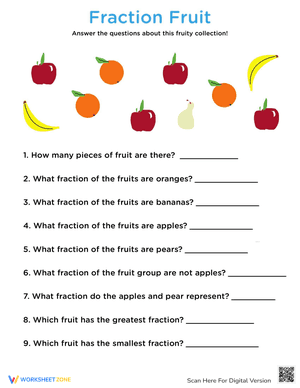
These fractions as parts of a set printable worksheets give teachers a structured way to move students beyond the shaded-circle model and into fraction reasoning that actually mirrors how fractions appear in the world — groups of objects, collections with attributes, real quantities that can be compared and counted. Each page presents visual sets of familiar items alongside write-the-fraction, draw-the-set, and word-problem tasks calibrated to grades 2 through 4.
The Specific Skills Each Page Targets
Worksheets in this set build three core competencies.
- First, students read a set — a row of 8 apples where 3 are circled — and record the corresponding fraction, reinforcing that the denominator accounts for every object in the group, not just the ones that qualify.
- Second, students construct a set from a given fraction: handed 4/6, they draw six objects and shade four. That reversal does more instructional work than it might appear to, because students who can only read a fraction from a picture often cannot yet hold the part-whole relationship in working memory.
- Third, students write fractions from short text prompts, extracting the numerator and denominator from sentences rather than images — a transfer step most area-model practice skips entirely.
Later pages in the set add side-by-side comparisons, asking which of two groups shows the larger fraction, and problems where students must identify what fraction is not shaded. That last task catches a gap worth watching for: students who write the correct fraction for the shaded portion often stall when asked about the remainder, which tells you whether they understand the two parts must sum to the whole.
Standards Alignment
The core instructional target here is CCSS 3.NF.A.1, which asks students to understand a fraction as a quantity formed by parts of a whole. The set model is not explicitly named in that standard, but it is essential preparation for 3.NF.A.3 (comparing fractions) and the ratio work in 6.RP.A.1. Students who encounter the ratio 3:8 in sixth grade without prior experience in the set model often struggle to see it as a part-whole relationship — they have only ever seen fractions as shapes. The worksheets here build the conceptual bridge across that gap while remaining squarely within the third- and fourth-grade instructional window.
Where These Fit in the Progression, Grade by Grade
At second grade the set model works best as informal language practice. Keep denominators at 2, 3, and 4, use sets of no more than six objects, and let students circle or color before they write anything. The goal is the vocabulary — half of the group, three out of four — before symbolic notation takes over. Third grade is where the formal work lands. Sets grow to 10 or 12 objects, denominators extend through eighths, and students label the numerator and denominator explicitly. This is also when comparison tasks become productive, because students have enough fraction vocabulary to argue which group shows more. By fourth grade, sets of 15 to 20 are reasonable, and the word problems should require students to reason in two steps — finding the fraction that is shaded and then using that to determine what fraction remains.
The reason the set model belongs in third grade specifically, rather than solely in second or fourth, is cognitive load. Third graders can hold a small collection of distinct objects in mind, count a subset, and write a fraction without losing track of the whole — a coordination that is genuinely difficult for many second graders and routine for most fourth graders. The worksheets are designed around that developmental window.
Patterns You'll Recognize in Student Work
Three errors appear persistently enough that they are worth anticipating before you distribute a page.
The most common is numerator-denominator reversal: a student looks at 5 stars with 2 shaded and writes 5/2. What is interesting about this error is that it is not random — students are almost always placing the number they counted first (the total) in the numerator position, because the numerator comes first when they write. Tasks that ask students to record the total number of objects on a separate line before writing the fraction disrupt this habit. The physical act of writing "total: 5" first slows down the reflex.
The second error is counting only the shaded objects for both positions, producing something like 2/2 for a set of five with two shaded. These students have not yet internalized that the denominator describes the whole group. A quick intervention: cover the unshaded objects with a finger and ask how many are hidden. Most students immediately see that the hidden items belong in the fraction too.
The third is model confusion. Students who have spent significant time with area-model worksheets sometimes treat a row of discrete objects like a partitioned shape and attempt to judge whether the pieces are "equal." They will argue that 3/7 is not a valid fraction because the stars are different sizes. A side-by-side worksheet showing the same fraction in both models — a shaded rectangle and a circled subset of objects — with explicit discussion of what the denominator means in each context is the most direct fix.
How Teachers Use These Pages
One sequence that works well: before distributing the worksheet, give each table group a small bag of two-color counters. Students shake and spill, then say the fraction that landed yellow-side-up. After two rounds of this, they move to the worksheet with a concrete experience already indexed in memory. The transition dramatically reduces the numerator-denominator reversal rate because students have just physically separated a group and counted both parts.
For whole-group warm-ups, projecting a single set image and asking students to show the fraction on a personal whiteboard takes about four minutes and gives immediate visual feedback on who needs support. Rotating between write-the-fraction and draw-the-set prompts on alternate days keeps the routine from going stale. For math centers, the draw-the-set tasks convert naturally into self-checking card matches — students draw, then flip a card to compare their drawing to a reference. A short half-page with three write-the-fraction items and one word problem works as an exit ticket; sorting the collected pages into three piles (solid, needs review, reteach) takes about five minutes and shapes the next day's small-group pull.
Frequently Asked Questions
1. What is the difference between parts of a set and parts of a whole?
Parts of a whole divides a single continuous shape into equal sections — the classic shaded rectangle or circle. Parts of a set works with a group of separate, countable objects where the denominator is the total count and the numerator is how many share a given attribute. The fraction looks the same on paper, but students need experience with both contexts to understand that the notation is flexible.
2. Can the same worksheet page be used across multiple grades?
Yes, with modification. A page designed for third grade typically uses sets of 8 to 12 and denominators through eighths. Second graders can work the same page if you cover the larger problems and focus on the first two rows. Fourth graders can use it as a timed fluency check or as a base for an extended task where they write a second fraction for the unshaded portion of each set.
3. How do I handle students who confuse this model with the area model?
Put both side by side on the same page and name the difference explicitly: in one model the denominator counts equal pieces of one shape; in the other it counts every object in a group. Students who see the comparison directly, rather than encountering the models in separate units weeks apart, sort out the distinction much faster.
















 Interactive Worksheet Maker
 Quiz Maker
 Word Search Maker
 Crossword Puzzle Maker
 Word Scramble Generator
 Sentence Scramble Generator
 Handwriting Worksheet Generator
 Name Tracing Generator
 Fill In The Blank Generator