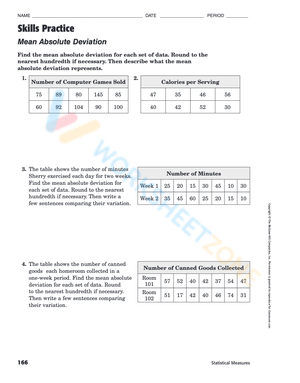
When students move from finding mean, median, and mode into describing how spread out a data set is, mean absolute deviation worksheets give them the structured repetition that concept needs. MAD is a Grade 6 Statistics and Probability concept, and it typically shows up right after students have already practiced measures of center. That sequencing matters for how you plan practice: if a class is shaky on finding the mean itself, a MAD worksheet will expose that gap immediately, since every MAD problem starts with a mean calculation.
For US classrooms working toward CCSS.6.SP.B.5c, mean absolute deviation worksheets are one of the most direct ways to build toward the standard's language around describing variability with reference to context. The standard asks students to give quantitative measures of center and variability, and MAD is explicitly one of the accepted variability measures alongside interquartile range. A well-built worksheet set does not just drill the arithmetic; it asks students to interpret what a MAD value of 2 versus a MAD value of 8 actually says about a data set.
Breaking Down the Three-Step MAD Calculation for Worksheet Scaffolding
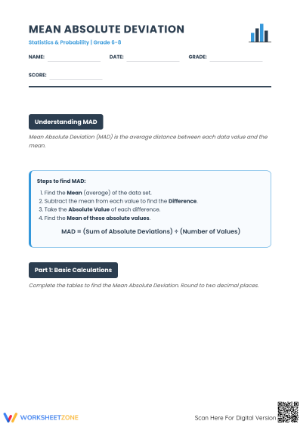
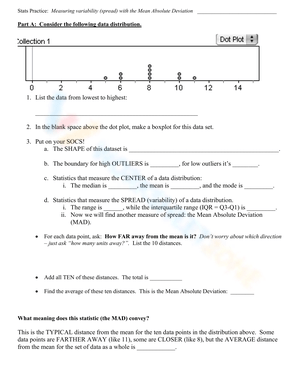
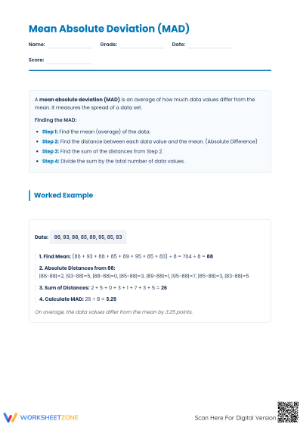
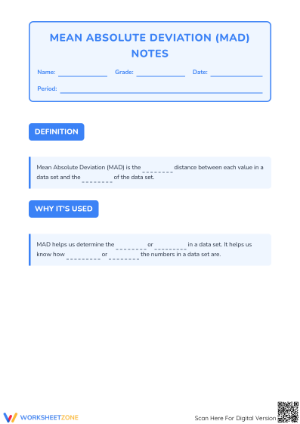
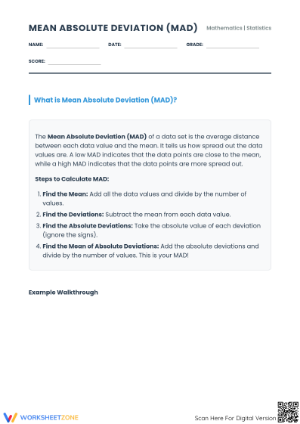
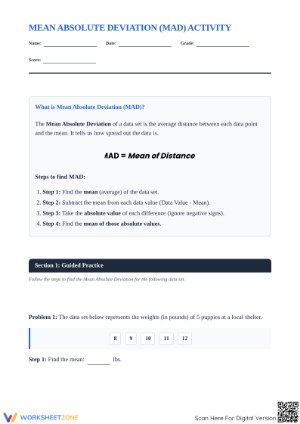
Mean absolute deviation worksheets work best when they mirror the same three-step process every time, so students internalize a routine rather than memorizing isolated problems. Step one is finding the mean of the data set. Step two is finding the absolute difference between each data point and that mean. Step three is averaging those absolute differences to get the MAD. Many students stumble specifically at step two, because they subtract in the wrong direction and forget to apply absolute value, which produces a MAD that looks plausible but is actually built from a mix of positive and negative deviations that partially cancel out.
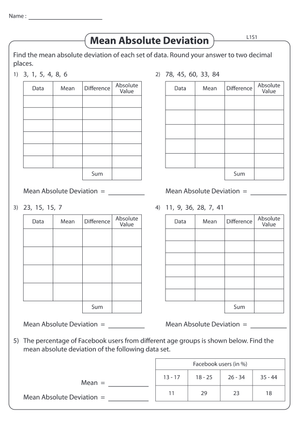
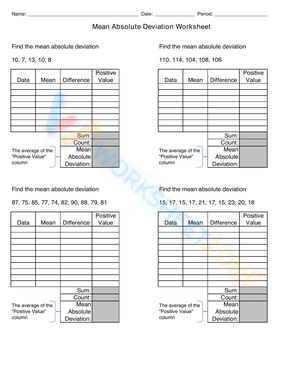
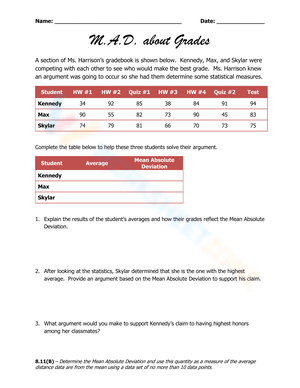
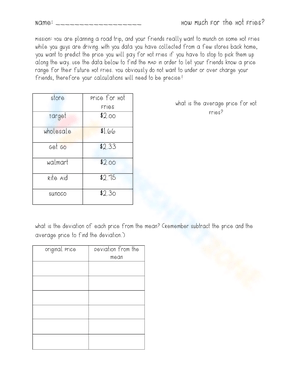
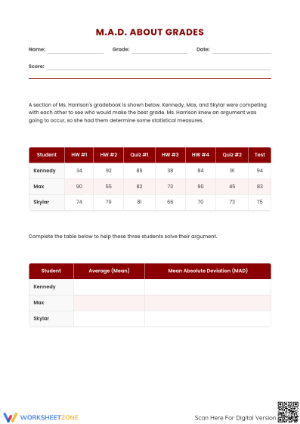
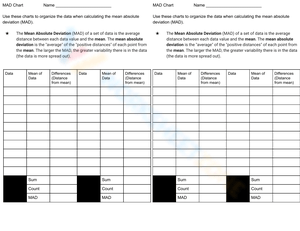
A worksheet that isolates each step in its own column, rather than asking for a single final answer, catches that error before it becomes a habit. Consider a table-style worksheet layout with columns for the data point, the deviation from the mean, and the absolute deviation. Students fill in each column left to right, and the final row asks them to average the absolute deviation column. This layout turns MAD from an abstract formula into a repeatable procedure students can check themselves.
Differentiating MAD Practice Across Ability Levels
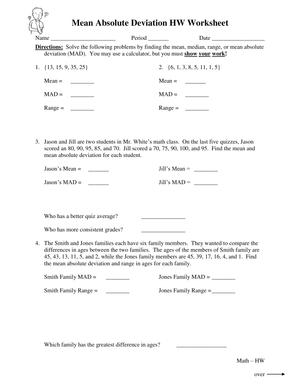
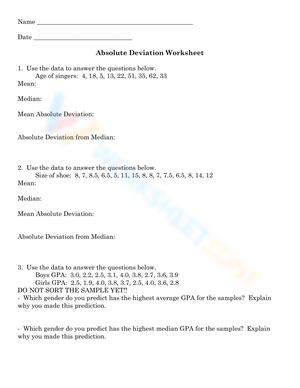
Not every student in a Grade 6 or 7 classroom needs the same MAD worksheet on the same day. For students still solidifying mean, median, and mode, a worksheet with a guided step chart and a small data set of five or six values keeps the cognitive load manageable. For students ready to extend their thinking, a worksheet that pairs two data sets side by side and asks which one has greater variability pushes them toward the comparison skills that CCSS.6.SP.B.5c ultimately expects.
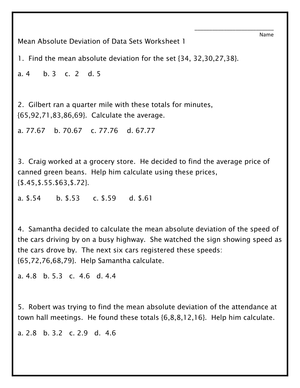
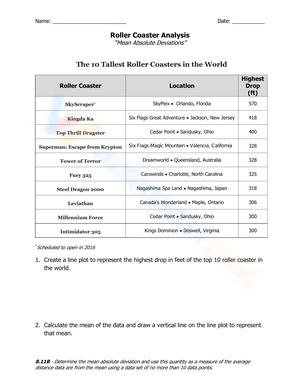
Between those two ends, a middle tier of mean absolute deviation worksheets can drop the step-by-step scaffolding but keep single data sets, asking students to show their work without a pre-built table. This tiered approach lets you use the same general worksheet format across a class with mixed readiness, adjusting only the scaffolding level and the number of data points rather than rewriting the whole assignment.
Common Student Errors on Mean Absolute Deviation Worksheets
Beyond the absolute value mistake described above, a second frequent error is rounding the mean too early. If a data set produces a mean like 6.33, and a student rounds to 6 before calculating deviations, every subsequent step compounds that rounding error. Worksheets that use data sets producing whole-number means for early practice, then gradually introduce non-whole-number means, help students build the habit of carrying decimals through the full calculation before rounding a final answer.
A third common error is dividing by the wrong count, especially when a data set has a value that repeats. Students sometimes divide the sum of absolute deviations by the number of unique values instead of the total number of data points. A worksheet answer key that shows the divisor explicitly, rather than just the final MAD value, gives you a fast way to spot this error pattern across a whole class set.
Classroom Implementation
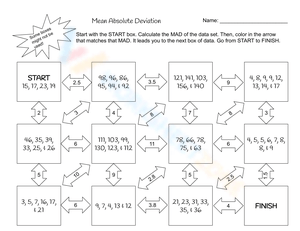
When you sequence MAD worksheets into a unit, start with worksheets that isolate the mean-finding step, since accuracy there determines accuracy everywhere else. Move next into the three-column deviation table format described above, then into single-data-set problems without scaffolding, and finally into two-data-set comparison tasks. This progression takes most classes three to four short sessions rather than a single long worksheet, which keeps each practice block focused on one skill layer at a time.
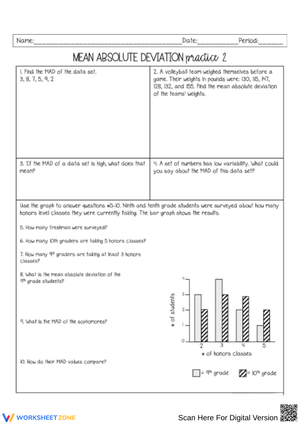
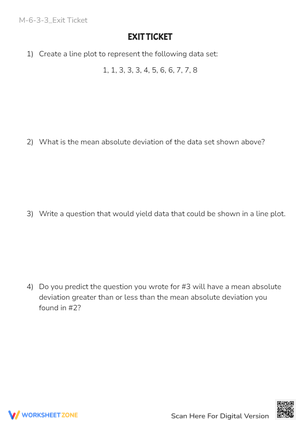
Pair MAD worksheets with a brief context discussion whenever possible. A worksheet that only asks students to calculate MAD, without ever asking what a larger or smaller MAD means about the data, misses half of what CCSS.6.SP.B.5c is asking for. Even a single follow-up question, like asking which of two class data sets is more consistent based on its MAD, turns a computation worksheet into a standards-aligned reasoning task.
Frequently Asked Questions
1. What grade level typically covers mean absolute deviation worksheets?
MAD is introduced as a Grade 6 concept under the Statistics and Probability domain, generally after students have already worked with mean, median, and mode. Many Grade 7 classrooms revisit MAD worksheets as review before extending into more advanced variability comparisons.
2. What is the difference between mean absolute deviation and standard deviation for classroom purposes?
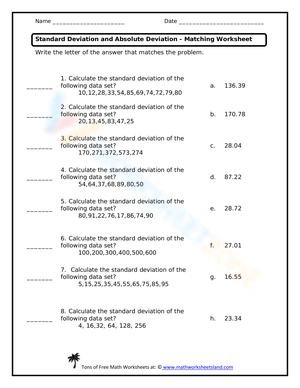
At the middle school level, MAD is the variability measure named in the standards, since it uses simpler absolute value arithmetic that Grade 6 students can complete without needing square roots or squared terms. Standard deviation is typically reserved for later math courses.
3. How can teachers use mean absolute deviation worksheets for small-group intervention?
Small groups let you watch students narrate each of the three MAD steps aloud, catching common errors like skipping absolute value or dividing by the wrong count before those habits show up on a graded assessment.
4. What prerequisite skills should students have before starting MAD worksheets?
Students need to be fluent in finding the mean of a data set and comfortable with absolute value, since every MAD problem depends on both skills before the averaging step can happen correctly.
5. How does mean absolute deviation worksheet practice align with CCSS.6.SP.B.5c?
CCSS.6.SP.B.5c asks students to give quantitative measures of center and variability with reference to the context of the data, and MAD is one of the two variability measures the standard names, making structured MAD worksheets a direct way to build toward that expectation.













 Interactive Worksheet Maker
 Quiz Maker
 Word Search Maker
 Crossword Puzzle Maker
 Word Scramble Generator
 Sentence Scramble Generator
 Handwriting Worksheet Generator
 Name Tracing Generator
 Fill In The Blank Generator