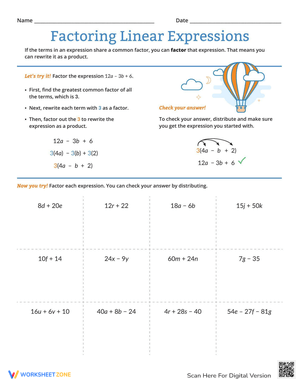
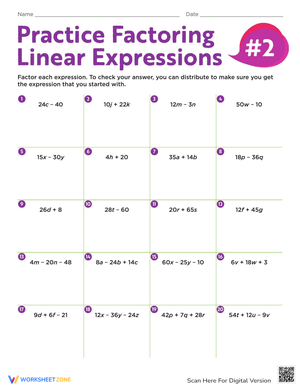
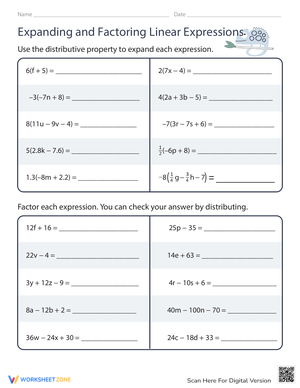
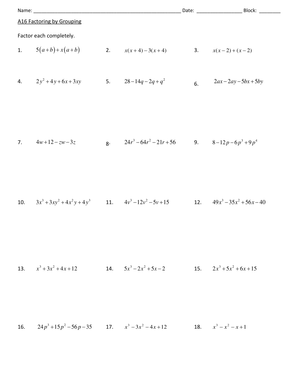
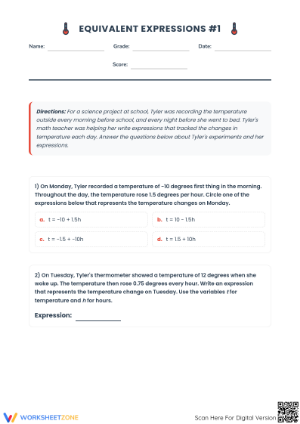
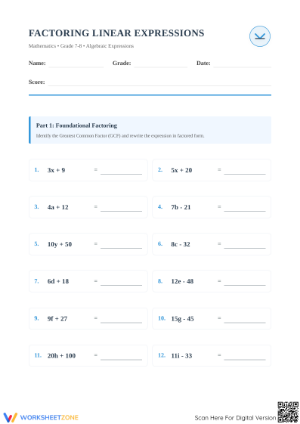
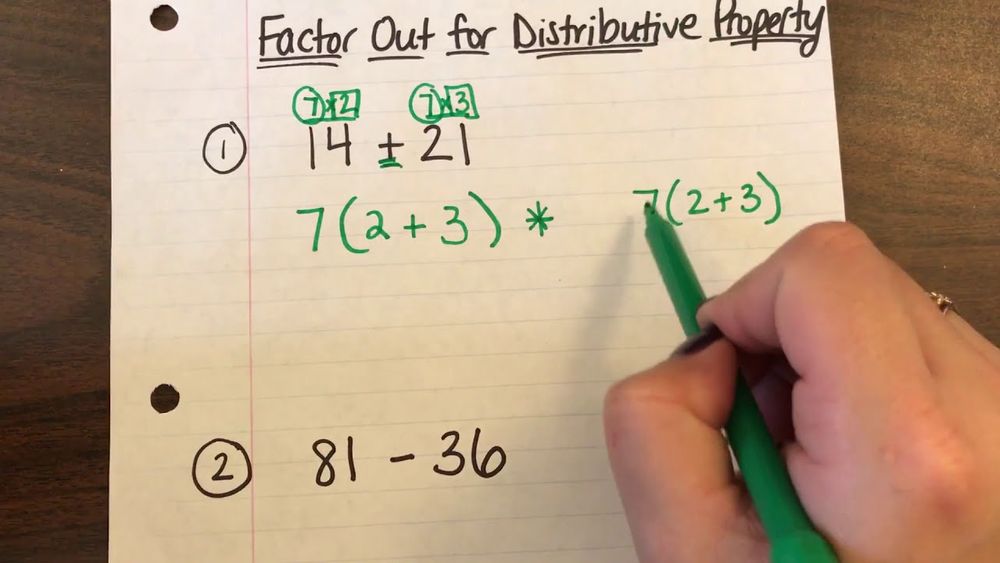
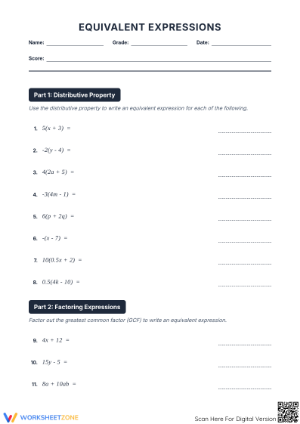
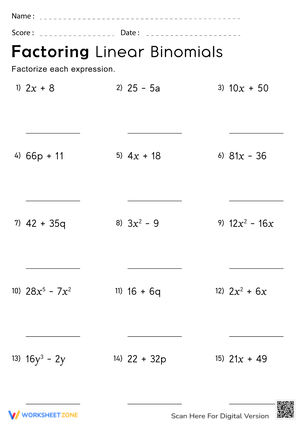
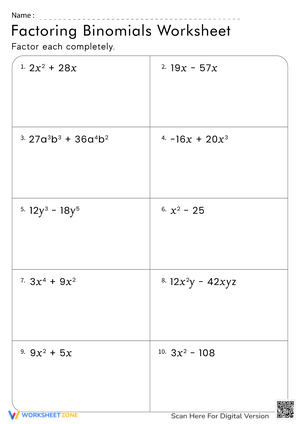
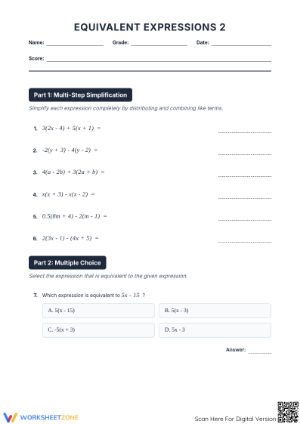
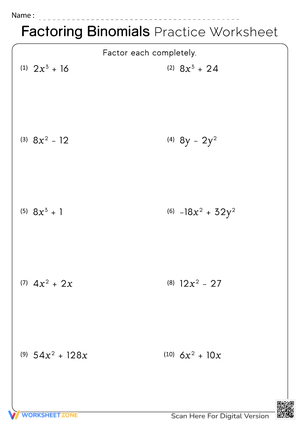
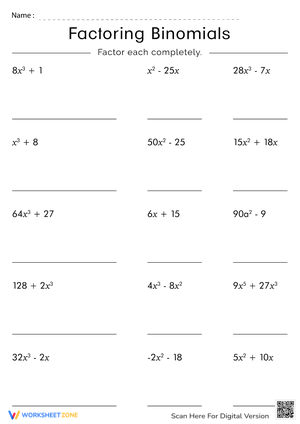
When students first meet expressions like 3(2 + x), many treat the parentheses as a puzzle to avoid rather than a structure to unlock. Equivalent expressions worksheets give sixth and seventh grade teachers a repeatable way to make that structure visible. Instead of asking students to memorize a rule, well-sequenced practice pages ask them to apply the commutative, associative, and distributive properties again and again until rewriting 6 + 3x as 3(2 + x) feels ordinary rather than mysterious. For a grade 6 or 7 math team, that repetition is not busywork. It is the on-ramp to every equation-solving unit that follows.
Building Fluency with the Distributive, Commutative, and Associative Properties
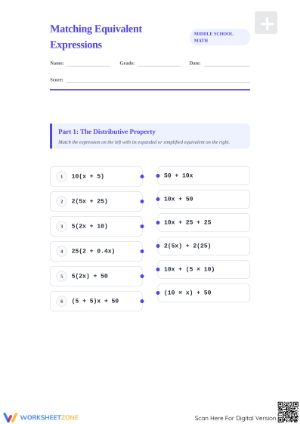
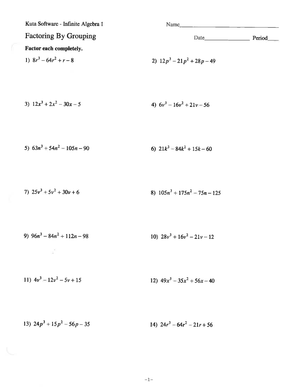
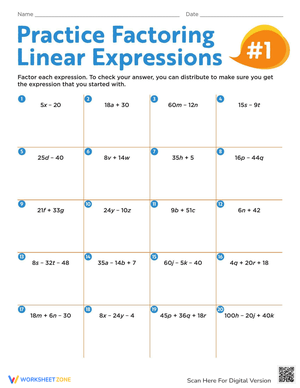
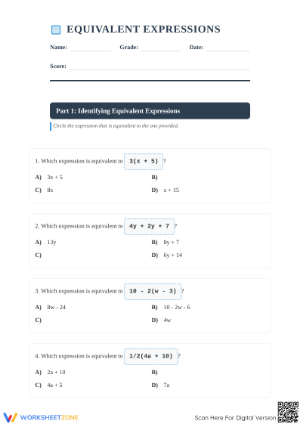
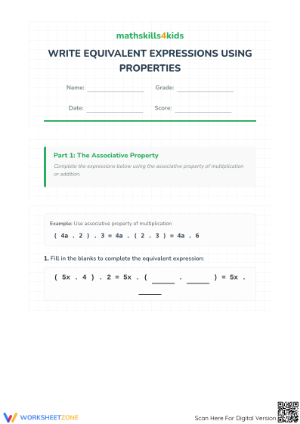
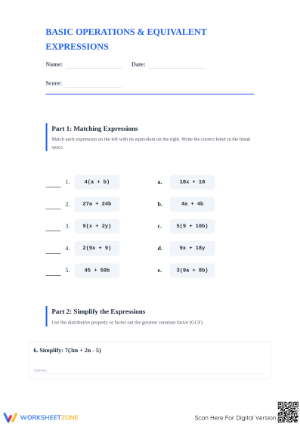
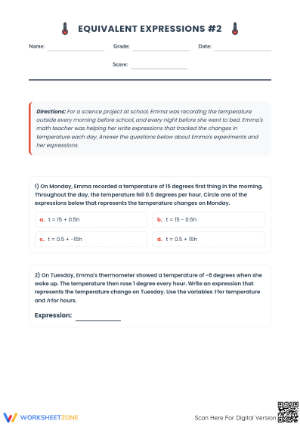
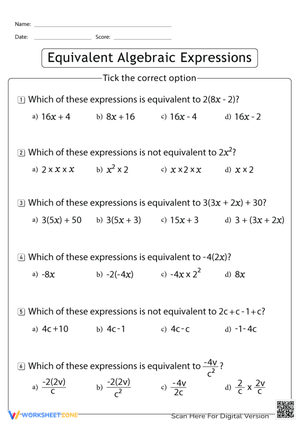
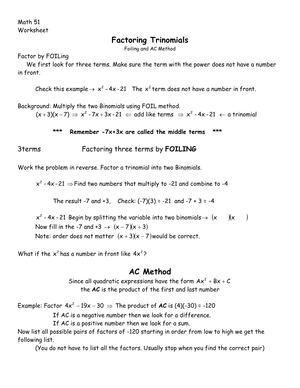
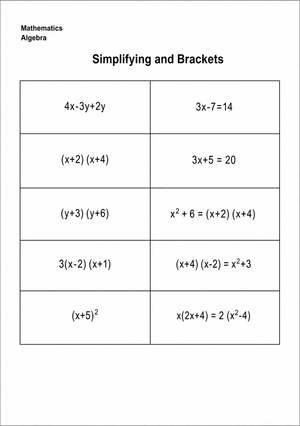
Equivalent expressions rest on three properties students should have met earlier, and worksheet practice is where those properties get stress-tested. A distributive property row might ask students to expand 4(x + 3) and confirm it matches 4x + 12. A commutative property row might reorder terms in 5x + 2y to 2y + 5x and ask whether the value changes. Associative property tasks group terms differently, such as (x + 3) + 5 versus x + (3 + 5), so students see that regrouping does not change the outcome. Mixing these property types on the same worksheet, rather than isolating them into separate units, forces students to identify which property applies before they can simplify, which is the actual skill tested once problems get more complex.
Sequencing Practice from Combining Like Terms to the Distributive Property
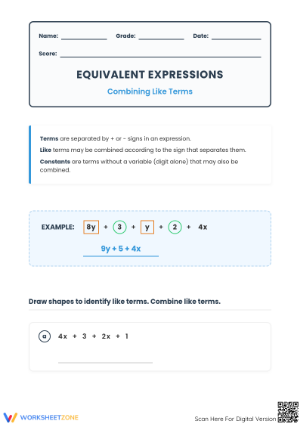
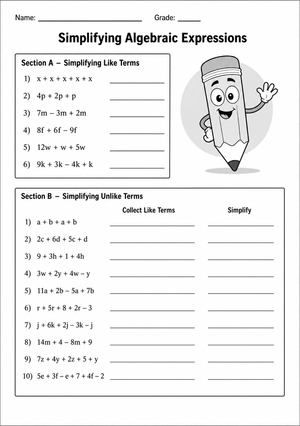
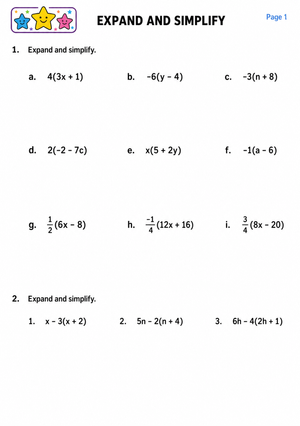
A common sequencing mistake is starting worksheet practice with distribution before students are fluent in combining like terms. A stronger order begins with simple like-term combination, such as simplifying 3x + 5x + 2 to 8x + 2, then introduces single-step distribution, then layers in multi-step expressions that combine both skills.
CCSS 6.EE.A.3 explicitly names the transformation y + y + y becomes 3y as an entry-level equivalence task, which means worksheet sets that start with repeated-addition style problems before moving to distribution are following the standard's own internal progression rather than an arbitrary teaching order.
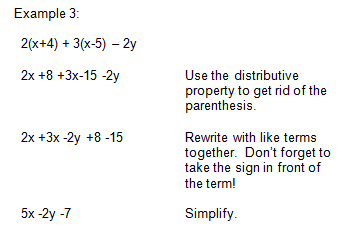
Once students can distribute and combine like terms independently, a worksheet that requires both in the same problem, like 2(x + 4) + 3x, becomes a genuine checkpoint rather than a first exposure.
Common Misconceptions and How Targeted Practice Fixes Them
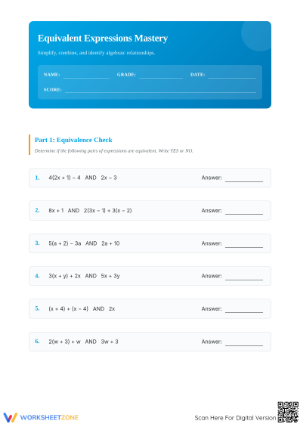
Three misconceptions show up repeatedly on equivalent expressions worksheets. First, students often distribute a coefficient across only the first term inside parentheses, turning 3(x + 4) into 3x + 4 instead of 3x + 12. Second, students confuse like terms by combining x and x-squared as though the exponent does not matter. Third, students assume that two expressions are equivalent because they produce the same value for one substituted number, rather than checking that the expressions match for every value, which is the actual requirement in CCSS 6.EE.A.4. Worksheets that include a substitution-check column, where students plug in two different values and compare results, directly target that third misconception instead of leaving it to a passing comment.
Classroom Implementation
For a whole-class rollout, pair each new property with a short worksheet set of six to eight problems rather than a long page of twenty, so students get feedback before errors compound. For small-group intervention, pull students who miss distribution problems specifically and give them a worksheet limited to that property, since mixing in commutative and associative items at that stage can mask whether the distribution gap has actually closed. Exit tickets built from two or three equivalent expressions problems work well as a quick fluency check at the end of a lesson. Teachers moving between grade 6 and grade 7 content can also use the same worksheet format across both grades, simply increasing the coefficient complexity from whole numbers to rational numbers, which keeps the worksheet routine familiar to students while raising the mathematical demand in line with CCSS 7.EE.A.1.
Frequently Asked Questions
1. What grade level should introduce equivalent expressions worksheets?
Grade 6 is the standard entry point, since CCSS 6.EE.A.3 and 6.EE.A.4 both require students to generate and identify equivalent expressions using properties of operations. Grade 7 teachers can reintroduce the same worksheet format with rational coefficients under CCSS 7.EE.A.1.
2. How do equivalent expressions worksheets support CCSS 6.EE and 7.EE standards?
They give students repeated, structured practice applying the distributive, commutative, and associative properties, which are the exact operations named in 6.EE.A.3, 6.EE.A.4, and 7.EE.A.1 for generating and verifying equivalent expressions.
3. What is the difference between simplifying an expression and finding an equivalent expression?
Simplifying usually means reducing an expression to its most compact form, such as combining like terms. Finding an equivalent expression can mean rewriting it in any valid alternate form, including an expanded or factored form, not just the shortest one.
4. How can teachers use equivalent expressions worksheets for intervention or reteaching?
Isolate one property at a time on a short worksheet, such as distribution only, so a small group can practice that specific skill without the added demand of switching between property types mid-page.
5. How do equivalent expressions worksheets prepare students for solving equations?
Equation solving requires students to combine like terms and distribute across parentheses as intermediate steps. Worksheets that build fluency in generating equivalent expressions remove that added cognitive load before students take on the separate skill of isolating a variable.













 Interactive Worksheet Maker
 Quiz Maker
 Word Search Maker
 Crossword Puzzle Maker
 Word Scramble Generator
 Sentence Scramble Generator
 Handwriting Worksheet Generator
 Name Tracing Generator
 Fill In The Blank Generator