


























Views
Downloads
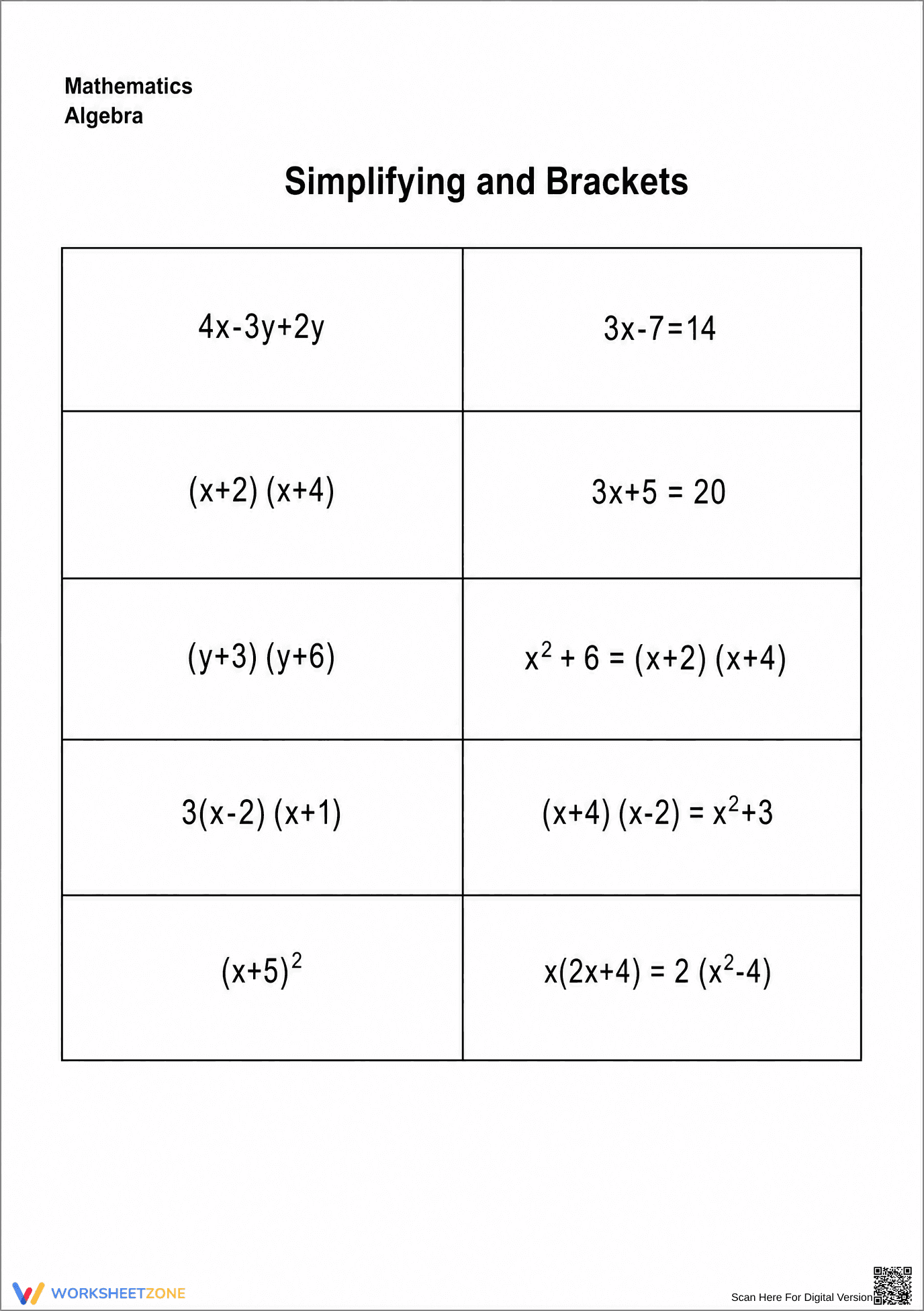

Essential Algebra: Simplifying and Brackets Worksheet
Paste this activity's link or code into your existing LMS (Google Classroom, Canvas, Teams, Schoology, Moodle, etc.).
Students can open and work on the activity right away, with no student login required.
You'll still be able to track student progress and results from your teacher account.
This algebra worksheet provides targeted practice for students mastering the art of simplifying expressions and expanding brackets. By working through a variety of linear and quadratic forms, learners build the procedural fluency necessary for higher-level mathematics. Students will transform complex algebraic strings into their simplest forms, ensuring a solid foundation for solving equations.
At a Glance
- Grade: 8-12 · Subject: Algebra
- Standard:
HSA.APR.A.1— Perform operations on polynomials including addition, subtraction, and multiplication.- Skill Focus: Simplifying and Bracket Expansion
- Format: 1 page · 10 problems · Answer key included · PDF
- Best For: Independent practice and skill reinforcement
- Time: 15–25 minutes
Inside this resource, you will find 10 carefully curated algebraic problems presented in a clean, two-column layout. The worksheet covers a range of tasks, from combining like terms in multi-variable expressions to expanding binomials using the distributive property or FOIL method. It also includes equations where students must simplify both sides to find a solution, providing a comprehensive review of core algebraic manipulations.
The worksheet follows a logical progression to support student success:
- Guided Practice: The initial problems focus on basic simplification and single-variable linear equations, allowing students to recall fundamental rules with minimal cognitive load.
- Supported Practice: The middle section introduces binomial expansion, such as (x+2)(x+4), requiring students to apply the distributive property across multiple terms.
- Independent Practice: The final tasks challenge students with multi-step equations involving squared terms and distributive properties on both sides of the equals sign.
This resource is aligned with CCSS.MATH.CONTENT.HSA.APR.A.1, which requires students to understand that polynomials form a system analogous to the integers. Specifically, it targets the ability to add, subtract, and multiply polynomials. This standard code can be copied directly into lesson plans, IEP goals, or district curriculum mapping tools.
Use this worksheet as a formative assessment after a lesson on the distributive property. It is particularly effective as a bell-ringer to gauge student understanding of bracket expansion before moving on to factoring quadratics. Teachers should observe whether students correctly handle negative signs when distributing. Completion typically takes 20 minutes.
This worksheet is designed for middle and high school students in Algebra 1 or Integrated Math courses. It serves as an excellent remediation tool for learners who struggle with the order of operations in an algebraic context. Pair this resource with a visual anchor chart demonstrating the FOIL method or a digital graphing tool to verify the equivalence of simplified expressions.
Algebraic fluency, specifically the ability to manipulate polynomials and expand brackets, is a critical predictor of success in advanced STEM coursework. According to the RAND AIRS 2024 report on mathematical proficiency, students who demonstrate mastery of standard HSA.APR.A.1 are significantly more likely to succeed in Calculus and physics-based disciplines. This worksheet provides the repetitive, high-quality practice required to move these skills from conscious effort to automaticity. By focusing on the distributive property and the simplification of like terms, the resource addresses the core mechanics of algebraic logic. Educators can utilize these 10 problems to identify specific misconceptions in variable handling or arithmetic operations within expressions. Providing structured opportunities for polynomial operations ensures that students can focus on higher-order problem-solving rather than basic calculation errors during complex assessments.


