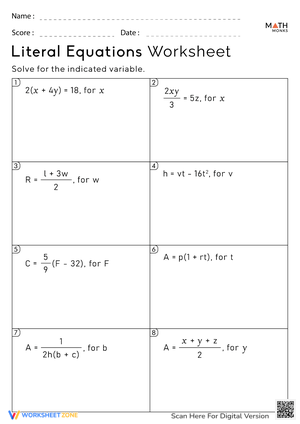
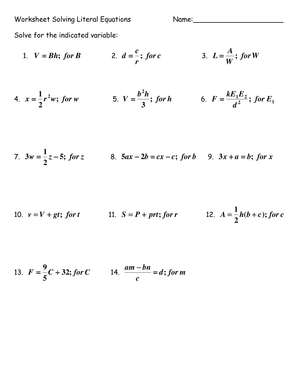
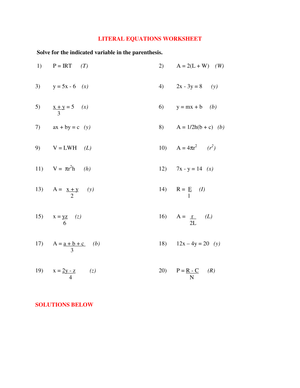
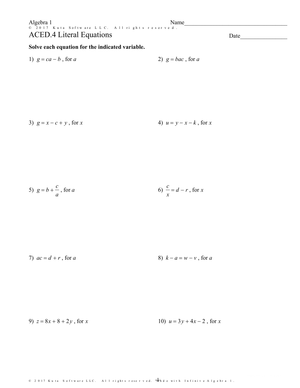
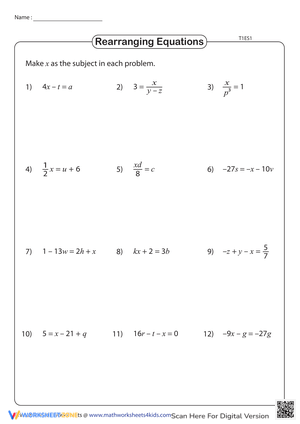
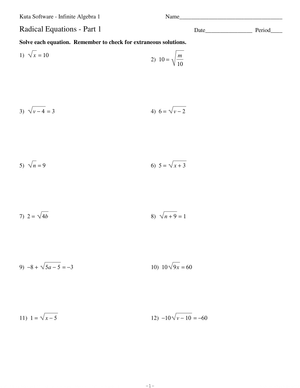
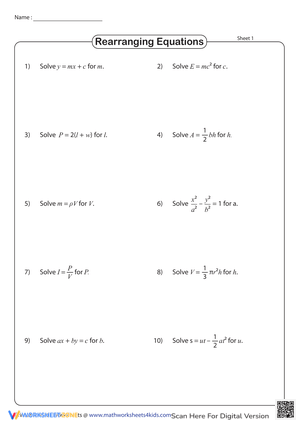
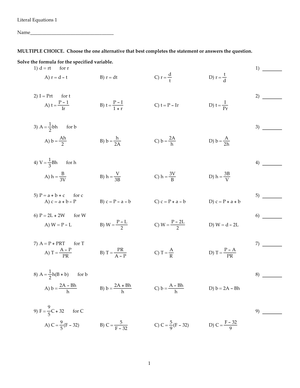
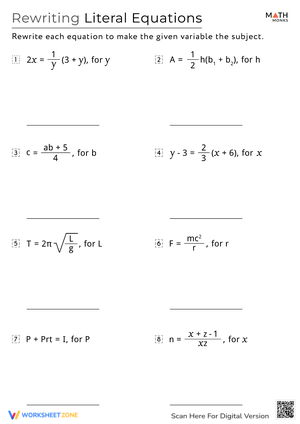
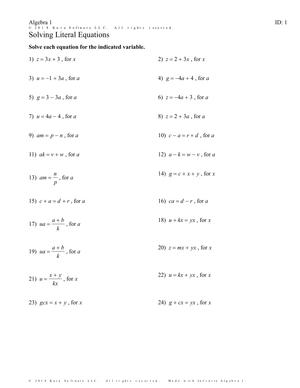
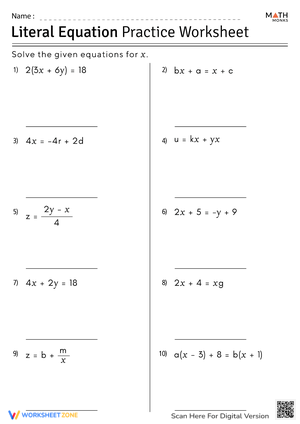
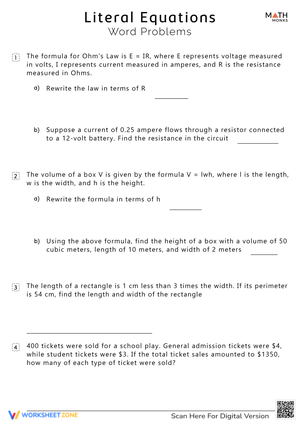
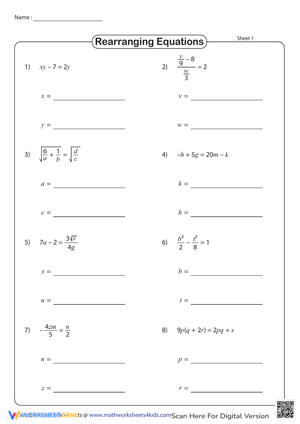
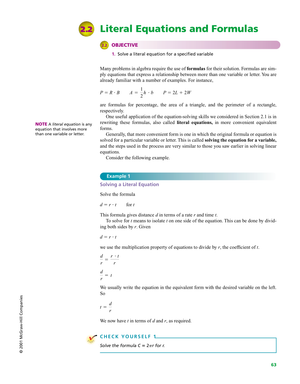
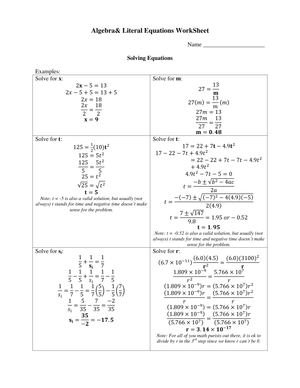
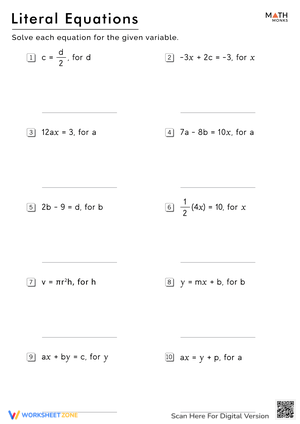
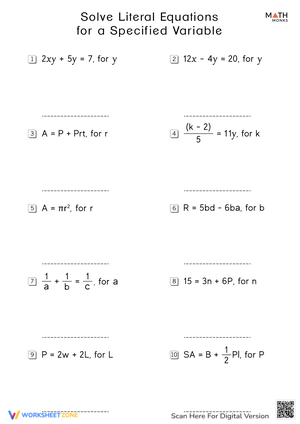
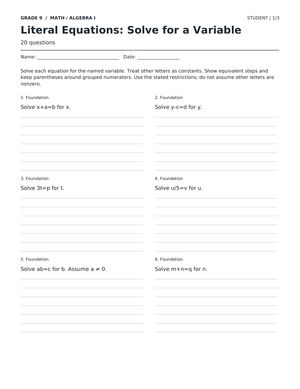
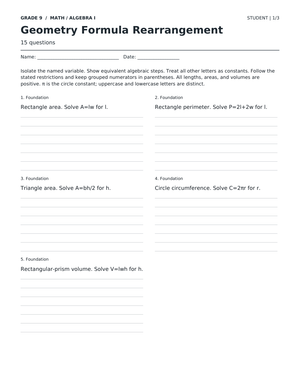
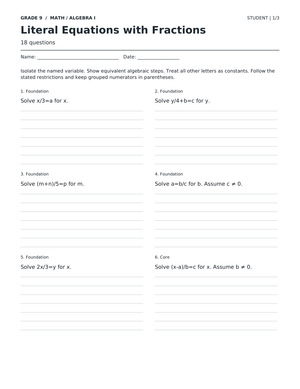
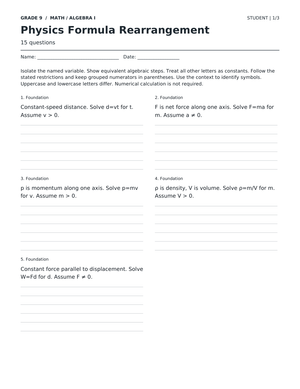
If your Algebra 1 students can solve 3x + 5 = 20 but freeze when asked to solve P = 2l + 2w for w, they need focused practice with literal equations. Solving literal equations worksheets give students the repetition they need to rearrange formulas and multi-variable equations until isolating a target variable feels like the same reasoning they already use on numeric problems. The pages below are meant for teachers planning instruction, small-group intervention, and exam review, not for one-off busywork.
What Solving Literal Equations Worksheets Actually Practice
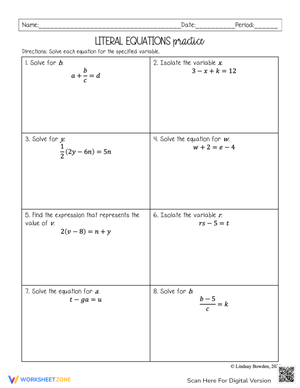
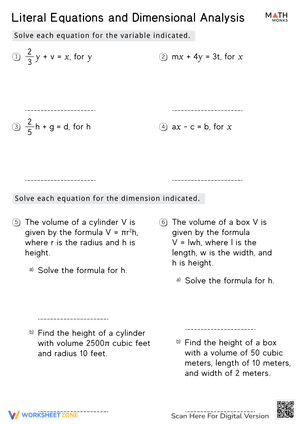
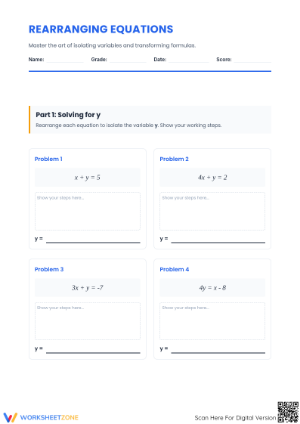
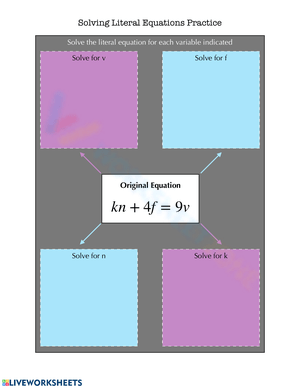
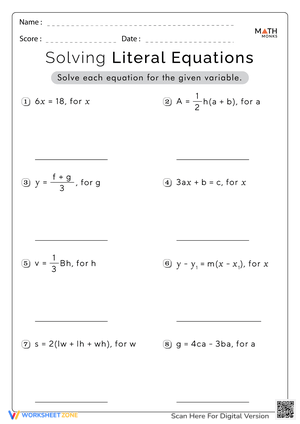
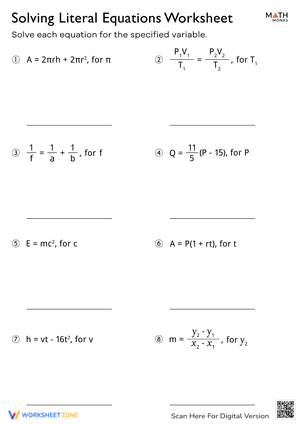
A literal equation contains two or more variables, and the task is to isolate one of them in terms of the others. Instead of landing on a single number, students produce a rearranged formula. Strong worksheets move learners from friendly equations like y = mx + b solved for m toward denser formulas drawn from geometry and science. The underlying move never changes: apply inverse operations in reverse order until the target variable stands alone.
The real value of a printable set is volume and consistency. Students meet the same structure again and again, which is exactly what builds fluency with a procedure that feels abstract on first contact. A worksheet also lets you control difficulty deliberately, so a class that just learned two-step equations is not thrown into a five-variable formula on day one. When the reps are predictable, students can spend their attention on the reasoning instead of decoding a new layout each time.
Why Literal Equations Belong in Every Algebra 1 Unit
Literal equations usually appear in Algebra 1, spanning grades 8-10 depending on your district's math sequence. They sit right at the hinge between one-variable equation solving and the formula manipulation students will do for years in science and geometry. A student who can rearrange d = rt to solve for t is rehearsing the exact skill they will need the moment a physics formula demands the same treatment.
These problems also surface frequently on state Algebra 1 end-of-course and Regents exams, which makes them a dependable review target in the weeks before standardized testing. Treating literal equations as a throwaway lesson tends to backfire, because the skill quietly underpins so much of what comes later. Giving it a genuine block of practice pays off well beyond the unit test.
How to Sequence Practice From Two-Step to Multi-Variable
Sequencing matters more here than in most Algebra 1 topics. Start with two-step literal equations where a single inverse operation stands between the student and the target variable. Then layer in problems that require distributing, combining like terms, or dividing by a variable coefficient.
A workable progression looks like this:
- Two-step formulas such as solving C = 2πr for r.
- Formulas requiring subtraction before division, such as solving P = 2l + 2w for l.
- Multi-variable formulas from real contexts, such as simple interest I = Prt or the distance-rate-time and area families.
Moving through those tiers in order keeps the cognitive load manageable and gives you clean checkpoints for formative assessment.
The Common Core State Standards Initiative's standard A-CED.A.4 directs students to rearrange formulas to highlight a quantity of interest, using the same reasoning as solving equations. This single Algebra 1 standard, taught across grades 8-10, is the backbone of every literal equations worksheet progression teachers build.
The Letter-Coefficient Misconception Worth Targeting
The single most common breakdown is that students treat a letter coefficient differently than a numeric one. Given ax = b, many students who would instantly divide both sides by 4 in 4x = b will stall, because dividing by a feels illegal when a is a letter rather than a number. The confusion is not about arithmetic; it is about trusting that a letter can be operated on the same way. The fix is explicit and fast: name the coefficient out loud, ask 'what is multiplying the variable?', and divide by that letter exactly as you would a number. A worksheet that stacks 4x = 20 directly above ax = b makes the parallel impossible to miss and shortens the reteach from a full lesson to a few minutes. Once students trust that letters obey the same rules, the rest of the unit accelerates.
Connecting Literal Equations to Science and Geometry
Literal equations are where algebra stops feeling self-contained. The same rearrangement students practice on a worksheet is exactly what a chemistry or physics teacher expects when a formula needs to be solved for a different variable. Ohm's law, V = IR, solved for R, is a clean example that connects straight to a unit students may already be seeing in science.
Geometry offers just as many entry points. Perimeter and area formulas, the distance-rate-time relationship, and simple interest all give students a concrete reason to rearrange rather than simply plug in. Pulling worksheet problems from these families signals that the skill has a payoff beyond the test, and it gives you an easy way to co-plan with a science or CTE colleague. When students see the same formula in two classes, the algebra sticks.
What to Look For in a Quality Literal Equations Worksheet
Not every printable earns a place in your rotation. The strongest literal equations worksheets share a few traits. They mix numeric and variable coefficients on the same page so students confront the misconception head-on. They include an answer key that shows the rearranged formula, not just a final value, so students can check their reasoning rather than a lone number. They vary the target variable within a single formula, asking students to solve P = 2l + 2w for l on one problem and for w on the next, which prevents pattern-matching.
It also helps when a worksheet groups problems by structure rather than scattering difficulty randomly. Predictable grouping lets you assign exactly the tier a student needs, whether that is a reteach set for an intervention group or a challenge column for students ready to move ahead.
Classroom Implementation
Literal equations practice fits naturally into short, repeatable routines rather than one long lecture. A few ways to deploy these worksheets:
- Warm-ups: Open class with a single formula to isolate, then walk through the inverse-operation sequence as a group.
- Small-group intervention: Pull students who struggled with numeric two-step equations and use paired numeric and literal problems side by side.
- Exit tickets: Ask students to solve one formula for a named variable and explain their first step in a sentence.
- Homework tied to A-CED.A.4: Assign a mixed set ranging from two-step to multi-variable so students self-assess where they slow down.
Because the skill is procedural, spacing it across several short sessions tends to stick better than a single marathon block. Revisiting a handful of problems each week through an exam-review cycle keeps rearranging fluent right up to the end-of-course assessment, and it turns a topic students often forget into one they can perform on demand.
Frequently Asked Questions
1. What grade level typically teaches solving literal equations?
Literal equations are usually taught in Algebra 1, which most US students take somewhere between grades 8 and 10 depending on their district's math pathway.
2. What is the difference between a literal equation and a regular equation?
A regular equation usually has one variable and a numeric solution. A literal equation has two or more variables, so the answer is a rearranged formula that isolates one variable in terms of the others.
3. Which Common Core standard covers literal equations?
CCSS A-CED.A.4 covers this skill. It asks students to rearrange formulas to highlight a quantity of interest, using the same reasoning they already use when solving equations.
4. How can teachers help students who struggle with variable coefficients?
Pair a numeric problem with an identical literal one, name the coefficient out loud, and divide by the letter exactly as you would a number. Seeing 4x = 20 above ax = b makes the parallel clear.
5. What real-world formulas are good examples for literal equations practice?
Perimeter, area, distance-rate-time, and simple interest formulas all work well, and Ohm's law is a strong cross-curricular link to science.













 Interactive Worksheet Maker
 Quiz Maker
 Word Search Maker
 Crossword Puzzle Maker
 Word Scramble Generator
 Sentence Scramble Generator
 Handwriting Worksheet Generator
 Name Tracing Generator
 Fill In The Blank Generator