


























Views
Downloads

Rearranging Equations Worksheet | Essential Algebra Practice
Paste this activity's link or code into your existing LMS (Google Classroom, Canvas, Teams, Schoology, Moodle, etc.).
Students can open and work on the activity right away, with no student login required.
You'll still be able to track student progress and results from your teacher account.
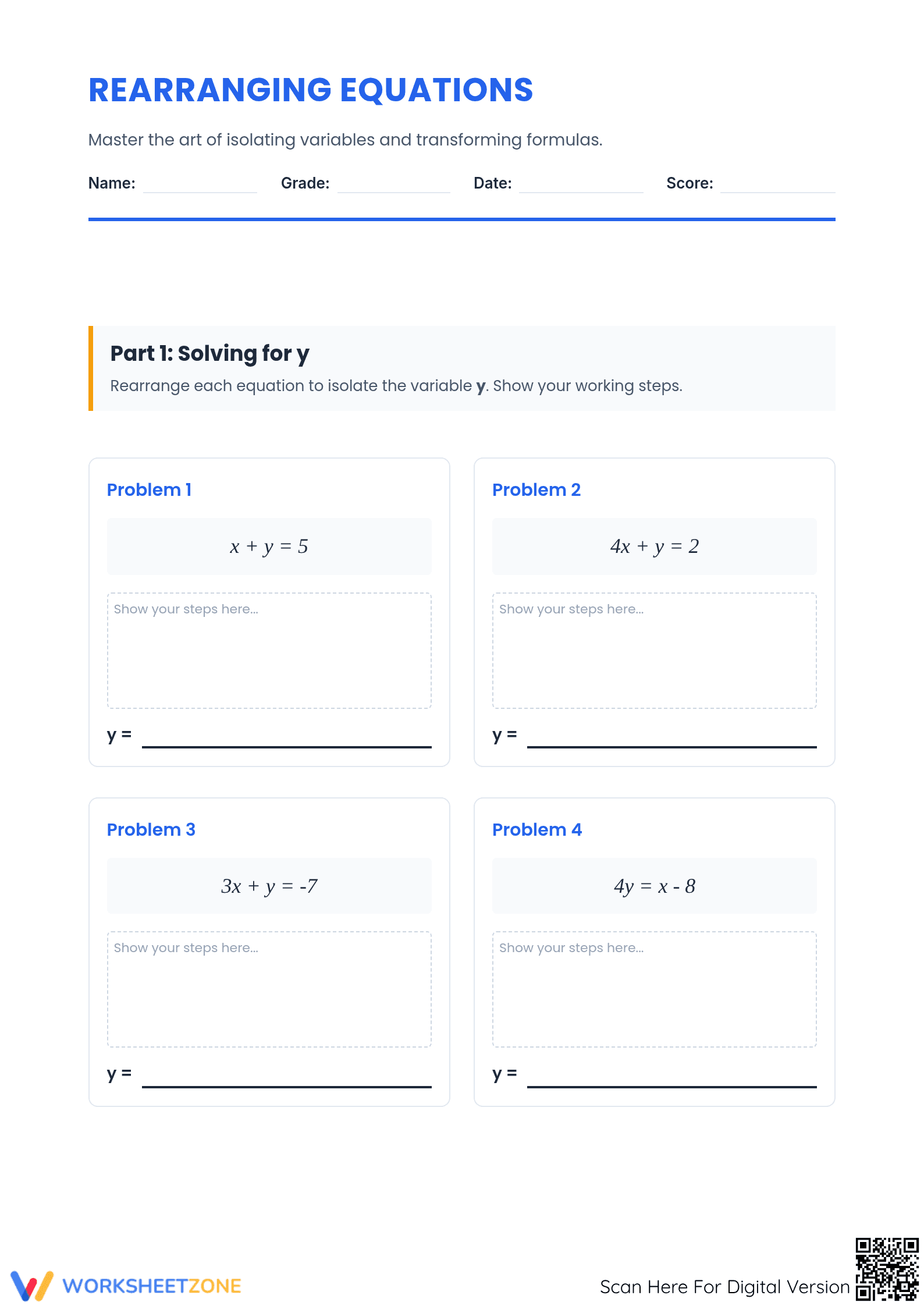
This comprehensive Algebra 1 worksheet provides students with targeted practice in rearranging literal equations and formulas to isolate specific variables. By applying inverse operations to multi-variable expressions, learners develop the algebraic fluency required for physics, chemistry, and advanced mathematics. Students move from basic linear forms to complex real-world scientific formulas with precision.
At a Glance
- Grade: 9 · Subject: Math
- Standard:
HSA.CED.A.4— Rearrange formulas to highlight a quantity of interest using equation-solving reasoning- Skill Focus: Isolating variables in literal equations
- Format: 4 pages · 18 problems · Answer key included · PDF
- Best For: Algebra 1 introduction or review
- Time: 45–60 minutes
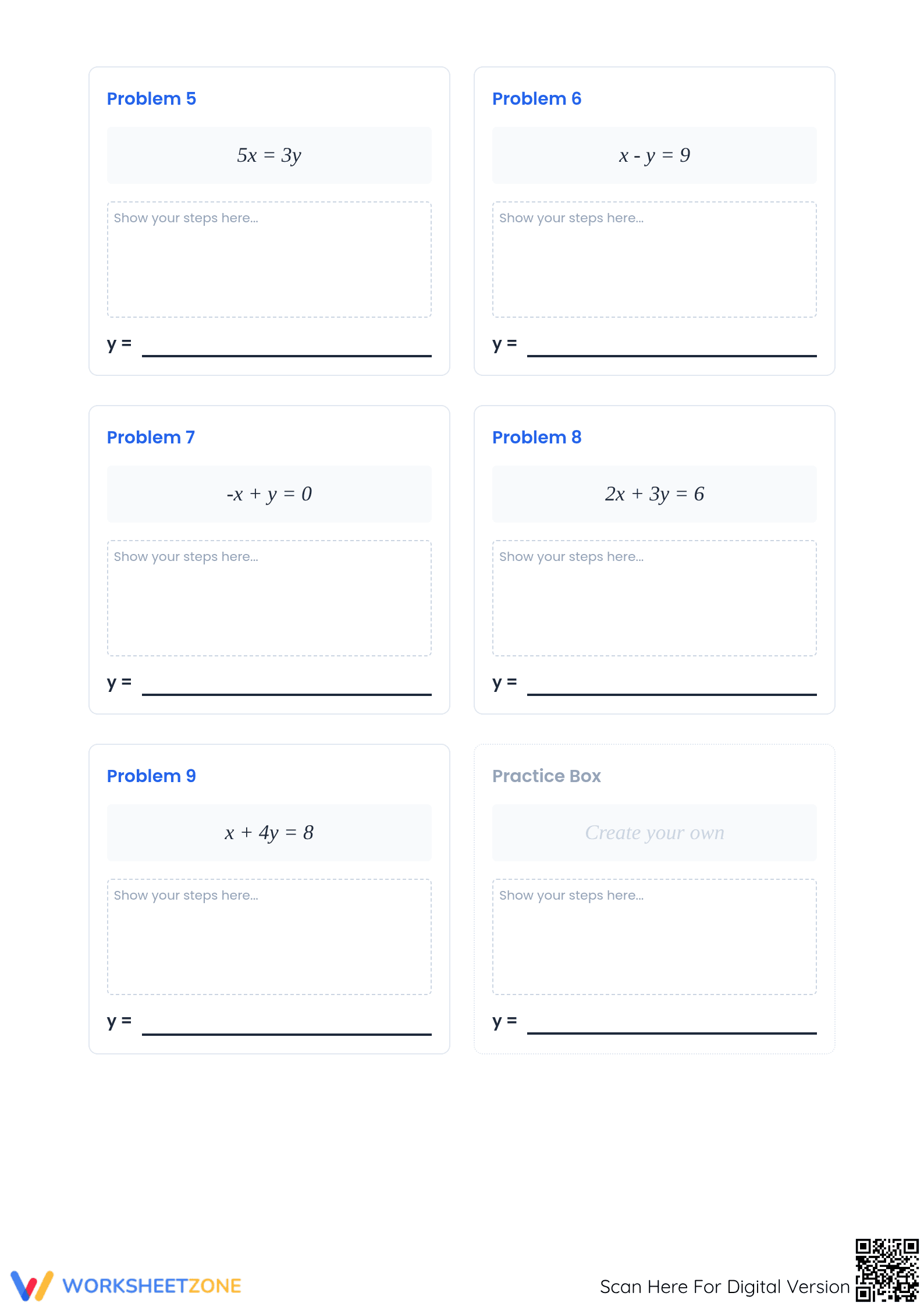
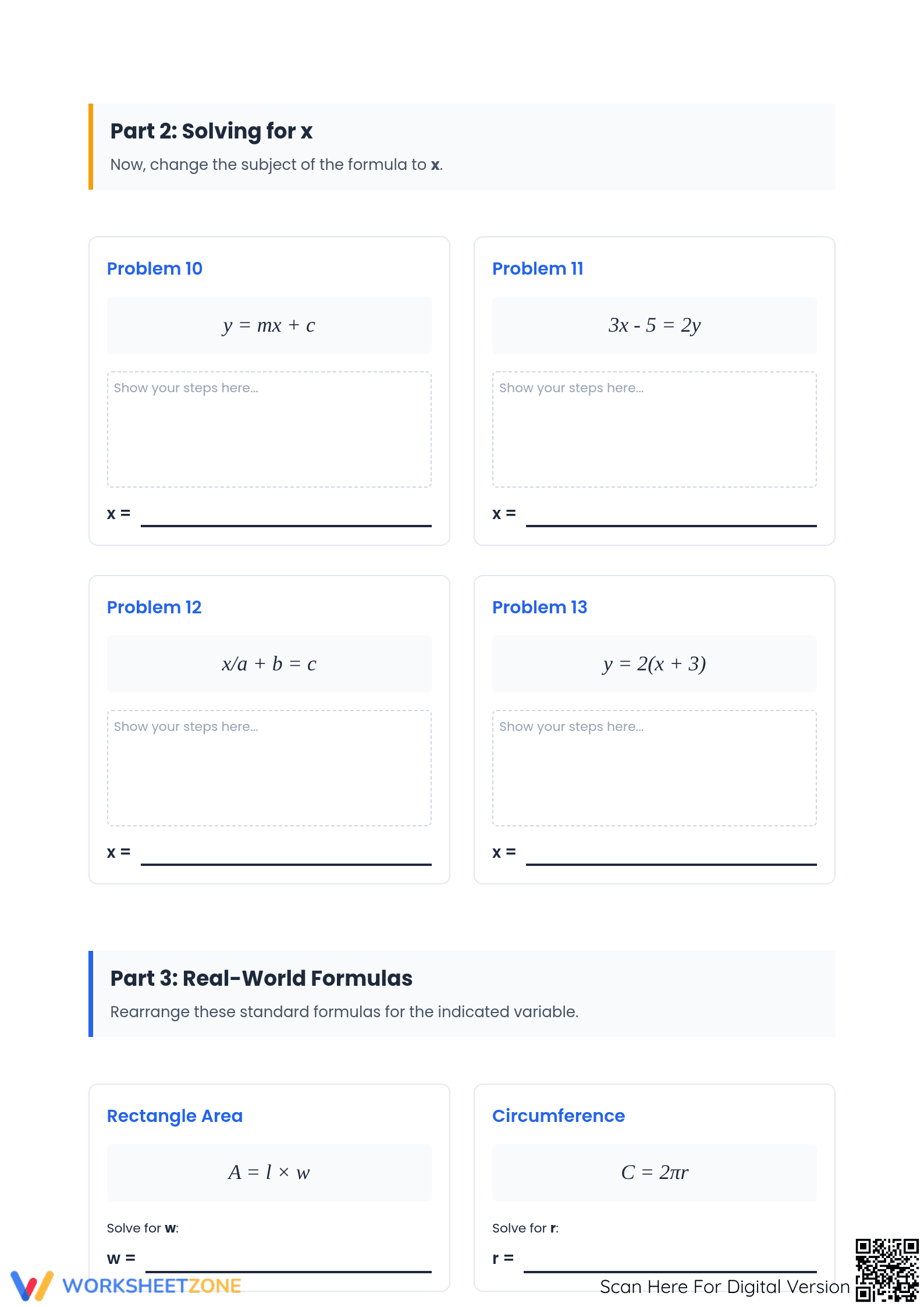
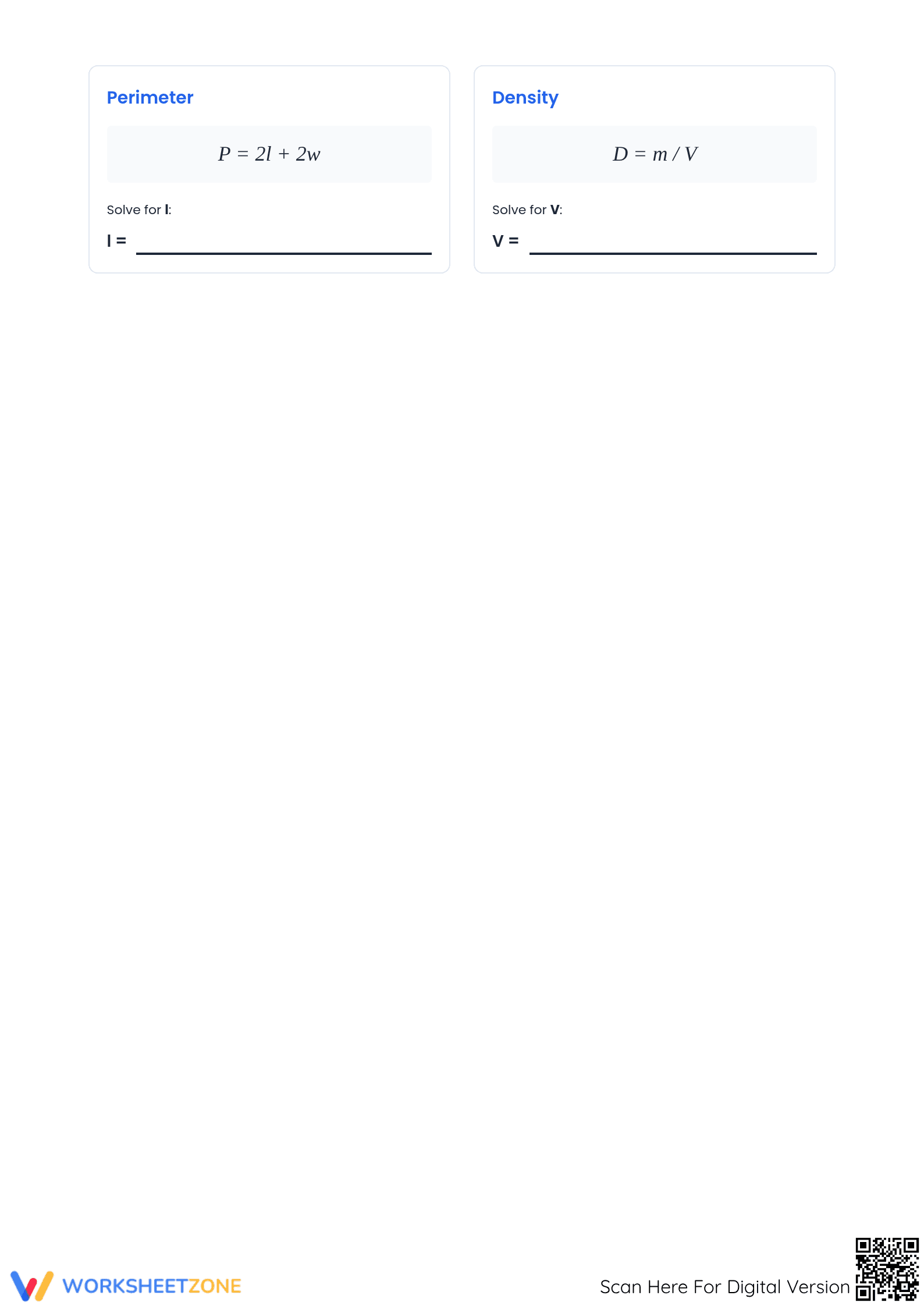
Across four structured pages, this resource presents 18 distinct challenges divided into three logical parts. Part 1 focuses on isolating 'y' in linear equations, Part 2 transitions to solving for 'x' in more complex arrangements involving slope-intercept and distributive forms, and Part 3 applies these skills to authentic formulas. A full answer key and a Practice Box for student-created problems are provided.
Skill Progression
- Guided practice begins with single-step addition and subtraction problems, such as x + y = 5, allowing students to focus on the concept of moving terms across the equal sign using inverse operations.
- Supported practice introduces multi-step operations including multiplication, division, and parentheses, requiring students to determine the correct order of operations to isolate the subject.
- Independent practice culminates in real-world application where students rearrange standard geometric and physical formulas like Density (D=m/V) and Circumference (C=2πr) for different variables.
This sequence follows the gradual-release model, ensuring students build confidence before tackling abstract scientific transformations.
Standards Alignment
This worksheet is directly aligned with HSA.CED.A.4, which requires students to rearrange formulas to highlight a quantity of interest. By treating variables as numbers, students use consistent algebraic properties to transform equations. This standard code can be copied directly into lesson plans, IEP goals, or district curriculum mapping tools.
How to Use It
Assign this worksheet during the independent practice phase of a lesson on literal equations to solidify student understanding of variable manipulation. It also serves as an excellent formative assessment tool; teachers should observe if students correctly apply the distributive property in reverse when solving formulas like y = 2(x + 3). Expect a completion time of 45 to 60 minutes.
Who It's For
This resource is designed for Algebra 1 students, though it is also highly effective for Grade 8 accelerated learners or high school science students struggling with the mathematical demands of chemistry and physics. Pair this with a formula anchor chart or a short direct instruction lesson on inverse operations for maximum impact.
The ability to manipulate literal equations is a foundational gateway skill for success in STEM fields. According to the RAND AIRS 2024 report on mathematical competency, students who master the rearrangement of formulas demonstrate significantly higher proficiency in modeling real-world situations and interpreting variable relationships in scientific contexts. This worksheet specifically addresses HSA.CED.A.4 by providing a high-volume environment for students to practice isolating variables. By moving from abstract linear equations to concrete formulas like the Perimeter of a rectangle, students bridge the gap between pure mathematics and applied science. The inclusion of structured working boxes encourages the development of mathematical meta-cognition, a practice emphasized by EdReports 2024 as critical for long-term retention of algebraic concepts. This resource provides the repetition necessary to move from procedural decoding to conceptual mastery of variable transformation.


