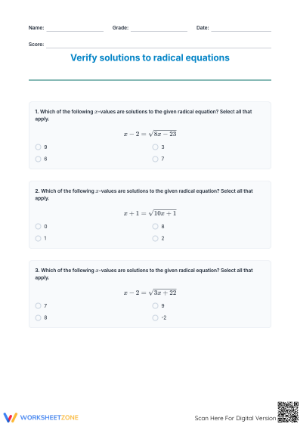
What a solving radical equations worksheet should actually cover
If you teach Algebra 1 or Algebra 2, you already know that radical equations are where a lot of students who felt confident with linear work suddenly stall. A strong set of solving radical equations worksheets does more than hand students ten square-root problems. It builds fluency in isolating the radical, raising both sides to a matching power, solving the leftover equation, and then checking every answer back in the original. That last step is the one most practice sets shortchange, and it's the one that separates a correct solution from a false one.
This page walks through what to look for in a practice set, how to sequence it across a unit, and how to turn the answer key into an error-analysis activity instead of a stopping point.
The step-by-step method students rehearse
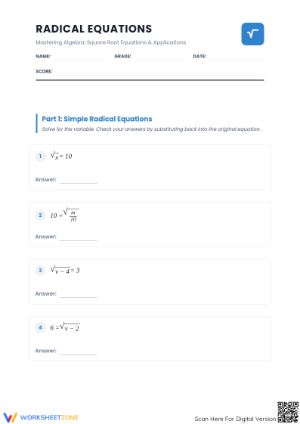
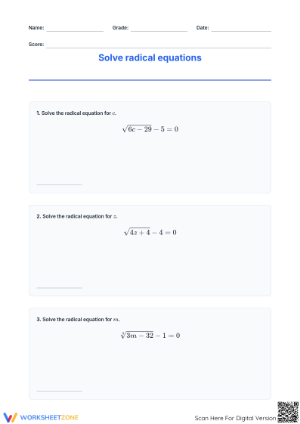
Every worksheet you assign should reinforce the same reliable procedure so students stop treating each problem as a fresh puzzle. The standard method is to isolate the radical term first, then raise both sides to the power that cancels it, solve the resulting linear or quadratic equation, and check each candidate solution in the original equation.
- Isolate the radical before doing anything else.
- Raise both sides to a matching power to eliminate the radical.
- Solve the equation that's left, factoring when it turns quadratic.
- Check every solution in the original equation and reject any that don't hold.
When a problem has more than one radical term, students repeat the isolate-and-raise cycle, which is exactly where arithmetic mistakes multiply. Worksheets that mix single- and double-radical items keep that skill sharp.
Why extraneous solutions show up in the answer key
Squaring both sides of an equation is not a reversible operation, so it can introduce roots that satisfy the squared equation but not the original one. Those false answers are called extraneous solutions, and spotting them is a graded skill, not a courtesy check.
Per Common Core standard HSA-REI.A.2, students must solve simple rational and radical equations in one variable and explain how extraneous solutions arise. That single standard packs two skills into one line, which is why a worksheet that omits solution-checking on all 20 items leaves half the standard unpracticed.
Here's the piece most practice sets miss: an extraneous solution isn't a student error, it's a mathematical byproduct of the method itself. When you square a step, you widen the solution set, so checking is the algebra that narrows it back down. Framing the check as the final line of the algorithm rather than an optional double-check changes how students treat it. Build at least a third of your worksheet items so that one candidate must be rejected, and students stop skipping the step because they learn it actually pays off.
A scaffolded worksheet progression
Radical equations sit in the broader Algebra unit on equations, usually after linear and quadratic work and often bridging into rational exponents. That placement means students arrive with uneven skills, so sequence your practice from clean to messy.
- Single radical, nothing outside: the radical is already isolated, so students focus on squaring and solving.
- Radical with a constant term: students must isolate before raising the power.
- Radicals on both sides: squaring produces a binomial students have to expand carefully.
- Extraneous-solution problems: at least one candidate fails the check.
Sequencing this way lets you diagnose exactly where a student breaks down instead of guessing. A student who nails the first tier but stumbles on the second usually has an isolating habit to fix, not a squaring problem.
The common errors these worksheets catch
The most frequent mistake is squaring before isolating. A student who squares both sides of an equation while a constant still sits next to the radical ends up expanding a binomial incorrectly and chasing a wrong answer for the rest of the problem. Worksheets that deliberately place a constant outside the radical force the isolate-first habit.
The second recurring gap is weak binomial squaring. When students write that a sum squared equals the sum of the squares, every double-radical problem falls apart. Pairing a radical equation set with a short warm-up on squaring binomials clears that blocker before it contaminates the main task. A five-item warm-up is usually enough to surface who needs the reminder.
Classroom Implementation
Use these worksheets in more than one mode across the unit. During initial instruction, work the first tier together, then let students try the second tier in pairs so they can talk through where to isolate. For review or small-group intervention, pull the extraneous-solution tier and run an error-analysis routine.
The answer key is your best classroom asset here. Instead of handing it out for self-grading, project a worked solution that arrives at an extraneous root and ask students to find why the check fails. That turns a passive key into a discussion about why the method produces false roots in the first place. For a fluency target, twelve to fifteen problems per sitting keeps students engaged without turning practice into a squaring marathon, and you can assign a shorter mixed set as a spiral review two weeks later.
Frequently Asked Questions
1. What grade level and course typically covers solving radical equations?
Solving radical equations is a high school Algebra topic, appearing in Algebra 1 and revisited with more depth in Algebra 2. It's usually taught inside the equations unit, after students have worked with linear and quadratic equations and are ready to connect radicals to rational exponents.
2. Why do radical equations produce extraneous solutions and how should students check for them?
Squaring both sides isn't reversible, so it can add roots that fit the squared equation but not the original. Students check by substituting each candidate back into the original equation and rejecting any answer that doesn't make it true. That check is a required step, not optional busywork.
3. How many practice problems should a worksheet include to build fluency?
Around twelve to fifteen problems per session works well: enough to practice the full isolate-raise-solve-check cycle several times without exhausting students. Include a mix of single-radical, double-radical, and extraneous-solution items so fluency covers every case they'll meet on assessments.
4. What prerequisite skills should students have first?
Students should be comfortable solving linear and quadratic equations, factoring, and especially squaring binomials correctly. That last skill is the most common blocker, so a quick warm-up on expanding a squared binomial before the worksheet saves a lot of confusion during double-radical problems.
5. How can teachers use these worksheets for both instruction and later review?
Use the scaffolded tiers during first instruction and pair work, then repurpose the extraneous-solution items for error-analysis during review or intervention. A shorter mixed set makes an effective spiral review a few weeks later, keeping the checking habit alive long after the unit ends.













 Interactive Worksheet Maker
 Quiz Maker
 Word Search Maker
 Crossword Puzzle Maker
 Word Scramble Generator
 Sentence Scramble Generator
 Handwriting Worksheet Generator
 Name Tracing Generator
 Fill In The Blank Generator