


























Views
Downloads
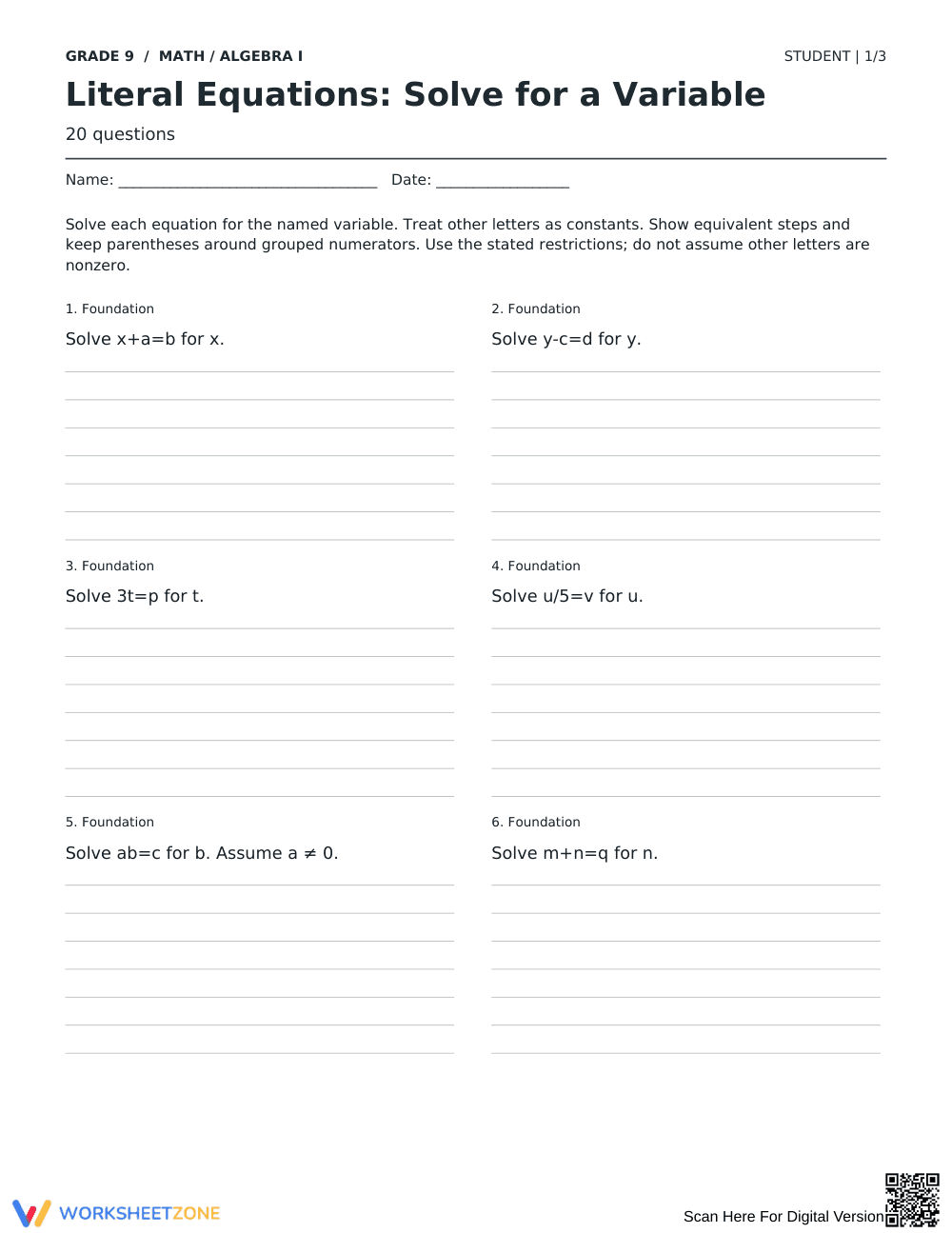
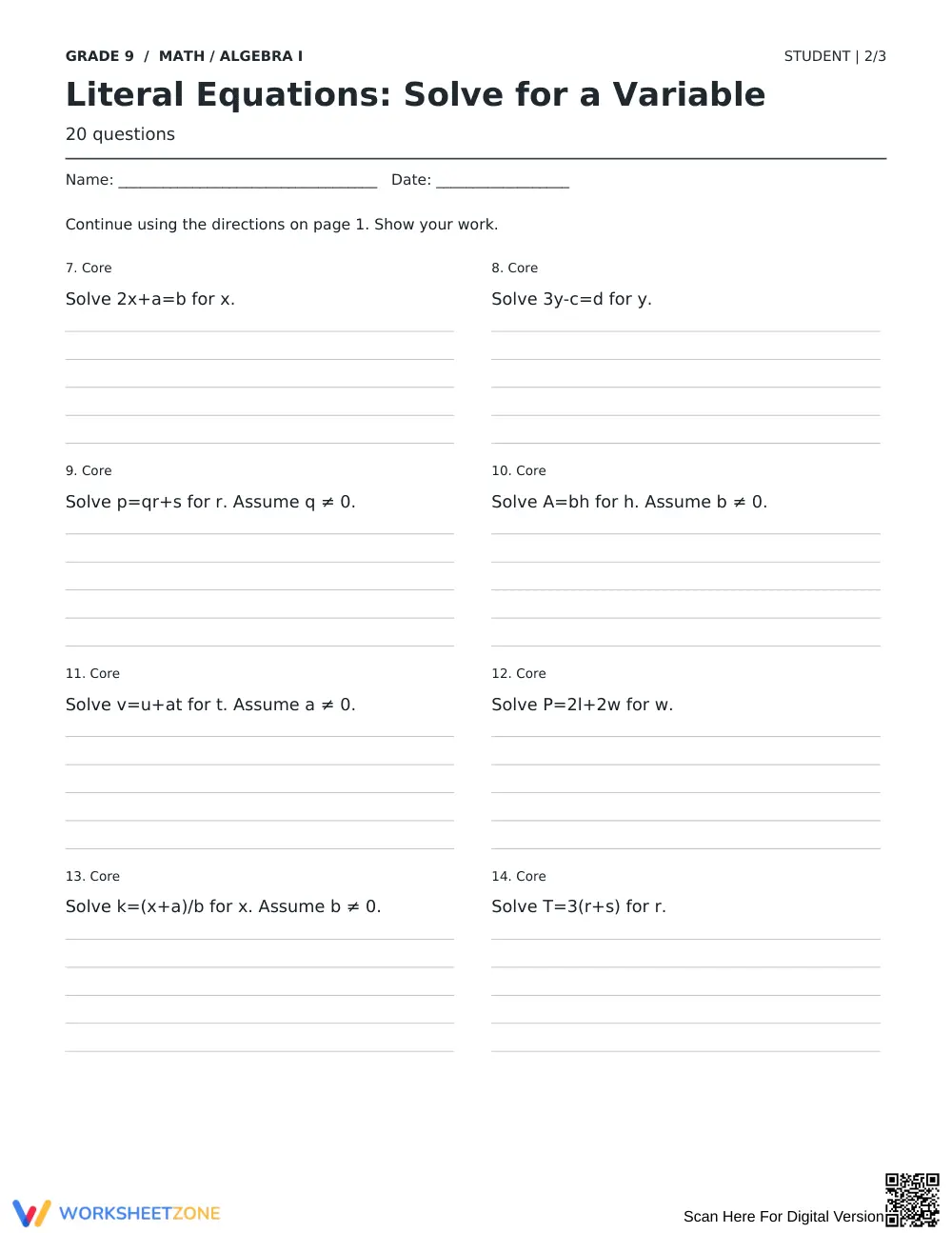
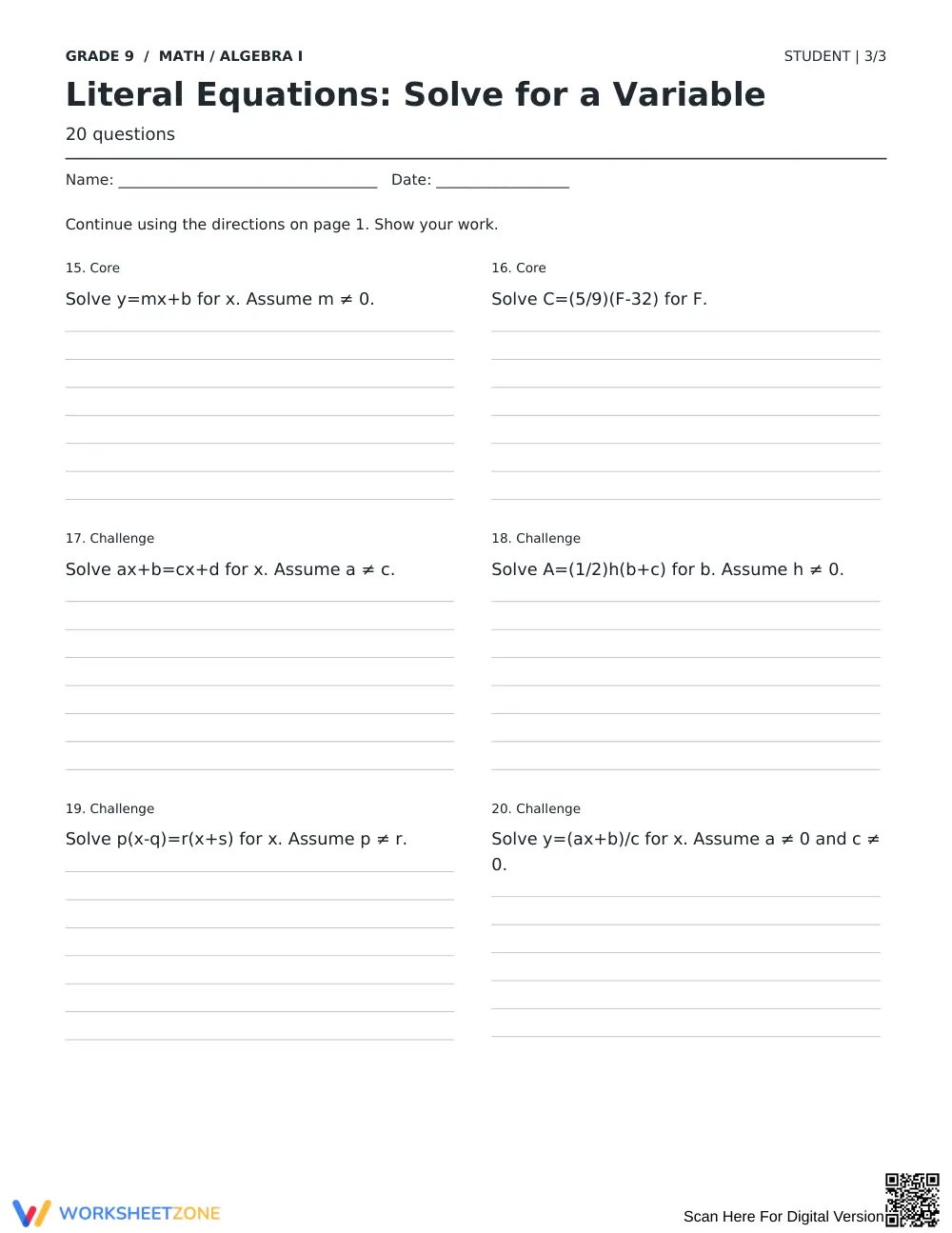

Literal Equations Printable Worksheet | Grade 9 Algebra
Paste this activity's link or code into your existing LMS (Google Classroom, Canvas, Teams, Schoology, Moodle, etc.).
Students can open and work on the activity right away, with no student login required.
You'll still be able to track student progress and results from your teacher account.
This Grade 9 Algebra worksheet builds fluency in rearranging literal equations by guiding students through 24 problems that require isolating a specified variable using inverse operations. Students practice applying algebraic properties systematically, building the procedural confidence needed for standardized assessments and real-world formula manipulation.
At a Glance
- Grade: 9 · Subject: Math / Algebra
- Standard:
CCSS.MATH.CONTENT.HSA-CED.A.4— Rearrange formulas to highlight a quantity of interest using the same reasoning as solving equations- Skill Focus: Solving literal equations for a specified variable
- Format: 3 pages · 24 problems · Answer key included · PDF
- Best For: Guided practice after direct instruction
- Time: 25–40 minutes
The worksheet spans three student pages and presents 24 literal equation problems in a clean, numbered format with ample workspace. Problems progress from two-variable equations requiring a single inverse operation to multi-step formulas involving distribution and combining like terms. The answer key shows the isolated variable in simplified form, making self-correction and teacher review straightforward.
- Guided practice (Problems 1–8): Single-step rearrangements where students isolate one variable by applying one inverse operation. Equations use familiar forms such as y = mx + b and A = lw, connecting to prior knowledge.
- Supported practice (Problems 9–16): Two-step equations requiring students to perform two inverse operations in sequence, reinforcing order-of-operations reasoning in reverse.
- Independent practice (Problems 17–24): Multi-step and multi-variable formulas, including equations that require factoring out the target variable before dividing. Students demonstrate readiness for assessment.
This gradual-release structure mirrors the I Do, We Do, You Do model: teachers can assign Problems 1–8 during guided notes, Problems 9–16 as collaborative pair work, and Problems 17–24 as an independent exit check.
The primary standard is CCSS.MATH.CONTENT.HSA-CED.A.4: Rearrange formulas to highlight a quantity of interest, using the same reasoning as in solving equations. A supporting standard, CCSS.MATH.CONTENT.HSA-REI.B.3, addresses solving linear equations in one variable, reinforcing the inverse-operation logic students apply here. Both codes can be copied directly into lesson plans or curriculum mapping tools.
Use this worksheet after direct instruction on inverse operations to consolidate new learning. Assign Problems 1–16 as in-class practice and reserve Problems 17–24 as a formative exit ticket — observe whether students correctly factor out the target variable, as errors there signal a distributive-property gap. Expected completion time is 25–40 minutes depending on student pace.
This resource is designed for Grade 9 Algebra 1 students encountering literal equations for the first time, as well as Algebra 2 students needing focused review before tackling function transformations or physics formulas. It pairs naturally with an anchor chart listing common formulas (e.g., d = rt, V = lwh, A = ½bh) that students can reference while working.
Aligned to CCSS.MATH.CONTENT.HSA-CED.A.4, this worksheet targets the high-school algebra skill of rearranging formulas — a competency directly assessed on state exams and the SAT. The three-phase problem sequence reflects the gradual-release framework that Fisher & Frey (2014) identify as highly effective for procedural fluency. The included answer key supports both teacher-led review and student self-assessment, reducing grading time while maintaining accountability. Suitable for Algebra 1 and Algebra 2 classrooms, intervention blocks, and homework, this resource gives teachers a ready-to-print tool connected directly to standards documentation.


