


























Views
Downloads
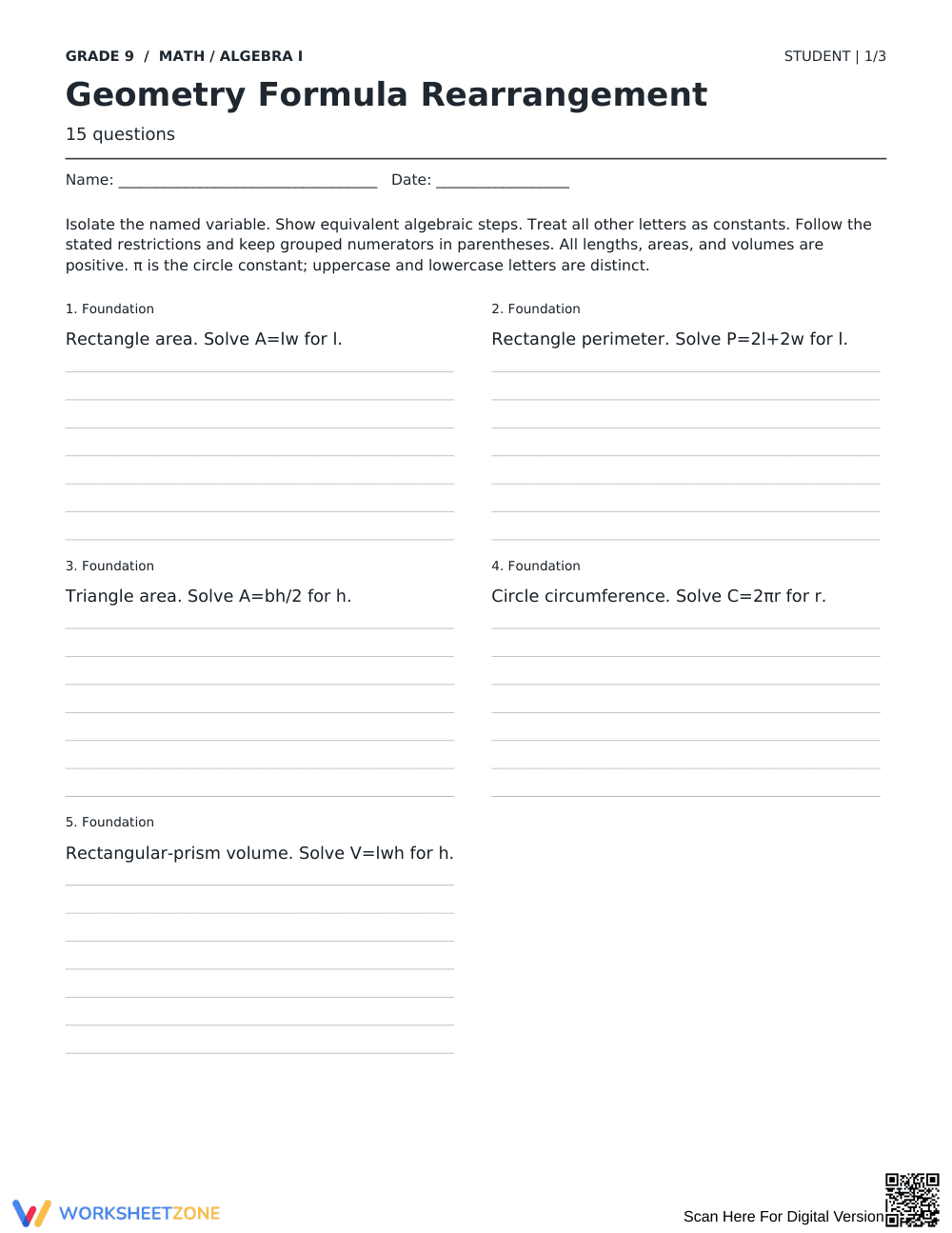
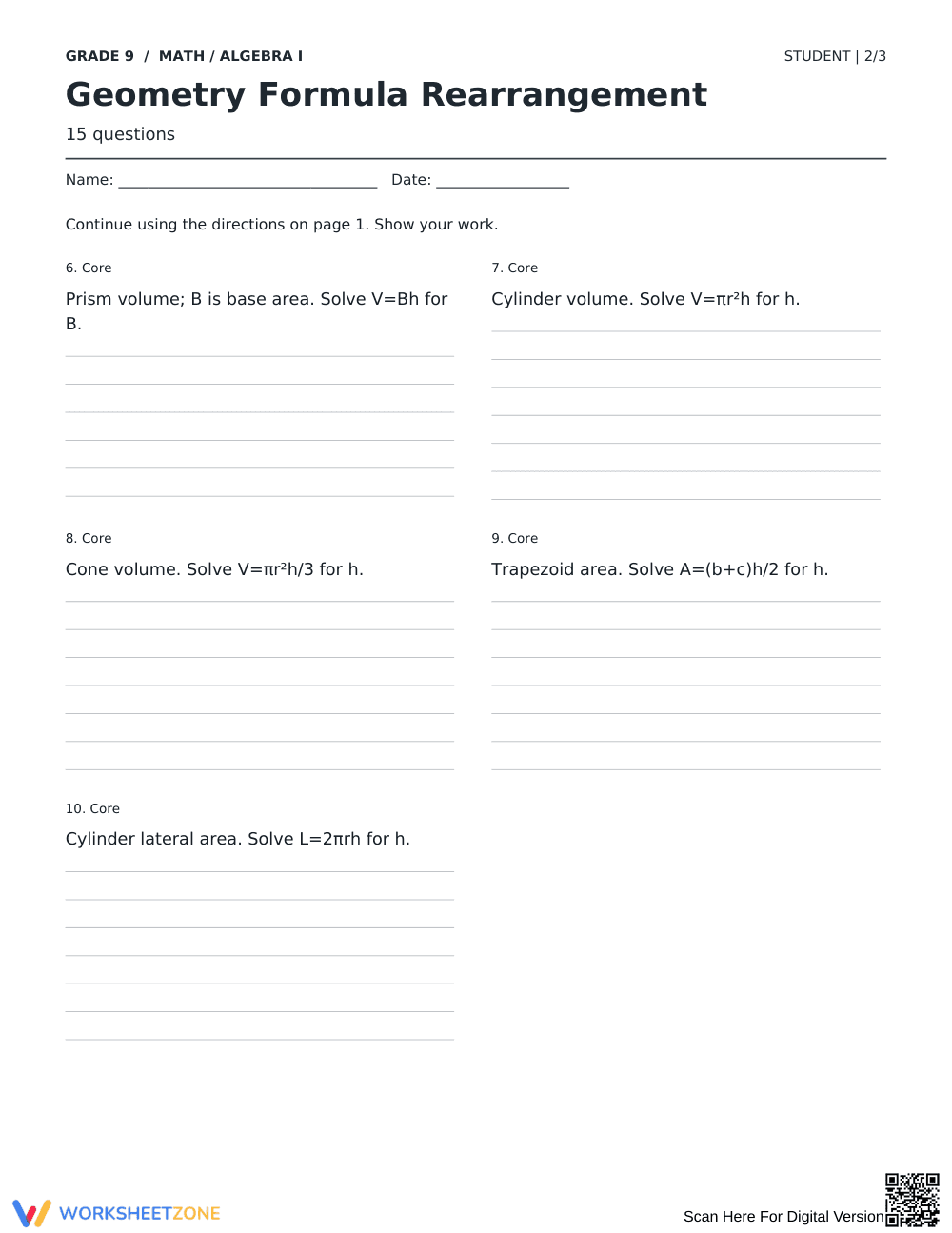
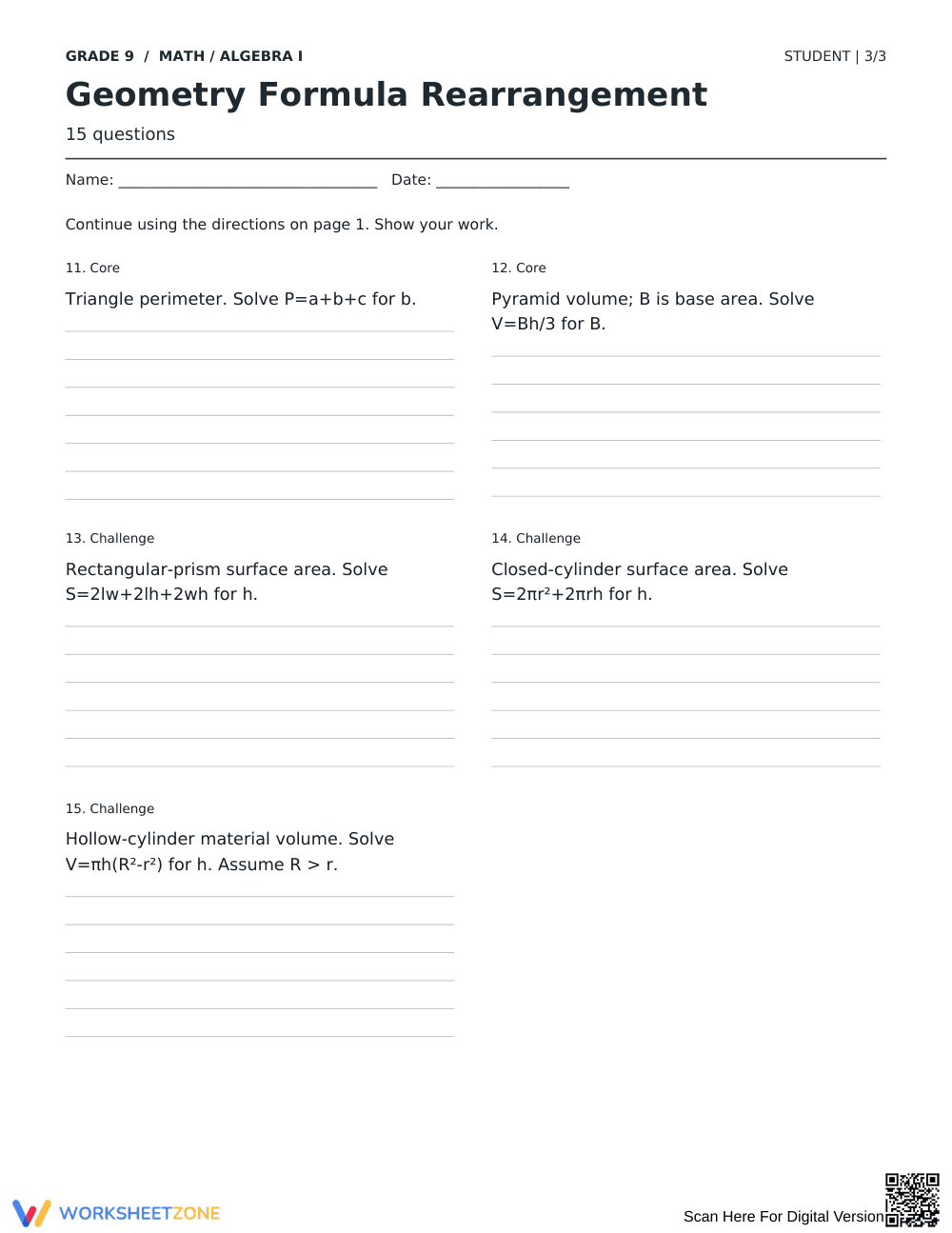

Geometry Formula Rearrangement | Grade 9 Essential
Paste this activity's link or code into your existing LMS (Google Classroom, Canvas, Teams, Schoology, Moodle, etc.).
Students can open and work on the activity right away, with no student login required.
You'll still be able to track student progress and results from your teacher account.
This 3-page algebra worksheet builds proficiency in isolating target variables within geometric formulas. Grade 9 students rearrange two- and three-dimensional formulas across 15 structured exercises, treating non-target variables as constants. By applying inverse operations to area, perimeter, and volume equations, learners strengthen algebraic manipulation skills.
At a Glance
- Grade: Grade 9 · Subject: Math / Algebra I
- Standard:
CCSS.MATH.CONTENT.HSA.CED.A.4— Rearrange formulas to isolate a target variable using equation-solving properties- Skill Focus: Geometric formula rearrangement and literal equations
- Format: 3 student pages · 15 problems · Full answer key included · Printable PDF
- Best For: Independent classroom practice and skill review
- Time: 25–40 instructional minutes
What's Inside
This resource features a 3-page student worksheet containing 15 open-response exercises paired with a 2-page complete answer key. Students manipulate formulas for perimeter, area, and volume across rectangular prisms, cylinders, and cones. Each problem provides dedicated lined workspace for recording inverse operations, while the key details algebraic steps and grading guidelines.
Skill Progression
- Guided practice (Problems 1–5): Foundation items target single-step division and two-step inverse operations using perimeter and area formulas.
- Supported practice (Problems 6–12): Core items introduce rational expressions, fractions, and circle constants like pi across three-dimensional solids.
- Independent practice (Problems 13–15): Challenge items require algebraic factoring and binomial grouping to isolate dimensions in surface area formulas.
This sequence mirrors the gradual-release model, advancing learners from basic inverse steps to complex multi-step isolation.
Standards Alignment
This worksheet aligns directly to CCSS.MATH.CONTENT.HSA.CED.A.4 by requiring students to rearrange formulas to highlight a quantity of interest using equation-solving principles. It additionally supports CCSS.MATH.CONTENT.HSA.REI.A.1 through explaining each step in equation solving. Both standard codes can be copied directly into lesson plans, IEP goals, or district curriculum mapping tools.
How to Use It
Administer this worksheet after direct instruction on literal equations as focused independent seatwork or structured partner practice. Alternatively, use Questions 1–5 as a mid-lesson check to ensure prerequisite mastery before assigning complex formulas. During work time, verify whether students properly maintain grouped numerators in parentheses when clearing denominators. Expect completion within 25 to 40 minutes.
Who It's For
This practice set is designed for Grade 9 Algebra I students learning literal equations and high school geometry classes reviewing dimensional formulas. The three tiers allow flexible differentiation between core practice and advanced enrichment. Pair this activity with a classroom anchor chart detailing algebraic properties of equality and common geometric volume formulas.
According to Fisher & Frey (2014), structured instructional materials that organize deliberate practice through scaffolded shifts from foundational prompts to complex multi-step tasks significantly improve student cognitive retention and algebraic fluency. This worksheet targets CCSS.MATH.CONTENT.HSA.CED.A.4 by guiding high school learners to rearrange literal equations and isolate target variables across familiar geometric contexts. By transitioning students from elementary one-step perimeter formulas to intricate volume relations requiring factoring and rational division, the resource reinforces the logical application of inverse operations and equality properties. The systematic design ensures that students do not simply memorize algorithmic tricks, but instead build rigorous mathematical reasoning that translates into success in STEM disciplines and standardized assessments. As evidenced by Fisher & Frey (2014), gradual release and consistent written accountability provide teachers with concrete diagnostic insights into student procedural precision and conceptual mastery.


