


























Views
Downloads

Physics Formula Rearrangement Worksheet | Grade 9 Essential
Paste this activity's link or code into your existing LMS (Google Classroom, Canvas, Teams, Schoology, Moodle, etc.).
Students can open and work on the activity right away, with no student login required.
You'll still be able to track student progress and results from your teacher account.
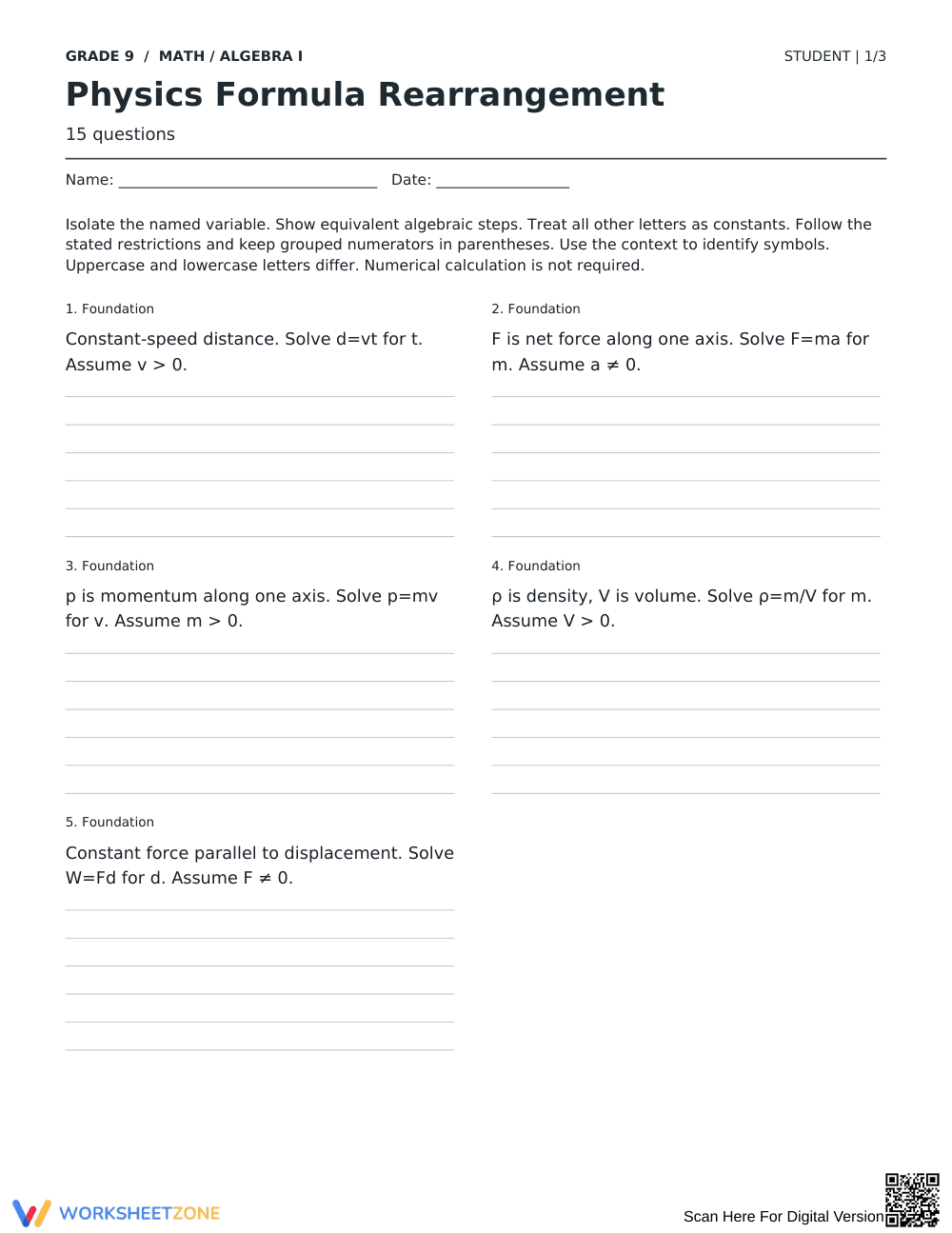
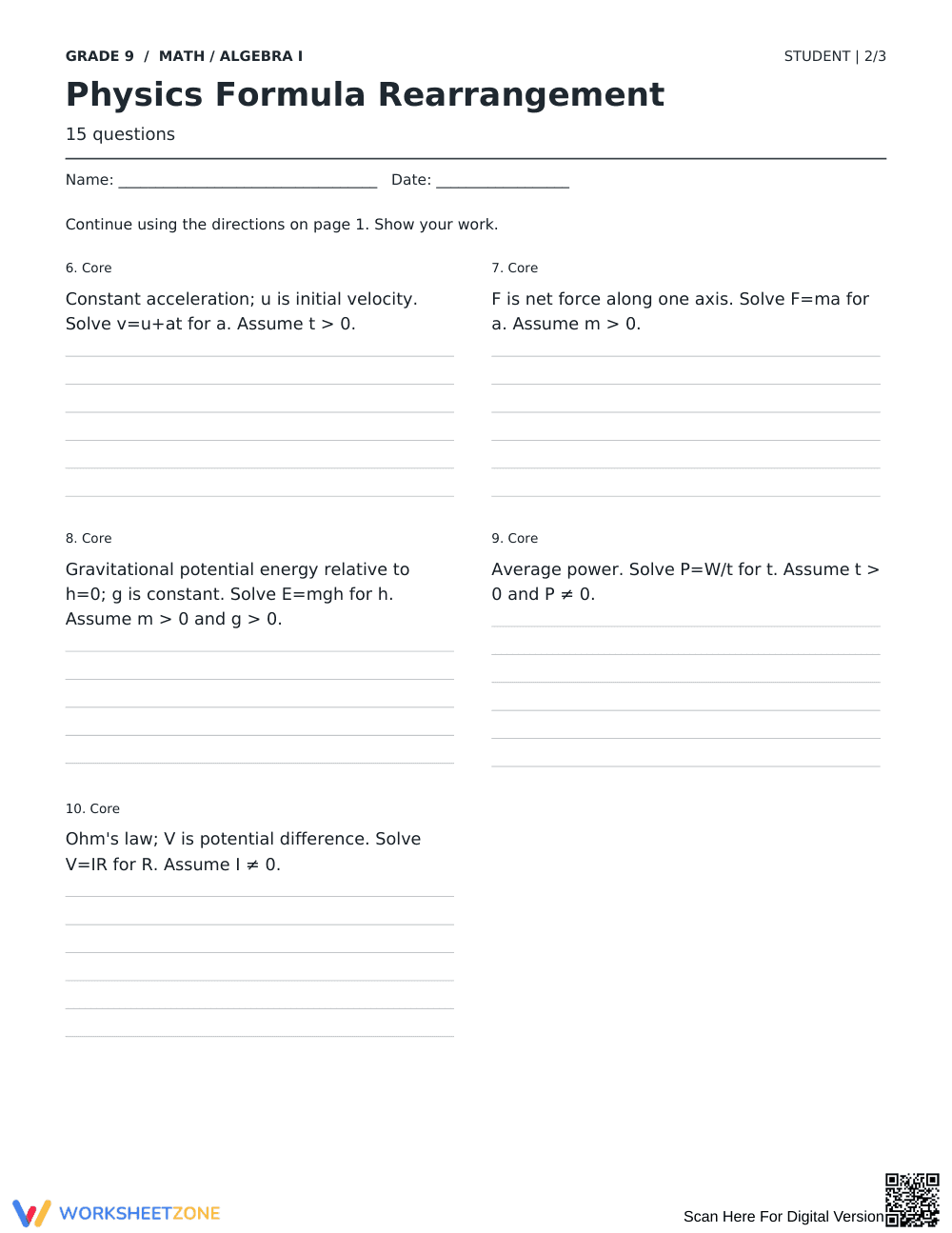
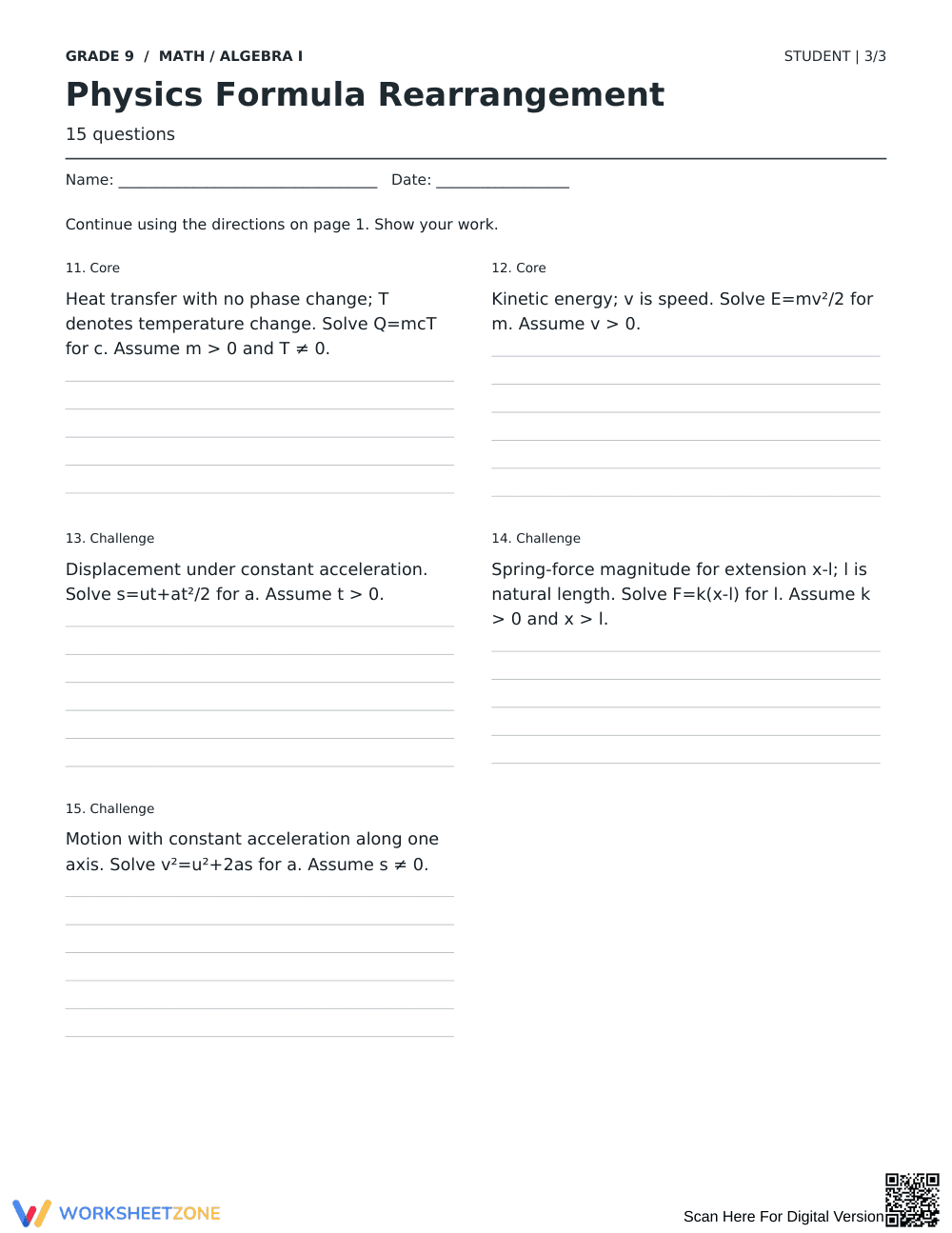
This high school algebra worksheet strengthens algebraic manipulation skills by training students to isolate target variables in 15 authentic physics formulas. Students apply inverse operations across single-step and multi-step equations without computing numerical values, solidifying their understanding of literal equations and variable relationships across STEM disciplines.
At a Glance
- Grade: 9 · Subject: Math (Algebra I)
- Standard:
CCSS.MATH.CONTENT.HSA.CED.A.4— Rearrange formulas to highlight a specific quantity of interest using equation-solving reasoning- Skill Focus: Rearranging literal equations and scientific formulas
- Format: 3 pages · 15 problems · Answer key included · PDF
- Best For: Independent practice, algebra-physics review, or homework
- Time: 25–40 minutes
What's Inside
This 3-page printable worksheet presents 15 clearly formatted literal equation tasks based on real-world physics formulas, including kinematics, work, density, power, and Ohm's law. Ample workspace allows students to show all algebraic steps. A complete 2-page teacher answer key provides step-by-step inverse operations and solutions for quick grading.
Skill Progression
- Foundation (Problems 1–5): Single-step multiplication and division equations (such as d = vt and F = ma) focusing on isolating one variable with explicit domain restrictions.
- Core (Problems 6–12): Multi-step linear and fractional relationships (such as v = u + at, P = W/t, and E = mgh) requiring addition, subtraction, and reciprocal operations.
- Challenge (Problems 13–15): Advanced multi-step formulas involving distribution, squared terms, and rational groupings (such as s = ut + at²/2 and v² = u² + 2as).
This tiered structure supports a gradual-release instructional model, moving learners from fundamental inverse operations to complex multi-step transformations.
Standards Alignment
This activity aligns directly with `CCSS.MATH.CONTENT.HSA.CED.A.4`: Rearrange formulas to highlight a quantity of interest, using the same reasoning as in solving equations. It also supports `CCSS.MATH.CONTENT.HSA.REI.A.1` by requiring students to justify each algebraic step. Both standard codes can be copied directly into lesson plans, IEP goals, or district curriculum mapping tools.
How to Use It
Deploy this worksheet after direct instruction on literal equations to transition students from pure numeric algebra to applied scientific formulas. During classwork, monitor student progress by checking whether students correctly distribute or factor out constants before dividing by composite expressions. The entire activity is designed for completion within 25 to 40 minutes.
Who It's For
This resource is tailored for Grade 9 Algebra I and introductory high school physics students. It serves as targeted practice for general education classrooms, structured intervention for students struggling with literal equations, and an ideal companion to introductory kinematics and mechanics units.
According to educational research by Fisher & Frey (2014), structured gradual-release instructional frameworks provide the critical foundational support necessary for secondary students to develop both procedural fluency and lasting conceptual transfer across academic disciplines. Mastering literal equations and standard CCSS.MATH.CONTENT.HSA.CED.A.4 through systematic physics formula rearrangement equips ninth-grade algebra students with essential symbolic manipulation capabilities required for long-term success in advanced STEM coursework. When learners actively isolate target variables within authentic scientific formulas rather than generic abstract expressions, they directly bridge the conceptual gap between pure mathematics and physical science. This deliberate, tiered approach reinforces inverse operations, structure recognition, and algebraic properties through scaffolded, repeated practice. Consequently, high school students build the mathematical confidence, precision, and analytical problem-solving skills needed to manipulate multi-step rational relationships, quadratic expressions, and scientific formulas across diverse STEM applications and standardized assessments.


