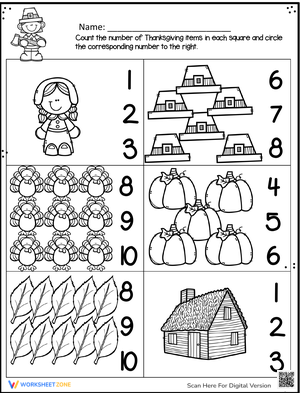
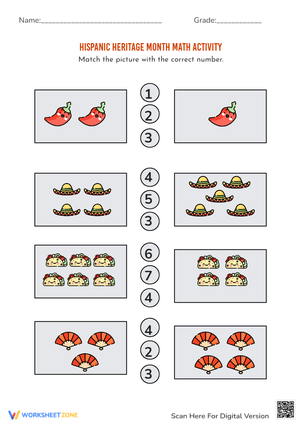
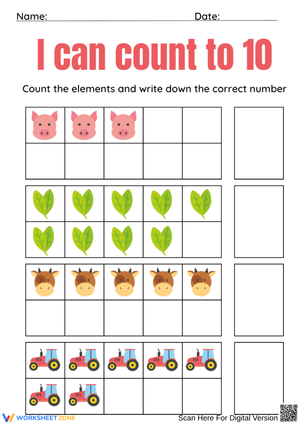
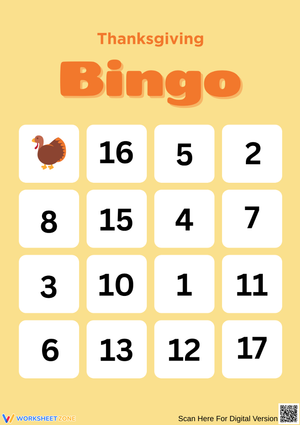
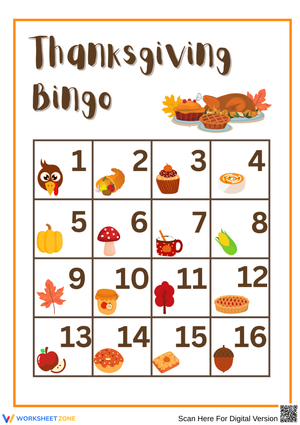
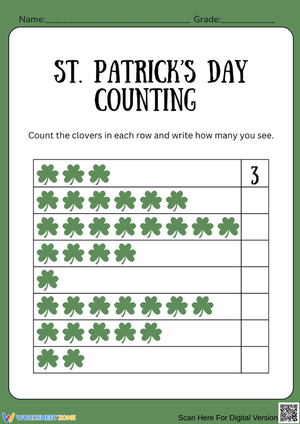
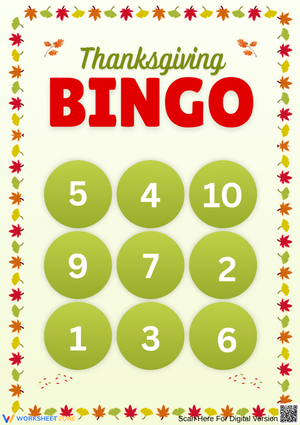
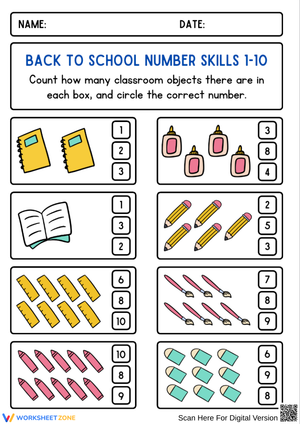
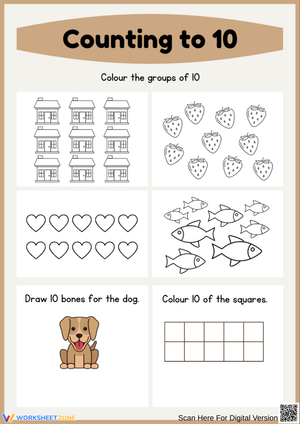
These kindergarten counting to 10 worksheets address a gap that appears in nearly every fall classroom: children who can recite the count sequence without error but cannot tell you how many objects are in a set after counting them. The set focuses on the skills that bridge that gap — one-to-one correspondence, cardinality, numeral recognition, and the connection between written symbols and actual quantities.
The Specific Skills Targeted
Each worksheet asks students to do something concrete with numbers rather than simply recite the count sequence. The task formats across the set include:
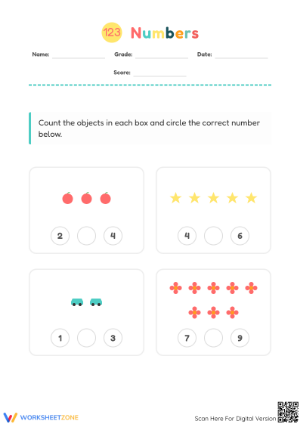
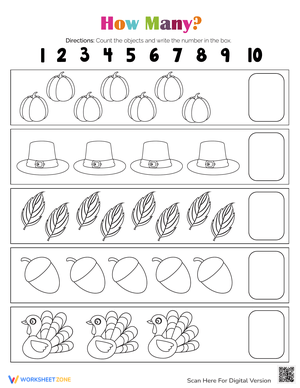
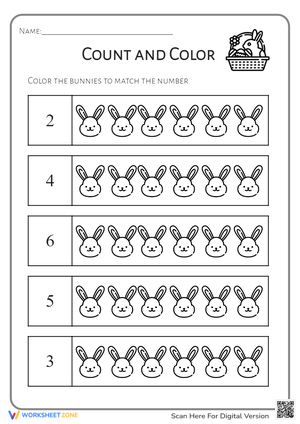
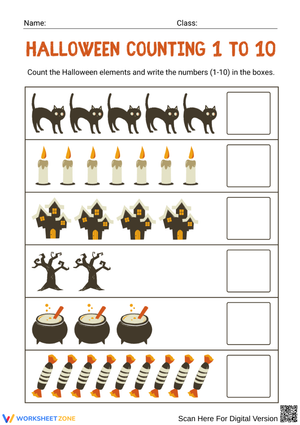
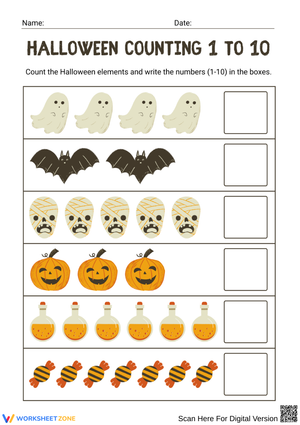
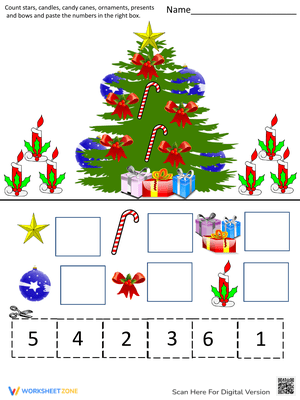
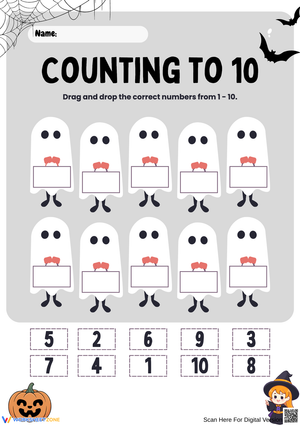
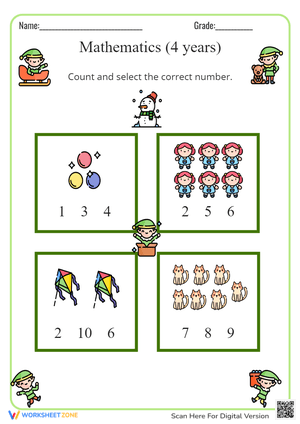
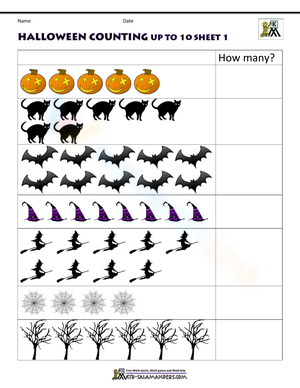
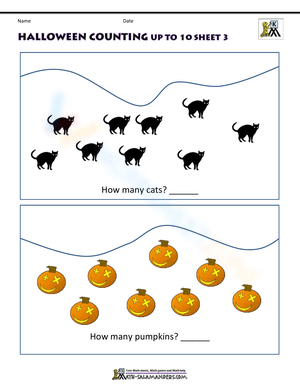
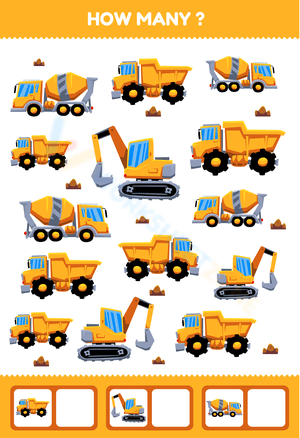
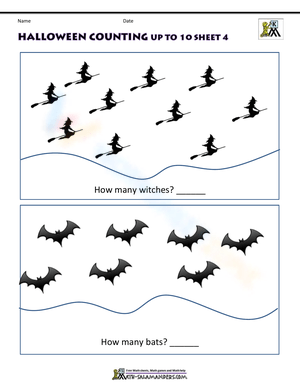
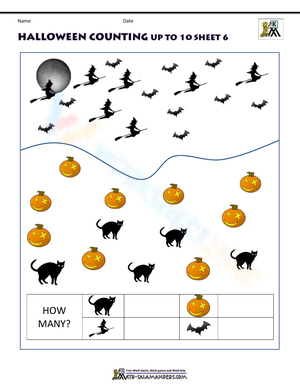
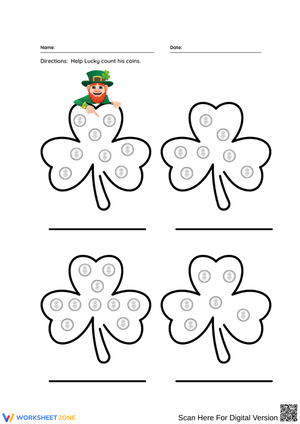
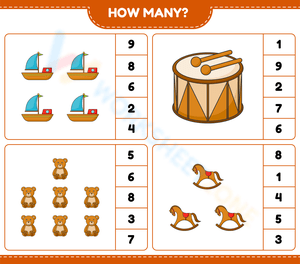
- Counting pictured objects and writing or circling the matching numeral
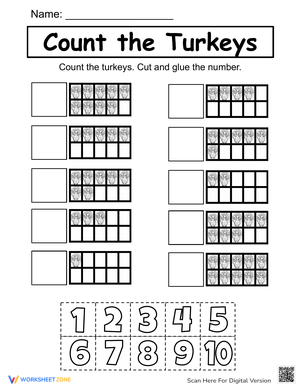
- Filling ten-frames by drawing dots to match a given number, or identifying how many cells remain empty
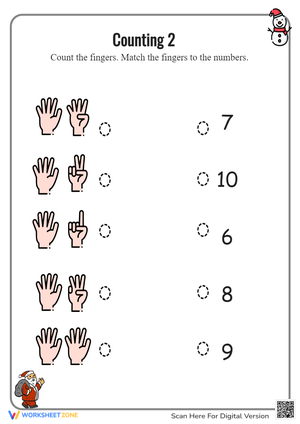
- Matching written numerals to sets arranged in different visual configurations — rows, scattered groups, tally marks
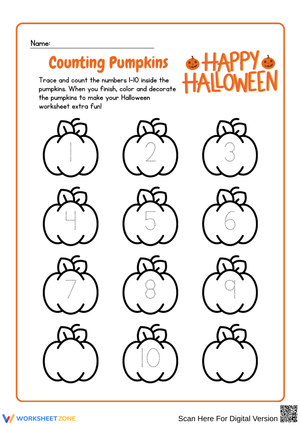
- Tracing numerals while the corresponding counted set stays visible on the same worksheet
The ten-frame worksheets prompt students to note empty cells, which is a low-key introduction to "how many more to make ten" that does not require naming it as a standard yet. Thematic images — seasonal objects, animals, classroom items — run throughout the set, letting teachers rotate materials by unit theme without disrupting the number sequence. The core task stays consistent: count the set, record the numeral.
Frequent Student Errors Worth Watching For
The most common problem is the finger-mouth lag: a student's voice says "four" while the finger is still resting on the third object, so the fourth object gets counted twice and the total lands one too high. The numeral the student writes looks plausible — a six when there should be a seven — and a quick scan of the finished worksheet will not reveal the cause. Watching the student's hand during the count is the only reliable diagnostic. These kindergarten counting to 10 worksheets surface the problem by requiring a written final numeral, which creates a visible record that purely oral counting practice would not.
A second pattern: students who have learned to perform cardinality without owning it. They say the last number they counted as their final answer because that is what was modeled — but they do not hold the quantity in mind. Cover the counted objects with your hand and ask "how many altogether?" A student who understands cardinality answers immediately. A student who is executing a memorized procedure reaches toward the paper to recount. That distinction drives the next instructional decision.
Scattered arrangements are consistently harder than lined rows, and this shows up in real student work. Many worksheets — including several in this set — arrange objects in rows or grids to reduce the tracking load. Do not assume that clean worksheet performance transfers automatically to a pile of objects on a table. Testing for that flexibility requires a separate hands-on moment, not another worksheet.
Smart Ways to Work These Worksheets Into Your Week
Kindergarten counting to 10 worksheets fit naturally into three slots: morning work, math centers, and the independent practice that closes a whole-group lesson. For math centers, slide worksheets into dry-erase sleeves — students complete the task with a whiteboard marker, you confirm the response and wipe it clean, and the same material runs all week without reprinting. This works especially well for ten-frame worksheets, where repeating the same visual structure across multiple sessions builds fluency faster than moving to a new format every day.
One technique worth building into your routine: before any pencil touches paper, have students place a small manipulative — a flat button, a mini eraser, a counting bear — directly on top of each printed object. They then remove the manipulatives one at a time, dropping each into a small cup while saying the number aloud. By the time the cup is full, the student has completed a physical count where hand and voice had to stay together. The numeral written after this step reflects an actual quantity rather than a guess. The added time is roughly 90 seconds per worksheet, and it eliminates the finger-mouth lag before it starts.
Adjusting the Worksheets for a Range of Learners
For students still consolidating counts of three to five, cover the upper portion of a larger printed set with a sticky note to reduce the visible quantity — no reprinting needed. Students who lose their place in scattered arrangements benefit from lining counters in a straight row beside the worksheet before beginning; the physical line gives them a track to follow. Both adjustments let the same worksheet material serve different readiness levels within a single center rotation without requiring separate printed versions.
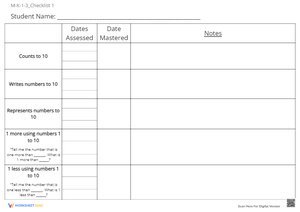
Students who count to ten reliably can extend the same worksheets by writing the number that is one more and the number that is one less beside their recorded total. Pairing two completed worksheets opens comparison work: which set is larger, which is smaller, and by how many. These extensions require only a verbal prompt from the teacher. It is worth being direct, though — kindergarten counting to 10 worksheets are the wrong tool for students already working fluently into the teens. Once a student handles all numbers to ten without hesitation, they need materials that move into a different range.
Standard Alignment
These worksheets address three clusters within the Common Core Counting and Cardinality domain. K.CC.A.1 — knowing number names and the standard count sequence — underlies every task where students recite numbers while pointing to objects. K.CC.B.4 governs the relationship between numbers and quantities and includes two critical substandards: K.CC.B.4a (pairing each object with exactly one number name, which is one-to-one correspondence) and K.CC.B.4b (understanding that the last number counted represents the total, which is cardinality). K.CC.B.5 addresses counting to answer "how many?" for sets of up to 20 objects; the worksheets here develop that fluency within the ten range first, which is the foundation the standard builds from. Teachers who move through the ten-frame activities early in the year also lay groundwork for K.NBT.1 work with teen numbers later in the year — students who already think in terms of "how many more to make ten" handle the jump from ten to eleven through nineteen with noticeably less confusion.
Frequently Asked Questions
How do I help a student who keeps skipping numbers while counting?
The problem is almost always a hand-voice synchronization issue, not a sequence gap. Have the student cross out each object with a crayon as they say the number — one mark, one word, no exceptions. The physical act of crossing out anchors the voice to the hand and makes it hard to rush past an object. If the pace is still inconsistent, use the manipulative-removal method described above: picking up and dropping a counter makes it physically impossible to count the same object twice in a row.
What separates rote counting from rational counting?
Rote counting is reciting the number sequence from memory — it requires no understanding of quantity, and most children arrive in kindergarten with it already intact. Rational counting attaches each spoken number to exactly one object and holds the final number as a meaningful total. A student relying on rote counting can say "one, two, three, four, five" perfectly while pointing at a cup that holds six crayons. The worksheets here require students to write a numeral at the end of counting, which makes that distinction visible: a student who records the correct total without recounting has moved into rational counting; a student who writes a wrong numeral and does not notice has not.
How can I use these worksheets to check for cardinality during small-group time?
After a student counts a set and records the numeral, cover the objects with your hand and ask "how many are there altogether?" without additional prompting. A student who owns cardinality answers immediately — the total means something to them and they hold it even when the objects disappear. A student who hesitates, glances at your hand, or asks to recount is still treating the count as a fresh procedure every time. That response tells you exactly what to work on in your next guided session with that student.













 Interactive Worksheet Maker
 Quiz Maker
 Word Search Maker
 Crossword Puzzle Maker
 Word Scramble Generator
 Sentence Scramble Generator
 Handwriting Worksheet Generator
 Name Tracing Generator
 Fill In The Blank Generator