These skip counting printable worksheets for kindergarten give teachers a set of number pattern activities spanning counts by 2s, 5s, and 10s — the three sequences kindergarteners need to encounter repeatedly before the patterns become automatic. Formats across the set include number lines with deliberate gaps, dot-to-dot picture reveals, cut-and-paste sequencing tasks, and thematic grouping worksheets where students count pairs of shoes or bundles of sticks. Each worksheet stands alone, so teachers can pull one for morning work or run several back-to-back during a math center rotation.
What's Inside the Set
Count-by-10s worksheets anchor the collection. The decade sequence is the most legible pattern for five- and six-year-olds because it mirrors the single-digit count — one, two, three maps almost directly onto ten, twenty, thirty — and students often hear the rhythm before they can write it. These worksheets ask students to fill in missing decades, arrange cut-apart number cards in order, and trace the jump path on a number line that stops short and asks them to continue.
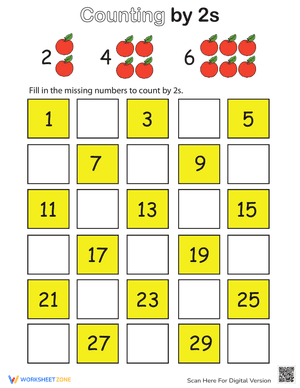
Count-by-5s worksheets introduce a tighter rhythm. Students mark tally groups, label nickels in a coin row, and complete sequences where every other number is hidden. The count-by-2s worksheets close the set with pair-based visuals — socks, mittens, dots on dice — so the idea of skipping feels grounded in a real physical grouping rather than an abstract rule.
Frequent Student Errors Worth Watching For
The most persistent issue is what might be called anchor dependency. A student who recites "10, 20, 30, 40" without hesitation will often freeze when a worksheet opens the sequence at 50 instead of 10. The chant has been memorized from one fixed starting point, not internalized as a rule that applies anywhere along the number line. Dot-to-dot worksheets expose this quickly: when a student connects the wrong dots, the picture doesn't resolve, and they know something went wrong even before they can explain it.
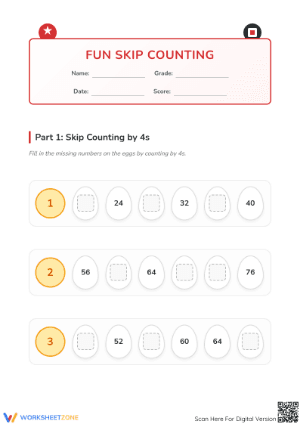
A second pattern shows up specifically in the count-by-5s work. Students will start correctly — 5, 10, 15, 20 — then switch to count-by-10s mid-sequence, writing 20, 30, 40 without registering the shift. This happens because fives and tens share visual overlap on a hundreds chart, and kindergarteners who haven't yet consolidated the two patterns will merge them under pressure. The fill-in-the-blank and missing-number formats across the skip counting printable worksheets for kindergarten set catch this substitution cleanly, and catching it on paper in October is far better than catching it on a winter benchmark.
How to Build These Worksheets Into Your Lesson Plans
Count-by-10s worksheets make strong Monday morning warm-ups through the first semester. Before distributing them, run three minutes of physical counting with the class — clap once per decade, count aloud together, stop at 100. Students who have felt the rhythm in their bodies move it to paper faster than students who go straight to pencil-and-paper work. That kinesthetic lead-in noticeably reduces the number of hands that go up mid-worksheet asking "what comes after 60?"
During math centers, pull a small group with the missing-number number line worksheets. While the rest of the class works independently, this is your clearest window into who is pattern-reasoning versus who is counting silently on fingers between each skip. Watch where students pause: a child who writes 10, holds the pencil still for several seconds, then writes 20 is counting up one at a time — that hesitation tells you the sequence hasn't solidified yet. That observation guides the next instructional move more precisely than any end-of-week quiz.
The dot-to-dot worksheets fit the eight minutes before dismissal pickup on Fridays. Students know the format, the picture reveal keeps them honest about errors, and there's something satisfying to show a caregiver at the door. Skip counting printable worksheets for kindergarten build more durable retention when distributed across the week — Monday morning work, Wednesday center, Friday closer — rather than run back-to-back in a single session. Spaced exposure at this age does more than massed practice to move a pattern from performance into memory.
Standard Alignment
The count-by-10s worksheets address K.CC.A.1, which requires kindergarteners to count to 100 by tens. This standard appears in the fall semester of most district pacing guides, making the set most useful from October through January. Count-by-5s and count-by-2s work sits at the edge of the K standard — CCSS places systematic skip counting primarily in second grade — but early pattern exposure in kindergarten is well-supported by NCTM's number sense recommendations because it builds the base-ten intuition students need before first-grade place value instruction begins. Teachers who extend into count-by-5s and count-by-2s in late winter are reinforcing a readiness foundation, not rushing ahead arbitrarily.
Differentiating These Worksheets Across Learners
Students still working toward count-by-10s fluency do better with the dot-to-dot and cut-and-paste formats than with open fill-in sequences. Those formats constrain the answer choices and reduce the cognitive demand of the task, so the student's attention stays on recognizing the pattern rather than simultaneously retrieving and writing numerals from scratch. Keeping a printed hundreds chart on the desk during independent work removes one retrieval barrier without removing the pattern practice itself.
For students who have secured count-by-10s, skip counting printable worksheets for kindergarten that present count-by-5s and count-by-2s on parallel number lines — asking students to complete both and identify what changed — offer appropriately challenging extension work. Adding a written prompt at the bottom of the worksheet ("How much did the numbers jump each time?") pushes toward pattern articulation without requiring the teacher to build a separate enrichment task from scratch.
Frequently Asked Questions
Which sequence should I introduce first?
Start with count-by-10s. The pattern is the most audible — ten, twenty, thirty sounds like a recognizable family of words — and it aligns directly with K.CC.A.1, the standard most kindergarten benchmark assessments will measure. Once students can begin a count-by-10s sequence from any decade number, not just from 10, move to count-by-5s, then count-by-2s.
How can I tell whether a student has truly mastered a sequence or just memorized a chant?
Ask the student to start the count mid-sequence: "Begin at 40 and count by tens to 100." Students who understand the rule can do this; students who have memorized the song from 10 typically cannot get it started. The fill-in worksheets that open a sequence at a non-zero starting point — showing 50 and 70 with a blank between them — are the fastest written equivalent of that same check.
Can I use these worksheets for students above the typical kindergarten level?
Yes. For students who have already internalized all three sequences, use the worksheets with an added constraint: cover the starting number and ask whether the sequence counts by 2s, 5s, or 10s based on the gap between the given numbers. That task shifts the cognitive work from recall to structural reasoning, which is appropriate for students operating a level ahead without requiring a different resource altogether.
















 Interactive Worksheet Maker
 Quiz Maker
 Word Search Maker
 Crossword Puzzle Maker
 Word Scramble Generator
 Sentence Scramble Generator
 Handwriting Worksheet Generator
 Name Tracing Generator
 Fill In The Blank Generator