


























Views
Downloads
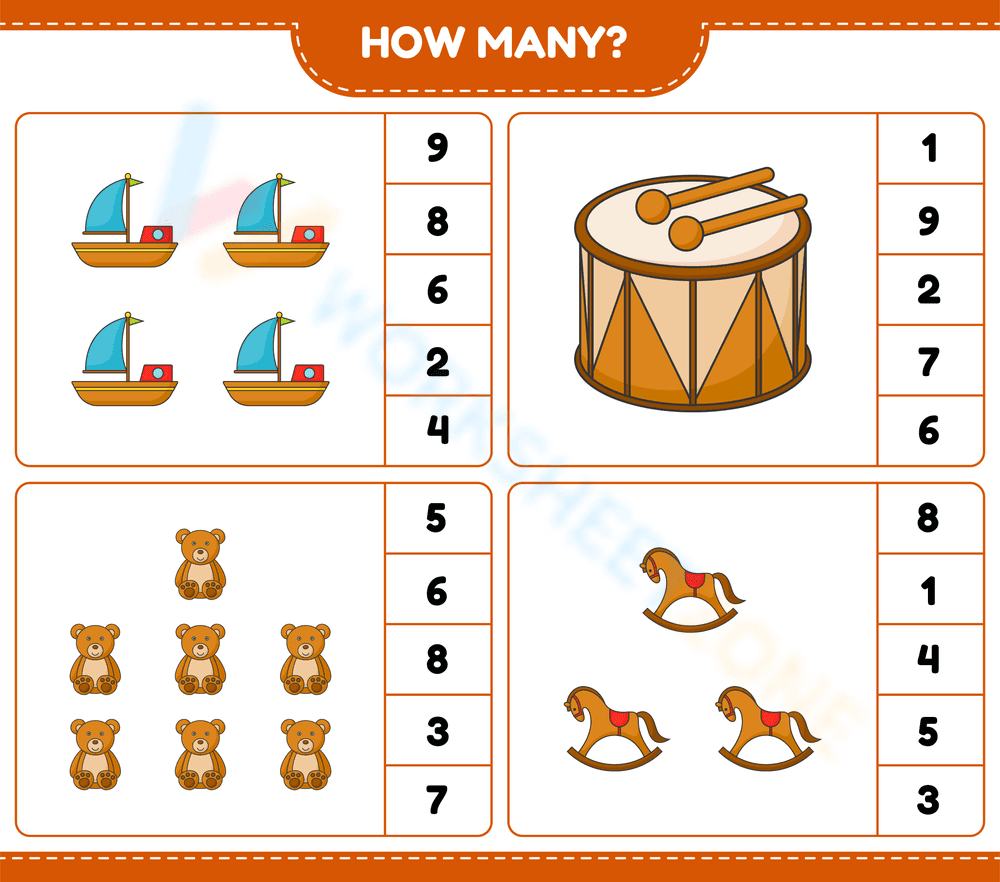

Grade K Counting — Printable No-Prep Worksheet
Paste this activity's link or code into your existing LMS (Google Classroom, Canvas, Teams, Schoology, Moodle, etc.).
Students can open and work on the activity right away, with no student login required.
You'll still be able to track student progress and results from your teacher account.
This Grade K math worksheet gives students focused practice counting objects up to 10 and identifying the corresponding numeral. By matching visual quantities of toys to written numbers, early learners build essential cardinality skills. The clear, visual layout ensures young students can independently demonstrate their foundational number sense.
At a Glance
- Grade: K · Subject: Math
- Standard:
CCSS.MATH.CONTENT.K.CC.B.5— Count to answer how many questions- Skill Focus: Counting objects to 10
- Format: 1 page · 4 problems · No answer key · PDF
- Best For: Independent practice or centers
- Time: 5–10 minutes
Inside this single-page resource, educators will find four counting tasks featuring toy illustrations like boats and teddy bears. Each problem presents a group of objects alongside a vertical number bank. Students count the items and select the correct numeral. The straightforward design eliminates distractions, utilizing large images to support early childhood visual processing and fine motor skills.
Zero-Prep Workflow
This resource is designed for immediate classroom implementation.
- Print (1 minute): The high-contrast PDF prints cleanly in color or grayscale, requiring no special formatting or cutting.
- Distribute (1 minute): Hand out directly to students during math block transitions or place in dry-erase sleeves for reusable center work.
- Review (Under 1 minute): The multiple-choice format allows for rapid visual grading by the teacher or paraprofessional.
Total teacher prep time is under two minutes, making this an ideal, reliable option for emergency sub plans or spontaneous skill reinforcement.
Standards Alignment
This activity is directly aligned to CCSS.MATH.CONTENT.K.CC.B.5, requiring students to count to answer "how many?" questions about things arranged in various configurations. It also supports foundational numeral recognition as students map the spoken number to the written digit. Both standard codes can be copied directly into lesson plans, IEP goals, or district curriculum mapping tools.
How to Use It
Deploy this worksheet during morning work to activate prior knowledge before a math lesson. Alternatively, use it as a quick formative assessment. While students work, observe their one-to-one correspondence: watch if they physically touch each toy as they count, indicating strong tracking skills. Expected completion time is 5 to 10 minutes.
Who It's For
This material is primarily designed for Kindergarten students mastering numbers 1 through 10. It serves as excellent remediation for first graders needing a refresher on basic counting principles, or as an extension for pre-K learners demonstrating early math readiness. Pair this worksheet with physical manipulatives, like counting bears or linking cubes, allowing students who need concrete support to build the quantities before circling the number.
Mastering early counting skills is a critical predictor of later mathematical achievement. This resource targets CCSS.MATH.CONTENT.K.CC.B.5, helping students count to answer how many questions accurately. According to EdReports 2024, instructional materials that provide clear, visual representations of quantities significantly improve early childhood number sense and cardinality. When young learners consistently practice mapping physical or illustrated objects to written numerals, they develop the cognitive pathways necessary for subsequent addition and subtraction tasks. This worksheet provides that exact targeted repetition in a low-stakes, highly engaging format. By isolating the skill of counting up to ten with distinct, recognizable objects, educators can quickly identify which students have solidified their one-to-one correspondence and which require further tactile intervention. Utilizing structured visual arrays ensures that foundational math concepts are firmly established before introducing more complex arithmetic operations.


