


























0
Views
0
Downloads

0.0
0
Save
0 Likes
Share
Add to 20 Tens-Frame Worksheet
0 Views
0 Downloads
Paste this activity's link or code into your existing LMS (Google Classroom, Canvas, Teams, Schoology, Moodle, etc.).
Students can open and work on the activity right away, with no student login required.
You'll still be able to track student progress and results from your teacher account.
Information
Description
What It Is:
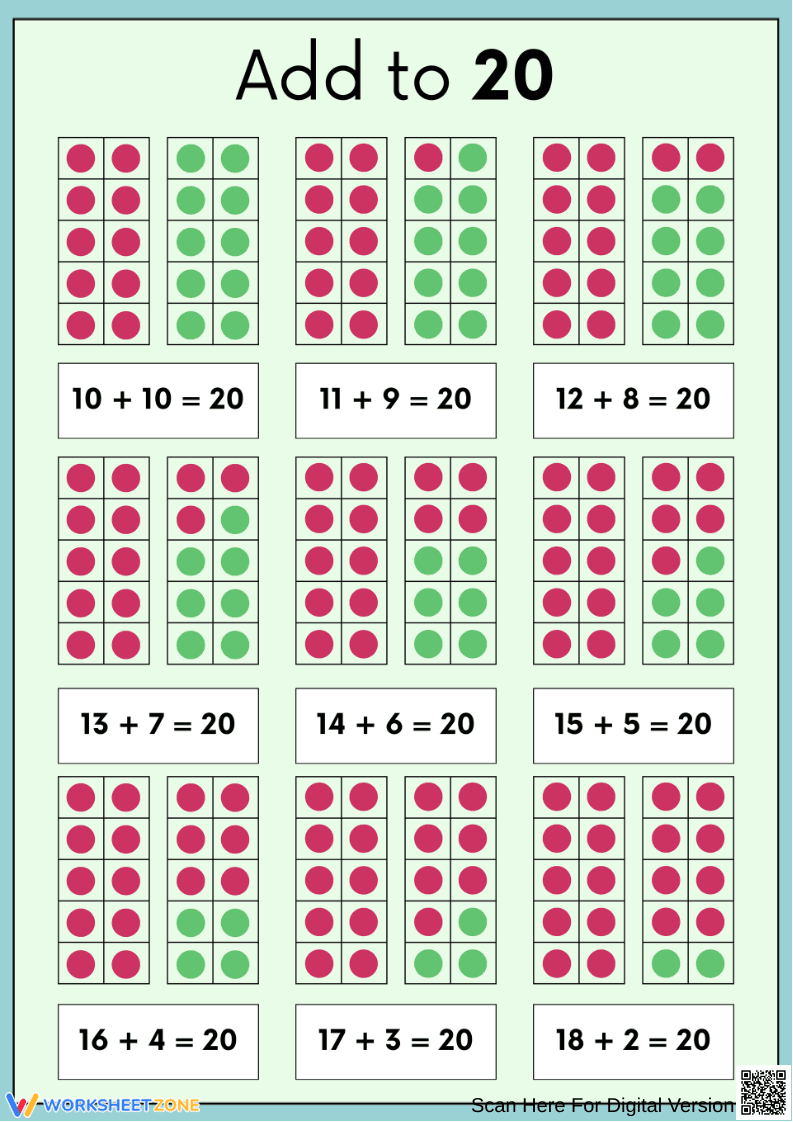
A visual math worksheet that uses tens-frame dot models to help students practice addition combinations that make 20. Each problem shows two tens-frame groups, and learners read the visual model to confirm the matching addition equation.
Why Use It:
This worksheet strengthens number sense and fluency with addition to 20. The visuals help students understand part–whole relationships, see how numbers combine to reach 20, and build confidence with mental math. It is especially effective for early learners who benefit from concrete visual supports.
How to Use It:
• Have students count the dots in each tens frame to identify both parts of 20.
• Read and complete the number sentence under each pair of models.
• Use during independent practice, math centers, small-group lessons, or as a warm-up activity.
Grade Suitability:
Best suited for Grades K–2.
• Beginning learners practicing addition facts to 20.
• Students developing number sense and part–whole understanding.
Target Users:
Teachers, interventionists, homeschool parents, and students working on foundational addition skills.
A visual math worksheet that uses tens-frame dot models to help students practice addition combinations that make 20. Each problem shows two tens-frame groups, and learners read the visual model to confirm the matching addition equation.
Why Use It:
This worksheet strengthens number sense and fluency with addition to 20. The visuals help students understand part–whole relationships, see how numbers combine to reach 20, and build confidence with mental math. It is especially effective for early learners who benefit from concrete visual supports.
How to Use It:
• Have students count the dots in each tens frame to identify both parts of 20.
• Read and complete the number sentence under each pair of models.
• Use during independent practice, math centers, small-group lessons, or as a warm-up activity.
Grade Suitability:
Best suited for Grades K–2.
• Beginning learners practicing addition facts to 20.
• Students developing number sense and part–whole understanding.
Target Users:
Teachers, interventionists, homeschool parents, and students working on foundational addition skills.


