Kindergarten Retelling a Story printable worksheets
These kindergarten retelling a story printable worksheets resources give teachers a concrete anchor point after a read-aloud — a structured place where students put what they heard into a sequence they can see, explain, and talk about with a partner.
What These Worksheets Ask Students to Do
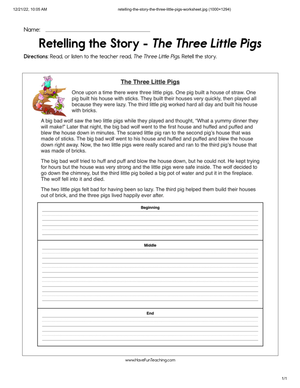
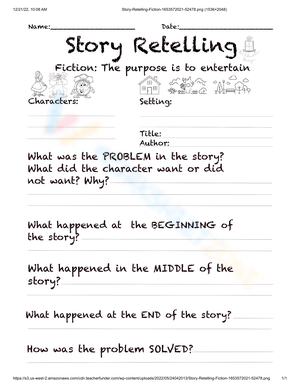
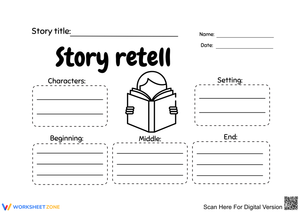
The set targets narrative sequencing at the kindergarten level: identifying characters and setting, then ordering events into beginning, middle, and end. Each worksheet pairs an illustration prompt with a sequencing task, so students who cannot yet write full sentences can still demonstrate understanding by drawing, coloring, or arranging picture cards in the correct order. A few worksheets include sentence starters — "First... Then... Finally..." — for students beginning to represent their thinking in print. The task range runs from simple three-event ordering, matching three pictures to three labeled boxes, to open-ended story maps where students supply the characters and sequence entirely from memory.
Working through the kindergarten retelling a story printable worksheets set over several weeks, students build the habit of asking three questions about any book they hear: Who is the story about? Where does it happen? What occurs in what order? Those three questions are the foundation for all literary analysis that comes later, even if the students won't hear that phrase for years.
Frequent Student Errors Worth Watching For
The error pattern that shows up most consistently is what you might call salience confusion: students place the most vivid or emotionally memorable moment in the "beginning" box instead of the actual first event. A student who loved the scene where the pig builds the brick house will often paste that image first, even right after the class finished discussing that the story opened with the pigs leaving home. This is not a reading failure — it is a developmental one. Five-year-olds organize narratives around emotional impact, not chronology, and the completed worksheet makes that tendency visible so the teacher can address it directly.
A second predictable error: when asked to name a character, students write or draw a location instead. "The forest" ends up in the character box frequently because that image dominated the illustrations. A quick whole-group reminder before students begin independent work — "Who is the story mostly about? A person or animal, not a place" — prevents this confusion from hardening into a habit.
How to Build These Worksheets Into Your Lesson Plans
The most reliable sequence is three steps: read aloud with the book held visible, build an anchor chart on the board that mirrors the worksheet format exactly, then send students to their own kindergarten retelling a story printable worksheets pages. The anchor chart step is the difference between students working with confidence and students staring blankly at the boxes. When the class fills in the chart together — who's the main character, where does the story happen, what's the first thing that occurs — students arrive at their individual worksheets already holding the answers in working memory. They are not starting from zero.
These worksheets also slot naturally into the last ten minutes of a literacy block, giving students a purposeful, hands-on task — cutting, gluing, drawing — without requiring extended independent writing. For a Monday morning routine, a quick five-minute retell conversation before students touch a crayon reactivates a story from a weekend read-at-home and turns the worksheet into a record of that conversation rather than a cold recall test.
Standard Alignment
These worksheets address CCSS.ELA-LITERACY.RL.K.2 — retelling familiar stories with key details and demonstrating understanding of a central message — and CCSS.ELA-LITERACY.RL.K.3, which covers identifying characters, settings, and major events. In classroom terms, RL.K.2 is typically introduced once students have enough read-aloud exposure to understand that stories follow a shape: they start somewhere, something happens, and then they end. RL.K.3 runs alongside it all year because sequencing without knowing who and where is not really retelling. The two standards are inseparable in practice, and these worksheets treat them that way.
Adjusting the Worksheets for a Range of Learners
For students still developing fine motor control, the cut-and-paste format can become a barrier before it becomes a comprehension task. Give those students pre-cut picture cards and ask them to place — rather than glue — the cards in order first. You see the thinking without the physical frustration of scissor work slowing everything down. This also keeps the activity diagnostic: if a student arranges the cards incorrectly, you know it's a comprehension gap, not a motor gap.
Students who are already reading simple texts benefit from the open-ended story maps and sentence-starter worksheets, which ask them to generate their own retell using temporal language rather than sequence a given set of pictures. For English language learners, the illustration-heavy worksheets are particularly valuable — drawing communicates comprehension when written words create a language bottleneck. Pairing the completed worksheet with a brief oral retell, even partly in the student's home language, gives a fuller picture of what they actually understood.
Frequently Asked Questions
Do these worksheets work with any picture book, or do they require specific titles?
The formats work with any picture book that has a clear, linear plot. Simple folk tales and cumulative stories — The Three Billy Goats Gruff, The Gingerbread Man, anything with a repeating structure — are strong early choices because the event sequence is transparent and the repetition reinforces it. Avoid books with flashbacks or multiple storylines until students have the beginning-middle-end structure firmly internalized.
How many times should students hear a story before completing a retelling activity?
Twice is a reasonable floor. The first read builds vocabulary and emotional engagement. The second read, done with deliberate pauses to discuss what's happening, gives students the retrieval foundation the worksheet requires. Some students need the book open and visible during the task — keeping it accessible is not cheating, it's modeling how readers use a text as a resource, which is a transferable behavior worth reinforcing.
Can these worksheets function as formative assessment?
Consistently, yes. A student who always puts the most exciting event in the "beginning" box signals a specific instructional need around chronological thinking. A student who sequences pictures correctly but leaves the character box blank needs targeted review of story element vocabulary. These kindergarten retelling a story printable worksheets resources generate written evidence that a brief conference alone doesn't always capture — and at the whole-class level, teachers leave the lesson with twenty or more data points in hand at once.
Clear All