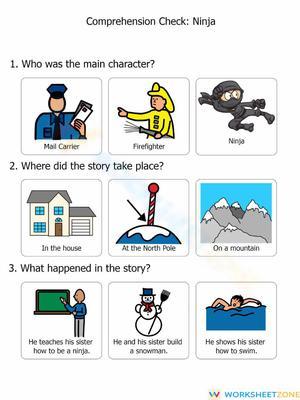
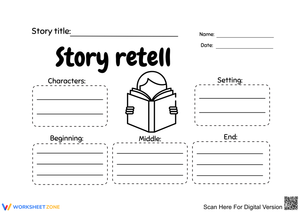
These kindergarten story elements printable worksheets move students from passive listeners to active analyzers — a shift that typically lands around October, once read-alouds have become a daily anchor and teachers start noticing which students can retell a story and which ones still summarize every book as "it was good." Each worksheet in the set addresses characters, setting, or story sequence through drawing prompts, cut-and-paste activities, and simple graphic organizers that work whether students are still learning to grip a pencil or already writing phonetically.
The Specific Skills Each Worksheet Targets
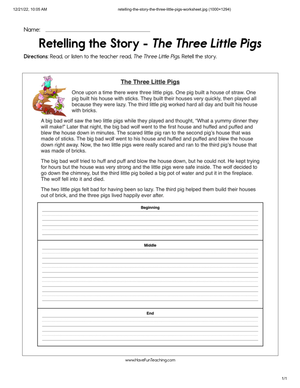
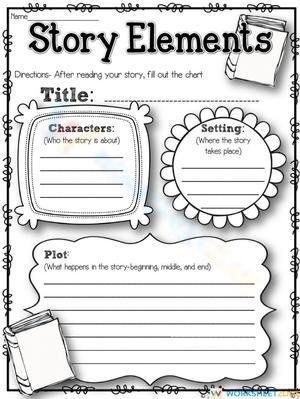
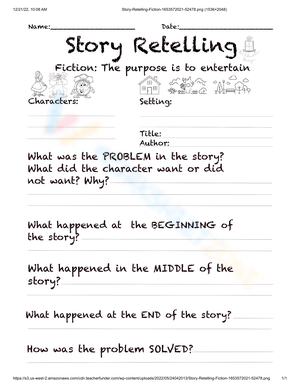
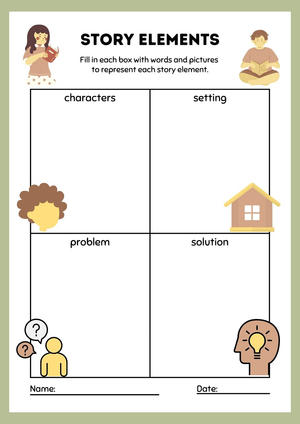
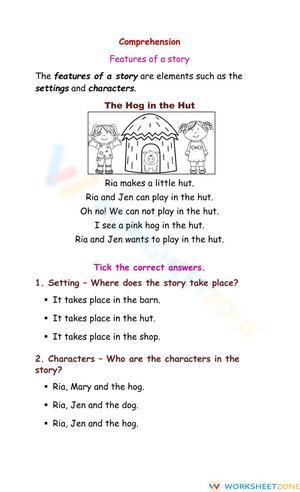
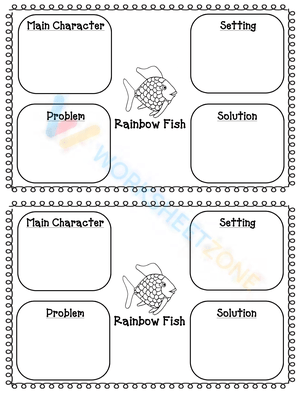
Each worksheet in this set of kindergarten story elements printable worksheets isolates one core narrative component before asking students to combine elements on a single graphic organizer. Character worksheets ask students to draw and label who appears in a story, distinguish main characters from background characters, or sort picture cards into characters versus objects. Setting worksheets feature blank frames where students sketch the location using details from the read-aloud — time of day, weather, indoor versus outdoor — rather than a generic drawing of a house or park. Story sequence worksheets use three-box maps where students draw what happened at the beginning, middle, and end, which produces a different kind of retelling than verbal discussion alone.
Several worksheets combine two elements at once:
- T-charts for sorting character images versus setting images
- Story maps that include a character box alongside the three-part event sequence
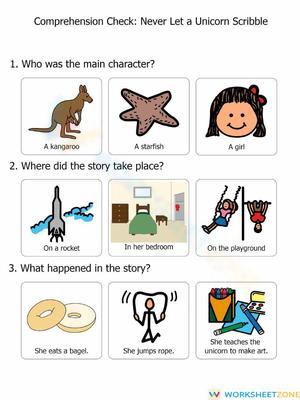
- Matching activities connecting a picture of a character to the setting where that character appeared
These combination worksheets are most effective after students have practiced each element separately. Moving to combined tasks too quickly is where comprehension gaps tend to surface first.
Frequent Student Errors These Worksheets Bring to the Surface
Setting causes the most confusion at this age, and the error follows a consistent pattern: students name a character as the setting. Ask a kindergartner where The Very Hungry Caterpillar takes place, and a significant number will answer "the caterpillar" — they interpreted the question as "what is this book about?" rather than "where does it happen?" On a setting worksheet, that same confusion shows up as a drawing of Eric Carle's caterpillar inside the setting frame. That is actually diagnostic. It tells you exactly what the student does not yet understand in a way that a verbal question rarely captures cleanly.
Sequence errors follow their own logic. Most students remember the ending — it is memorable and the most recent part they heard. The beginning and middle collapse together. On three-box story maps, it is common to see two nearly identical drawings in boxes one and two, both representing the same moment, while box three holds the climax. Reviewing completed maps before whole-group share time creates a natural window for pulling a small group for a quick reteach before the misconception solidifies.
Where These Worksheets Fit in the Literacy Block
The most reliable placement is immediately after a read-aloud, while the story is still in working memory. Students complete the worksheet at their seats while the teacher circulates — which also creates a natural observation window before the transition to centers. If the read-aloud runs long, as it often does on Mondays when students want to process the weekend before settling into work, the worksheet shifts to the first task of small-group time instead.
During guided reading, a short decodable text followed by a single-element worksheet — character drawing only, or setting only — reinforces comprehension without overloading students who are simultaneously working on decoding. The handoff from oral identification to independent documentation is where the learning transfers. Using kindergarten story elements printable worksheets as center tasks works best when the source text is one the class has already heard several times, so students spend their cognitive energy on identifying story elements rather than processing an unfamiliar plot.
Adjusting These Worksheets for Mixed-Ability Classrooms
The drawing-first format naturally accommodates a wide range of writing development. A student who sketches a detailed scene and adds phonetic labels is doing more analytical work than a student who writes a single copied word and moves on. Most worksheets in the set do not require a separate modified version for lower-readiness students — the open drawing format handles that variation on its own.
For students who finish quickly, verbal extensions work well: "Add a speech bubble showing what your character is thinking" or "Write one word that describes the setting." These are given as spoken prompts, not additional worksheets. For students who struggle to recall story details independently, leaving the picture book open during the activity is a genuine instructional move — it teaches reference skills alongside story element identification, which is its own literacy goal at this stage. Several kindergarten story elements printable worksheets in the set include a small image bank at the bottom, with illustrations sorted by story category, specifically for students who need a visual anchor to get started.
Standard Alignment
These worksheets address CCSS.ELA-LITERACY.RL.K.3, which asks kindergarten students to identify characters, settings, and major events in a story with prompting and support. That phrase — "with prompting and support" — is precisely why graphic organizers are the right tool here. The standard does not expect independent written analysis; it expects students to respond when a teacher asks guiding questions. Worksheets built around drawing and physical manipulation mirror exactly the kind of supported response the standard describes. Setting worksheets also connect to CCSS.ELA-LITERACY.RL.K.7, which asks students to use illustrations alongside text to describe where a story takes place — a skill that the setting-frame format practices directly.
Frequently Asked Questions
What story elements do these worksheets cover?
The set addresses characters, setting, and story sequence — specifically the beginning, middle, and end structure. Worksheets isolate each element individually, and several combine two elements, such as a character-and-setting T-chart or a full story map that includes spaces for all three components.
Can these worksheets be used with any picture book?
Yes. Each worksheet pairs with any narrative picture book rather than a specific title. The prompts — "draw the main character," "show where the story takes place" — apply across texts. Many teachers keep a folder of these worksheets near the classroom library and pull whichever one fits after the day's read-aloud.
How do I assess comprehension when students cannot yet write?
Drawing is the primary mode of response throughout the set, so a student who is not yet writing is not at a disadvantage. Assessment at this level means sitting beside a student for two minutes and asking them to walk through their drawing — "tell me about who you drew here" — while noting what they say. That verbal explanation alongside the drawing gives a fuller picture of comprehension than a written label would at this stage.
When during the year should story sequence worksheets be introduced?
Single-element worksheets — character drawing prompts and cut-and-paste sorts — work from the second or third week of school. Three-box sequence maps are better introduced after students have discussed beginning, middle, and end verbally several times during whole-group read-alouds. Most teachers bring in sequence worksheets around late September or October, once the concept has already been named and practiced as a class.












 Interactive Worksheet Maker
 Quiz Maker
 Word Search Maker
 Crossword Puzzle Maker
 Word Scramble Generator
 Sentence Scramble Generator
 Handwriting Worksheet Generator
 Name Tracing Generator
 Fill In The Blank Generator