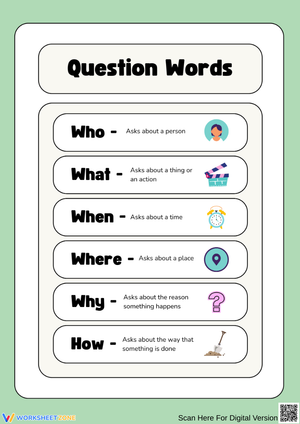
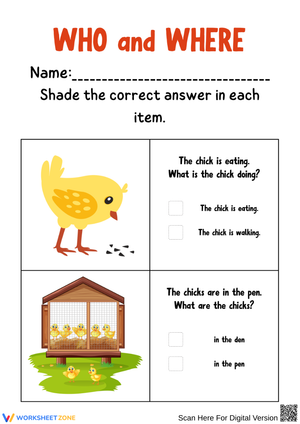
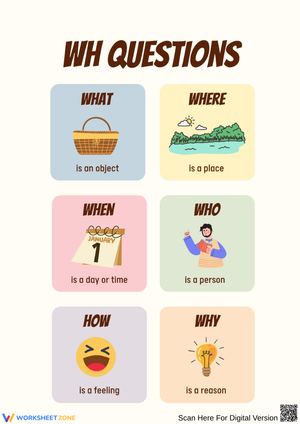
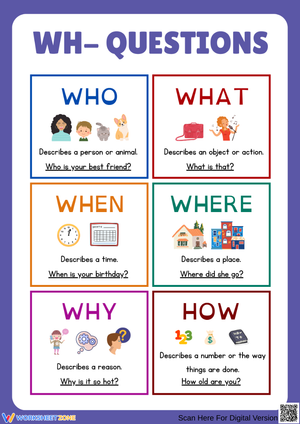
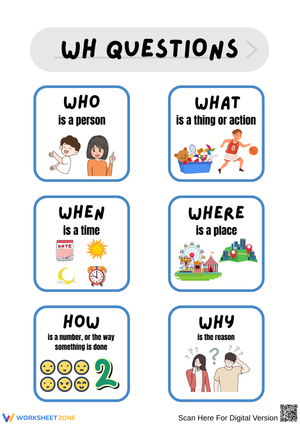
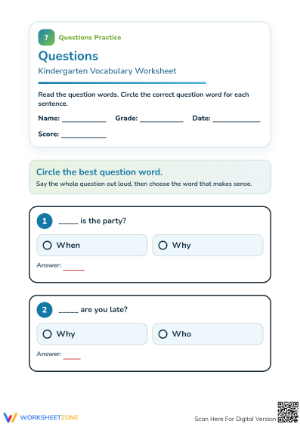
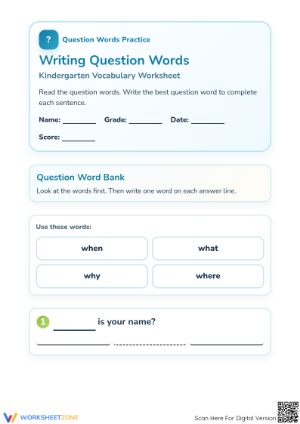
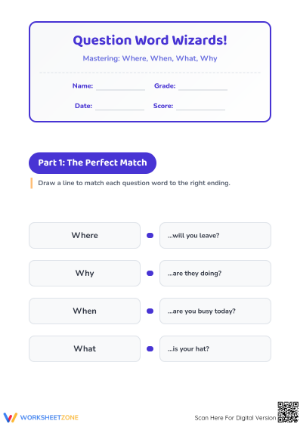
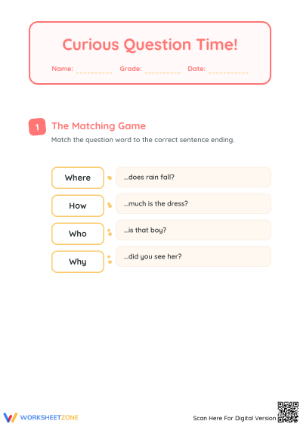
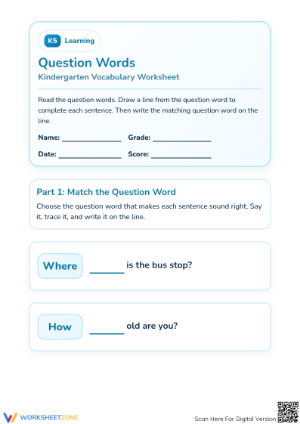
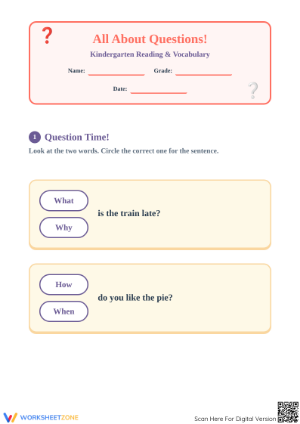
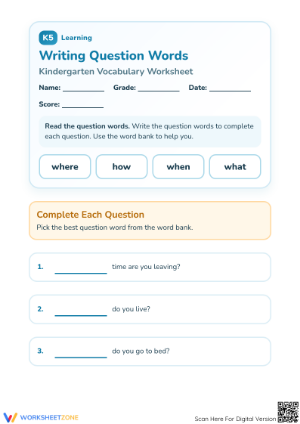
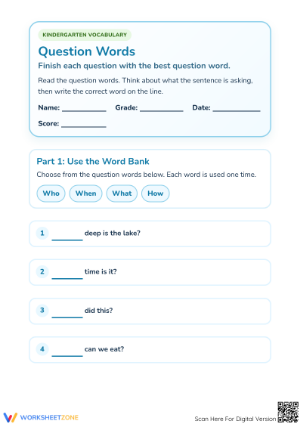
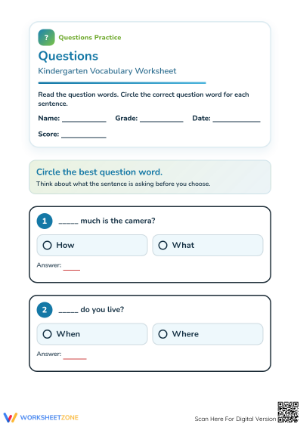
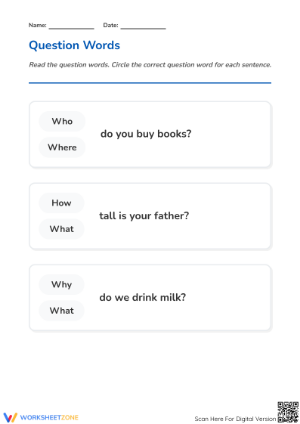
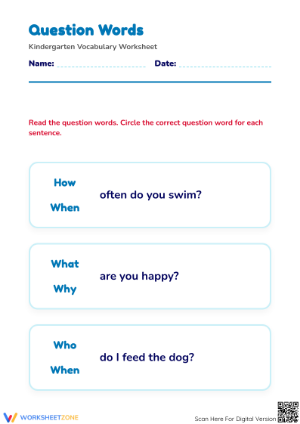
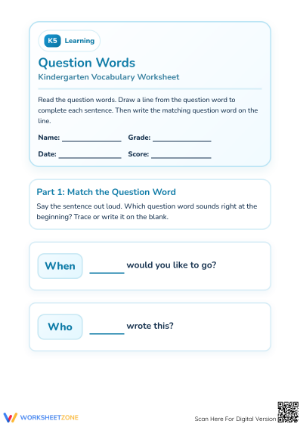
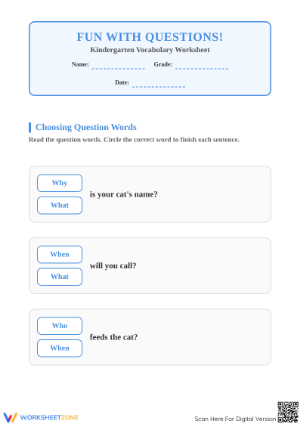
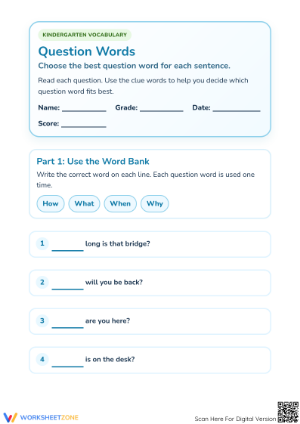
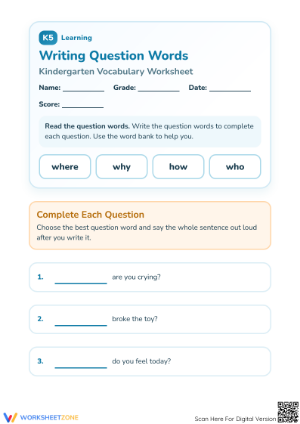
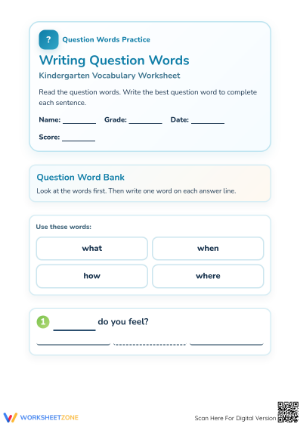
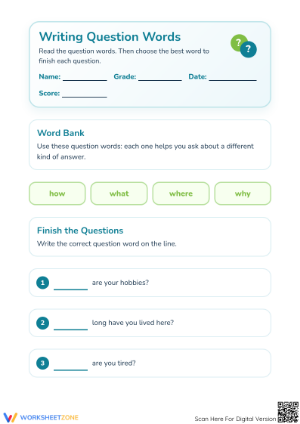
These wh questions worksheets for kindergarten give teachers a concrete entry point into one of early literacy's most foundational comprehension skills — helping five-year-olds understand what a question is actually asking before they can reliably decode the words on a page. Each worksheet uses clear illustrations and minimal text so that students practice identifying who, what, where, when, and why details from pictures and short read-aloud passages. The set moves from concrete, object-focused tasks early in the year toward more abstract reasoning as oral language and thinking develop.
Skills Covered Across the Set
Each worksheet targets one question word or a deliberate pairing of two, with the format matched to the cognitive demand. For who and what, students circle, color, or point to a picture representing the correct answer — a person at a birthday party, an object on a shelf. These early tasks require almost no reading and build the habit of treating illustrations as information sources, a habit that carries well past kindergarten.
The where worksheets move into spatial vocabulary: students sort pictures of locations or match a character to a setting shown in a scene. For when and why, the tasks add more picture support — sequencing cards, cause-and-effect image pairs, and clock or sun-and-moon icons for time of day — because those concepts are genuinely harder. Formats across the set include:
- picture sorting by category (people versus places, cause versus effect)
- cut-and-paste matching activities
- circle-the-correct-picture response tasks
- short read-aloud comprehension with picture-choice answers
- mixed-review question-type identification, where students must first recognize what the question is asking for before selecting an answer
Building These Worksheets Into Your Lesson Week
Wh questions worksheets for kindergarten fit cleanly into three spots in the daily schedule. The most effective early-year use is a whole-group walkthrough projected on a whiteboard during the literacy block — teacher reads the question aloud, students discuss what the question is looking for before anyone marks anything, and the class arrives at the answer together. That five-to-eight-minute discussion does the actual teaching; the worksheet becomes the record of what students understood, not the instruction itself.
In small-group rotations, these worksheets let you run two instructional tracks at once: students working on who and what are solidifying concrete vocabulary, while a group ready for when and why is doing genuine inferential reasoning. Sending a familiar worksheet home — one the class already walked through together — gives parents a specific, low-stakes way to ask the same questions aloud at the kitchen table, which is where a lot of the real language practice happens for students who need repetition.
A sequencing approach worth trying: spend a full week on a single question word. Every read-aloud, every morning message, and every worksheet in that week centers on one word only. When students stop mixing up who and what responses without being corrected, move to the next word. The mixed-review worksheets then function as a genuine formative check rather than just more practice.
Student Errors Worth Catching Before They Calcify
The most consistent error pattern is students answering with the right category of information but in response to the wrong question word. A student who has who solid will look at "Why did the boy fall?" and answer "the boy" — not because they ignored the fall, but because they defaulted to the question-word type they know best. That error signals the student hasn't yet attached meaning to why; they're pattern-matching on "there must be a person in the picture."
The when versus why confusion looks different. A student asked "Why did the girl cry?" will sometimes respond "at night" — a when answer — because both words feel equally abstract, and a bedroom scene suggests time of day more visually than it suggests cause. At that point, more worksheet repetition rarely helps. Going back to oral language does: act out a cause-and-effect moment — knock over a cup of blocks, then ask "why did those fall?" — and return to the worksheet once students can answer that question aloud without paper in front of them.
Adjusting Each Worksheet for the Range of Learners in Your Class
Wh questions worksheets for kindergarten cover a genuinely wide span of readiness within one classroom. A student with strong pre-literacy skills may be ready to write one-word answers on lines provided; a student developing English or one with a language delay needs the same worksheet with text-based answer choices replaced by picture choices. Printing one worksheet at two response levels — circling a picture versus writing on a line — handles mixed readiness without building an entirely separate activity set.
For students ready to push further, cover the question word with a sticky note, show the illustration only, and ask them to generate their own question about the scene. Producing a question is a harder task than answering one, and it's a natural next step for students moving quickly through the basic formats.
On the other end, students who freeze in front of any paper-based task respond well to completing the worksheet alongside a partner first, then finishing their own copy. This doesn't require a modified version — just a different grouping arrangement during that rotation.
Frequently Asked Questions
When in the kindergarten year should I introduce these worksheets?
Start with who and what in the first month, using worksheets that rely entirely on pictures. Most kindergarteners can answer these questions orally before they can decode text, so the worksheet provides a visual anchor for a skill they're already developing in conversation. Wh questions worksheets for kindergarten that progress from picture-only formats to short decodable text can stay in rotation all year as reading skills catch up to oral language ability.
How do I know when a student is ready to move from who and what to where?
Watch for self-correction on the who and what worksheets. When a student marks the wrong picture, pauses, rechecks the question word, and switches answers without a prompt, the question word has real meaning for them. Students who are still guessing or who circle answers before reading the question word need more isolated practice with those two words before a third is added.
Can these worksheets be used in speech-language therapy alongside classroom instruction?
Yes, and coordination between the classroom teacher and an SLP around this skill is worth the effort. When both settings use the same picture formats and question-word icons — a sun for when, a magnifying glass for where — students don't have to decode a new visual system every time they switch rooms. Consistent cues reinforce meaning faster than varied formats across two settings.












 Interactive Worksheet Maker
 Quiz Maker
 Word Search Maker
 Crossword Puzzle Maker
 Word Scramble Generator
 Sentence Scramble Generator
 Handwriting Worksheet Generator
 Name Tracing Generator
 Fill In The Blank Generator