


























Views
Downloads


Printable Question Words Worksheet | Grade K ELA
Paste this activity's link or code into your existing LMS (Google Classroom, Canvas, Teams, Schoology, Moodle, etc.).
Students can open and work on the activity right away, with no student login required.
You'll still be able to track student progress and results from your teacher account.
Mastering interrogatives is a foundational step for early learners developing communication skills. This Kindergarten English Language Arts worksheet provides clear, visual practice for identifying and using common question words. Students move from basic matching to creative drawing tasks, ensuring they understand how to ask for specific information in daily conversations.
At a Glance
- Grade: Kindergarten · Subject: ELA
- Standard:
CCSS.ELA-LITERACY.L.K.1.D— Understand and use question words (interrogatives) like who, what, where, when, why, and how- Skill Focus: Interrogative identification and application
- Format: 4 pages · 11 problems · Answer key included · PDF
- Best For: Literacy centers and independent skill practice
- Time: 15–20 minutes
What's Inside
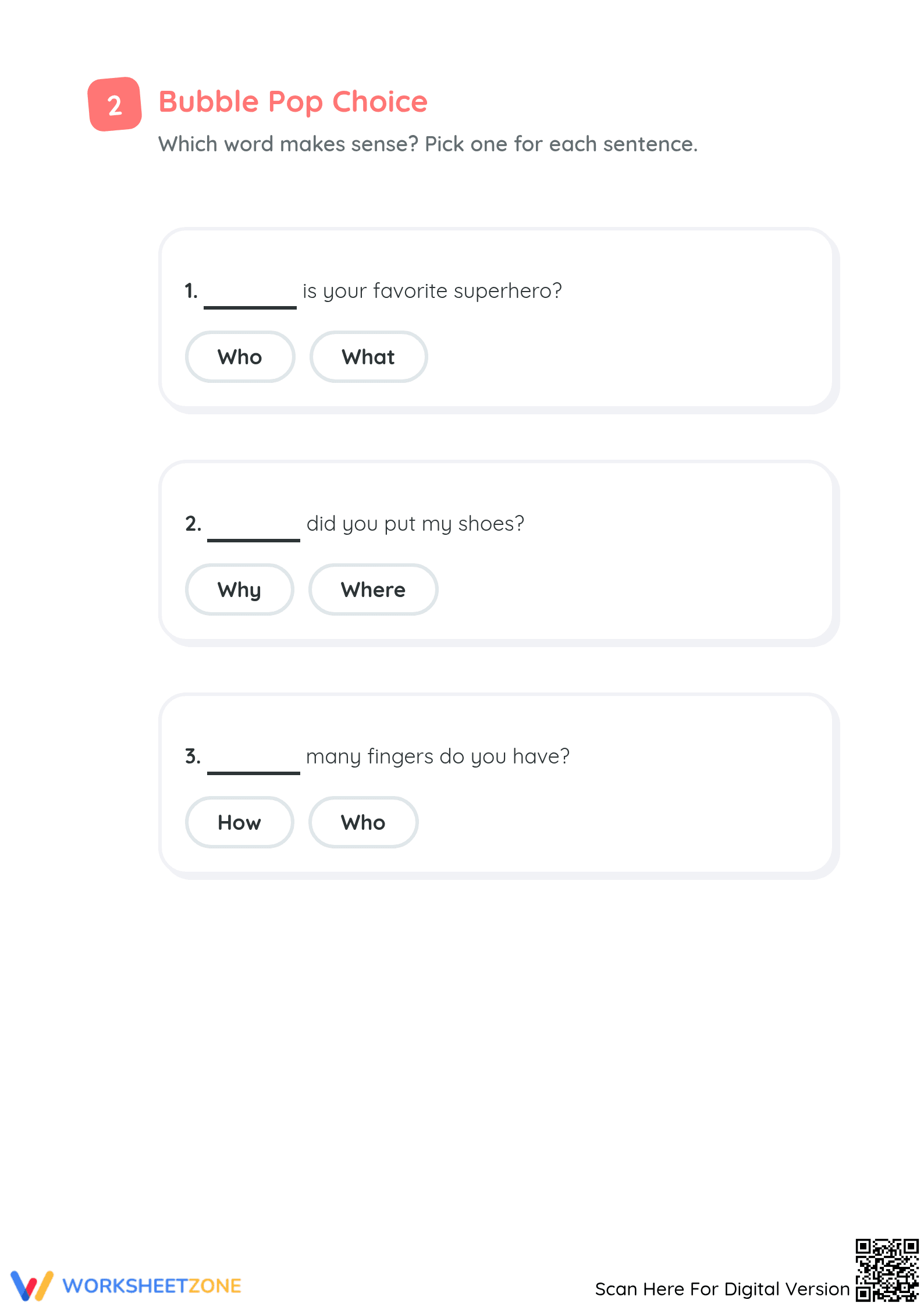
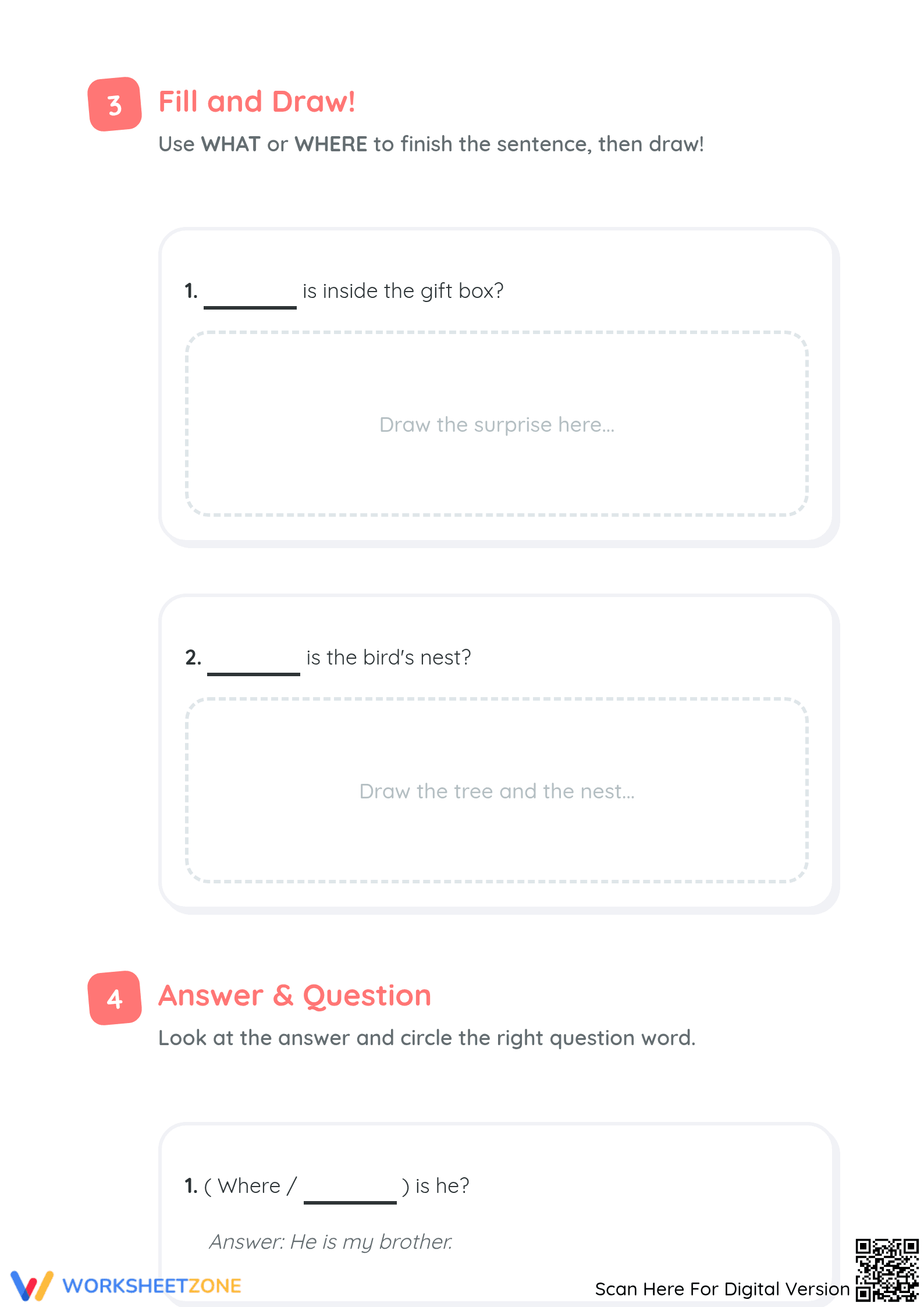
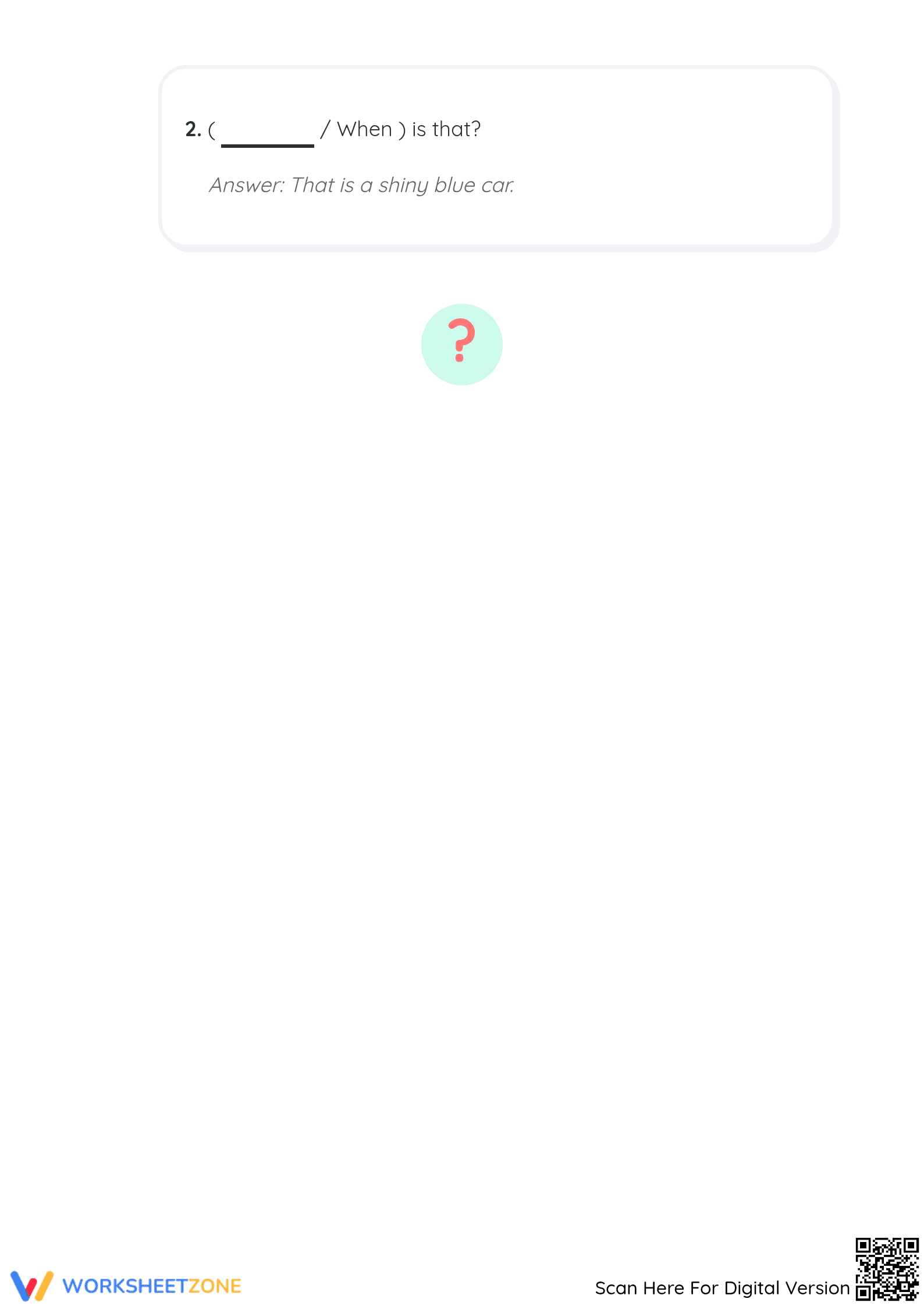
This comprehensive 4-page PDF resource includes 11 unique problems spread across four distinct activities. The worksheet features matching games, multiple-choice "bubble pop" selections, fill-in-the-blank sentences paired with drawing boxes for visual reinforcement, and context-based circling tasks. A full answer key is provided to facilitate quick grading or student self-correction.
Skill Progression
- Guided Practice: Students begin with "The Matching Game," connecting primary question words to their logical sentence endings with visual cues for immediate success.
- Supported Practice: Learners transition to "Bubble Pop Choice" and circling tasks, where they must evaluate which interrogative makes sense within a provided sentence structure.
- Independent Practice: The final stage requires students to select the correct word and illustrate the answer, demonstrating a deeper conceptual grasp of the information being requested.
This progression follows a gradual-release model, moving from recognition to application and creative representation.
Standards Alignment
The primary focus is CCSS.ELA-LITERACY.L.K.1.D: "Understand and use question words (interrogatives) (e.g., who, what, where, when, why, how)." The activities also support broader conventions of standard English and early literacy development. Both standard codes can be copied directly into lesson plans, IEP goals, or district curriculum mapping tools.
How to Use It
Introduce this worksheet during a whole-group lesson on asking questions. After modeling how "Who" refers to people and "Where" refers to places, assign the matching task as a check for understanding. Use the "Fill and Draw" section as a formative assessment; observe if students' drawings correctly correspond to the interrogative used. Expected completion time is 20 minutes.
Who It's For
This resource is designed for Kindergarten students, but is highly effective for English Language Learners (ELL) and students in first grade requiring remedial support. The visual components make it an excellent choice for a literacy workstation or as a supplemental activity following a read-aloud focused on inquiry.
Instructional design for early literacy emphasizes the importance of explicit interrogative training to bridge the gap between simple decoding and active comprehension. According to Fisher & Frey (2014), the "gradual release of responsibility" is vital when introducing abstract linguistic concepts like question words to Kindergarteners. By moving from recognition (matching) to production (writing and drawing), students build the cognitive scaffolds necessary to process complex informational texts. This worksheet targets CCSS.ELA-LITERACY.L.K.1.D through 11 multi-modal tasks that engage visual and verbal processing centers. Recent NAEP data indicates that students who master basic inquiry structures early demonstrate higher reading proficiency in later primary grades. This resource provides the structured repetition required for mastery, allowing educators to accurately measure progress through evidence-based practice. The inclusion of a drawing component aligns with research suggesting that dual-coding information enhances long-term retention in early childhood education settings.


