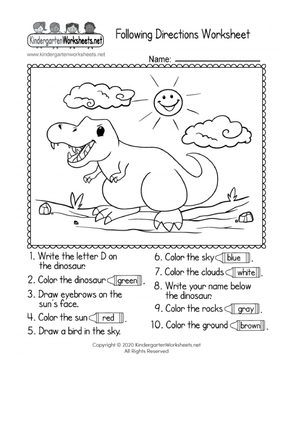
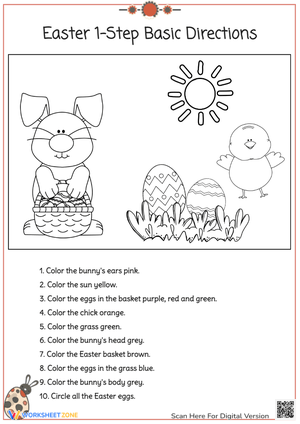
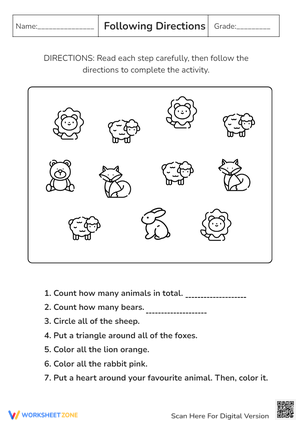
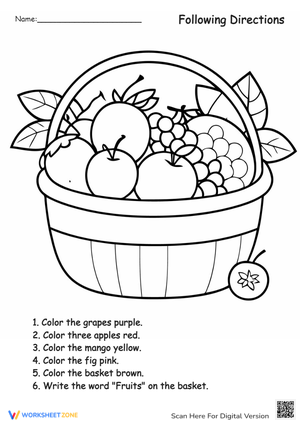
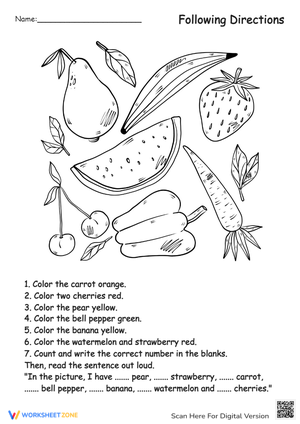
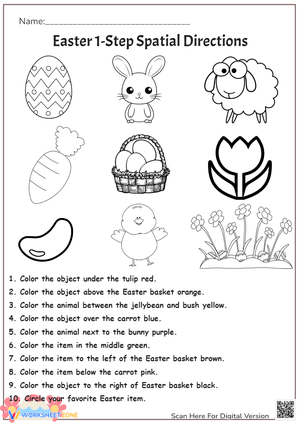
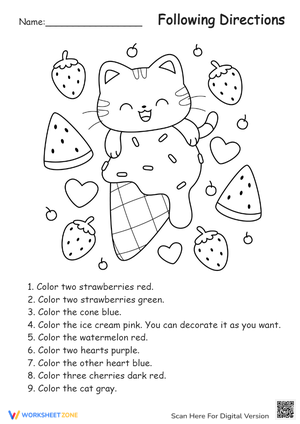
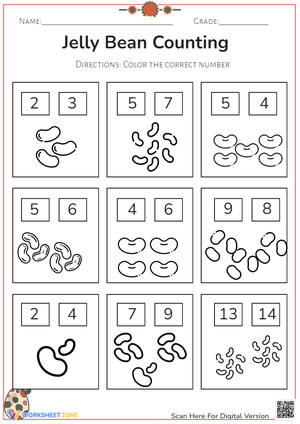
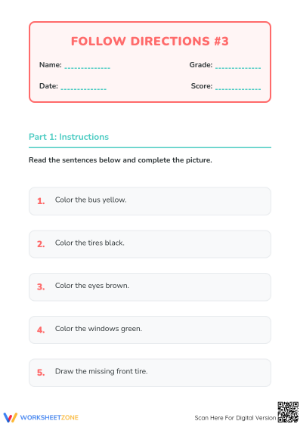
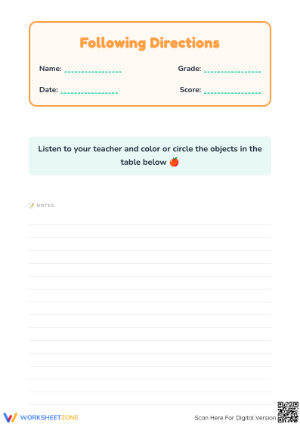
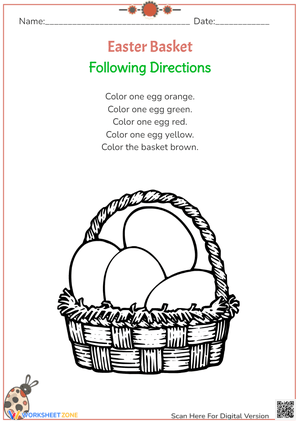
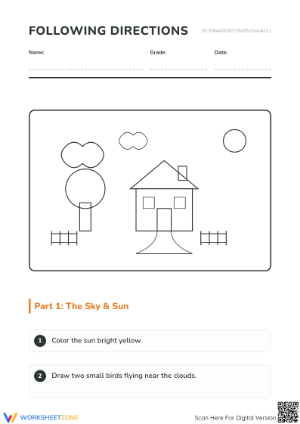
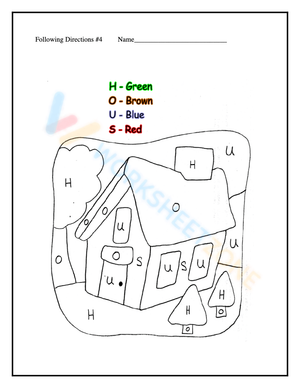
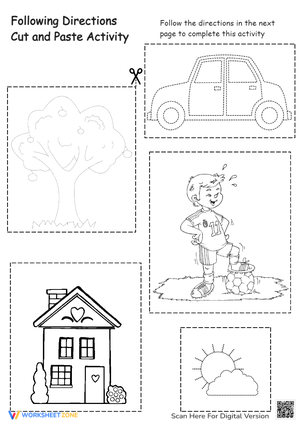
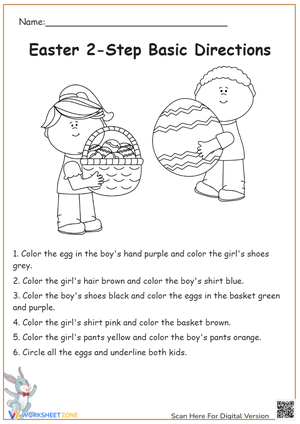
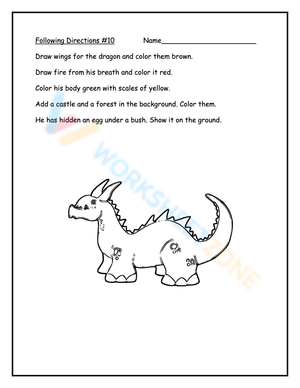
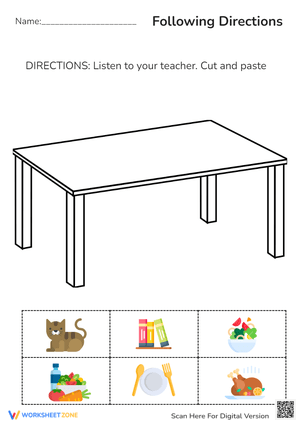
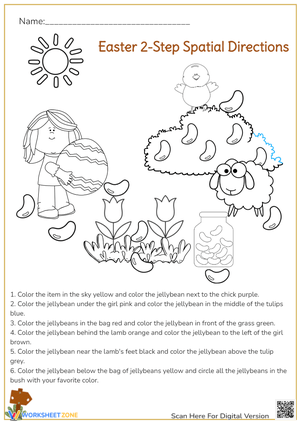
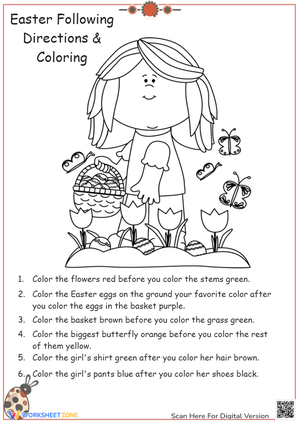
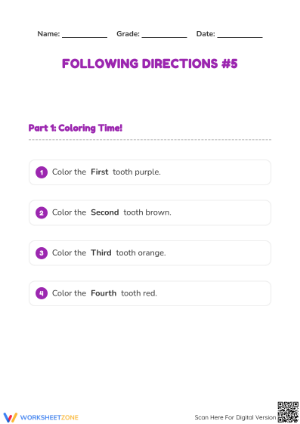
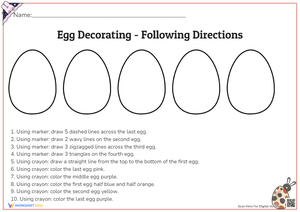
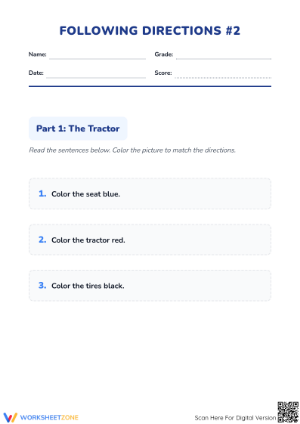
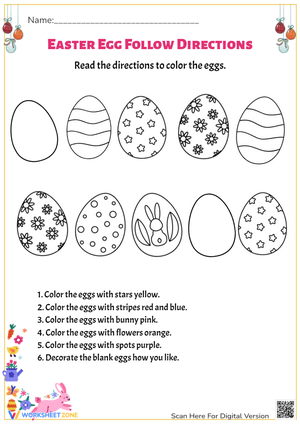
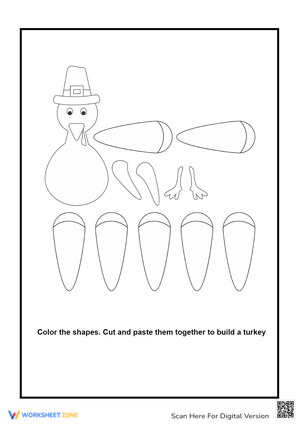
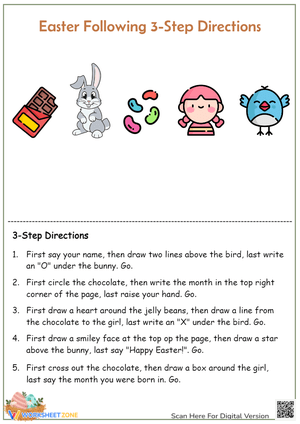
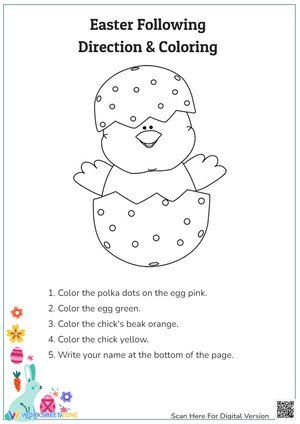
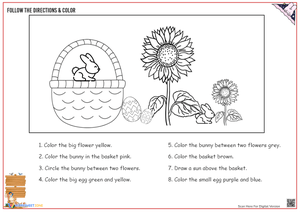
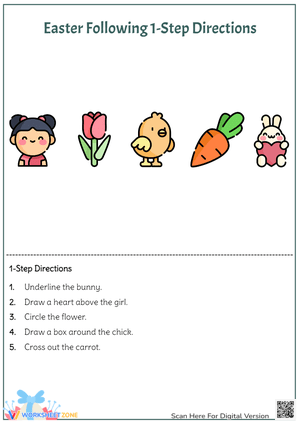
These following directions worksheets for kindergarten give teachers a structured way to build one of the most foundational classroom skills — the ability to receive an oral direction, hold it in working memory, and carry it out before the next instruction arrives. The set moves from single-step tasks to two-step sequences, covering positional language, color identification, and basic shapes throughout.
What Each Worksheet Targets
The skills across this set go well beyond simple compliance. Each worksheet exercises the intersection of auditory processing, working memory, and fine motor coordination — three systems that kindergarteners are developing simultaneously and that rarely line up at the same pace. The most common task type asks students to mark, color, or draw based on a spoken direction. Others require students to apply a sequence: first do this, then do that. Several worksheets focus specifically on positional vocabulary — "above," "below," "beside," "between," "in front of" — because that language is the raw material for both spatial reasoning in math and literal comprehension in reading.
- Single-step oral direction tasks using familiar classroom objects and animals
- Two-step sequential instructions that require students to track order, not just content
- Positional language exercises moving from basic terms ("on," "in," "under") to directional ones ("left," "right")
- Fine motor integration: coloring within constraints, drawing in specific locations, circling versus underlining on command
- Listening tasks that isolate one detail — color, size, or position — from a slightly longer verbal instruction
Mistakes Students Make That These Worksheets Help You Catch
The most consistent error is position confusion, and it surfaces in a specific pattern. Students who accurately respond to "on" and "in" almost always handle "under" correctly as well, because those three words form a natural cluster in how children learn spatial language. The trouble begins with "above" and "below." These terms sound unrelated to each other, and many five-year-olds assign them almost interchangeably until a teacher makes the spatial relationship visible. A student who draws the cloud below the house instead of above it isn't being careless — she hasn't yet connected the word "above" to the concept of higher physical position in a reliable way.
"Left" and "right" are in a category of their own. Most kindergarteners cannot reliably distinguish them until late in the year, and worksheet practice alone will not fix that — it requires paired physical anchoring, such as the raised-left-hand "L" trick or a consistent classroom reference point like "the door side." When a direction says "circle the animal on the right side of the box," watch for students who choose correctly but are actually reading body language or copying a neighbor. The worksheets surface this pattern; the instructional response still has to happen verbally and physically alongside the written task.
Smart Ways to Work These Worksheets Into Your Week
These worksheets work best when the teacher is the voice behind the directions — not a printed prompt on the worksheet itself. For kindergarteners, that means the worksheet functions as the student response surface, not a self-directed task. In a small group of four or five students, a teacher can deliver each direction at a natural pace, pause, scan for hesitation or confusion, and repeat the direction only once before moving on. That single-repetition limit is deliberate: it conditions students to listen the first time, which is the actual behavior the classroom needs.
The most reliable slot in the day is the first fifteen minutes after morning meeting. Students are seated, routines have settled, and the listening window is at its widest before fatigue accumulates. Teachers who try these worksheets during afternoon transitions report more variable results — not because the worksheets change, but because auditory processing in five-year-olds drops noticeably after lunch. The set also fits cleanly inside a literacy center rotation, where a paraprofessional leads the small group while the teacher works elsewhere. In that format, recording each direction as a short audio clip keeps delivery consistent across groups and removes the variability that comes from different adults pausing and pacing differently.
One technique worth trying before students put pencil to paper: have them "air-draw" the action first. If the direction is to draw a line under a picture, students move their hand in a sweeping motion beneath the image before touching the worksheet. That brief kinesthetic step reduces errors on positional tasks by a meaningful margin, particularly for students still building the vocabulary.
Differentiating These Worksheets Across Ability Levels
The natural entry point for students still working on single-step retention is to strip each direction down to its core verb and target: "Color the star yellow." Positional terms, size qualifiers, and color conditions can be added one element at a time as the student shows consistent mastery. For students who move through single-step tasks quickly, the two-step directions in the set give them room to grow without requiring separate materials. The key variable is the pause between steps — some students need the teacher to deliver each step separately and confirm completion before the second step is given.
Students receiving support from a speech-language pathologist benefit from using the following directions worksheets for kindergarten as a bridge between pull-out sessions and classroom instruction, since the SLP and classroom teacher can work from the same vocabulary and task types. Students acquiring English as an additional language often need a quick physical demonstration paired with the oral direction — the teacher colors a sample square on the board while stating the direction aloud. That pairing isn't simplifying the task; it's how spatial vocabulary is actually acquired. The listening demand stays fully intact.
Standard Alignment
These worksheets align primarily with the Listening and Speaking strand of the Common Core State Standards for Kindergarten, specifically CCSS.ELA-LITERACY.SL.K.2 — confirming understanding of information presented orally or of a text read aloud. In classroom terms, that standard describes exactly what happens here: a student receives a verbal direction and demonstrates comprehension by producing a physical response, with no printed prompt to fall back on. Positional language tasks also connect to CCSS.MATH.CONTENT.K.G.A.1, which asks students to describe the positions of objects using terms such as above, below, beside, in front of, behind, and next to. Teachers working toward both ELA and math standards can draw on this set across content blocks rather than treating it as a standalone listening activity.
Frequently Asked Questions
Are students supposed to complete these worksheets on their own?
No — and that distinction is important to communicate to any adult leading the activity. The directions are delivered orally, so students respond to what they hear, not to printed text. Handing a worksheet to a student to complete independently removes the entire listening component. The written surface captures the student's response; the teacher's voice carries the instruction.
How many steps can a kindergartener reasonably follow at once?
Most kindergarteners arrive in the fall able to follow one-step directions reliably. Two-step directions become manageable for many students by mid-year, though the range is wide. Three-step directions are worth introducing only after a student shows consistent accuracy on two-step tasks — for typical developers, that's usually the final quarter of the school year. The set progresses through these levels so teachers can match the worksheet to a student's current working memory capacity rather than the calendar date.
What should I do when a student completes the task incorrectly?
Resist the impulse to immediately re-give the direction. Instead, ask the student to say back what they thought the direction was. That answer almost always reveals whether the error came from an auditory processing gap, a vocabulary gap, or a sequencing gap — and each of those requires a different instructional response. A student who says "you told me to color the square" when the direction was "color the circle under the square" has a different need than a student who cannot repeat any part of the direction at all.
Can families use these at home for extra practice?
The following directions worksheets for kindergarten format works well at home precisely because a parent reading directions aloud replicates what happens in the classroom. The main guidance to share with families is to give each direction once, at a relaxed but steady pace, without restating it. That consistency is what builds the listening habit. If the child struggles, the parent should note which part broke down and pass that observation back to the classroom teacher — it's genuinely useful diagnostic information.
Is it better to use these during whole-group instruction or small groups?
Small groups of four or five students let the teacher observe individual response patterns in real time — who hesitates, who starts immediately and corrects mid-task, who looks around before acting. That level of observation is impossible in a whole-group setting where only one or two students are visible at a time. Whole-group use works for introducing a new direction type or modeling expectations, but the instructional payoff comes from small-group delivery where every student's response is visible.












 Interactive Worksheet Maker
 Quiz Maker
 Word Search Maker
 Crossword Puzzle Maker
 Word Scramble Generator
 Sentence Scramble Generator
 Handwriting Worksheet Generator
 Name Tracing Generator
 Fill In The Blank Generator