


























Views
Downloads


Essential Question Words Worksheet | Grade K ELA
Paste this activity's link or code into your existing LMS (Google Classroom, Canvas, Teams, Schoology, Moodle, etc.).
Students can open and work on the activity right away, with no student login required.
You'll still be able to track student progress and results from your teacher account.
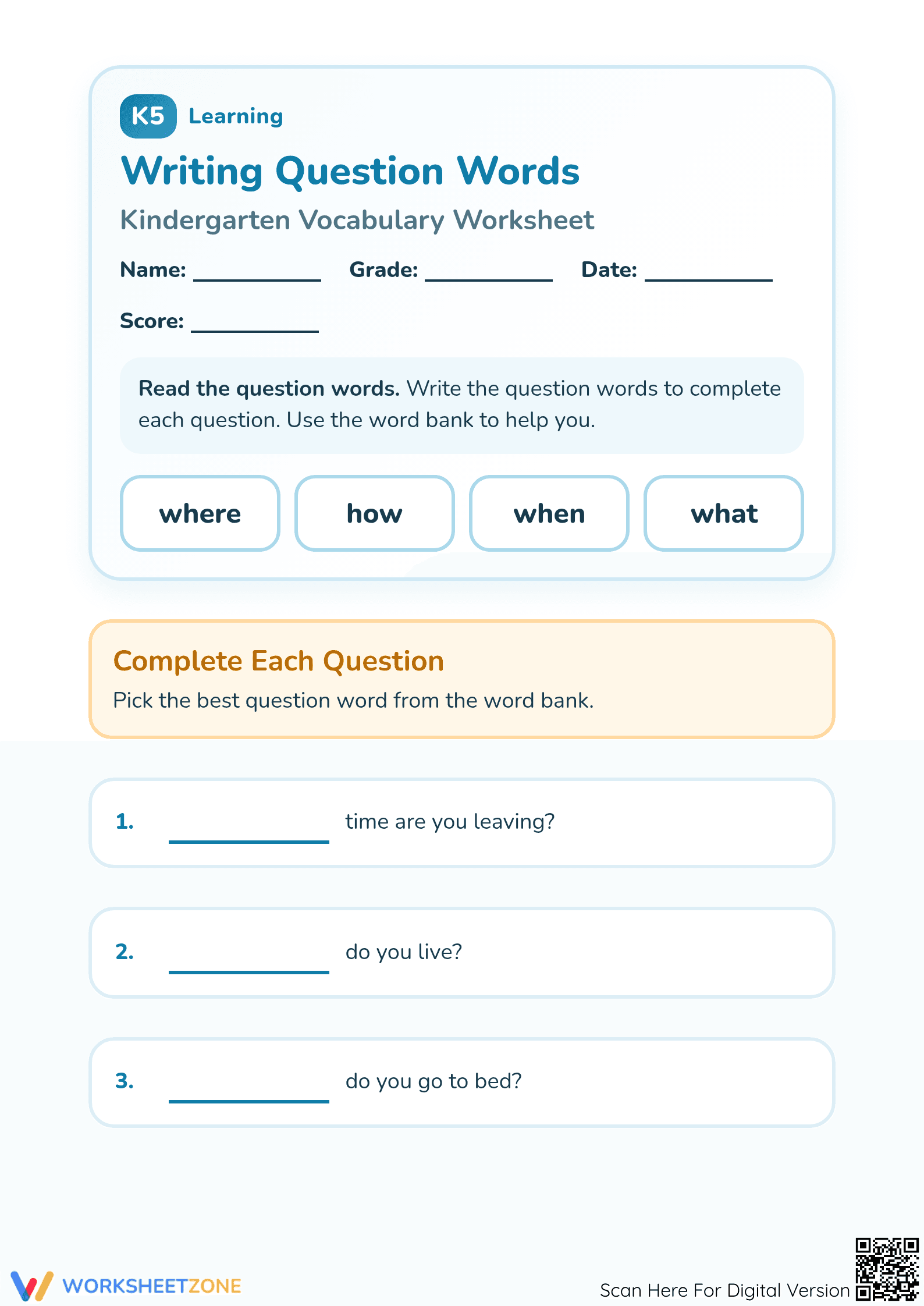
This printable Kindergarten ELA worksheet provides targeted practice for early learners to master interrogatives, or common question words. By completing sentence-level tasks, students build the foundational linguistic skills necessary to ask clear questions and participate in classroom discussions. It focuses on identifying the correct question word based on the context of the sentence provided.
At a Glance
- Grade: Kindergarten · Subject: ELA
- Standard:
CCSS.ELA-LITERACY.L.K.1.D— Use question words like who, what, where, when, why, and how- Skill Focus: Question word identification and application
- Format: 2 pages · 8 problems · Answer key included · PDF
- Best For: Literacy centers and independent grammar practice
- Time: 10–15 minutes
This comprehensive 2-page PDF features 8 structured fill-in-the-blank questions designed for Kindergarteners. The worksheet includes a visual word bank containing the words "where," "how," "when," and "what" to support young writers. Each task presents a familiar sentence context, such as asking about the time, location, or color of an object. A full answer key is included for efficient grading or student self-correction.
- Guided Practice: The first four tasks use a word bank to scaffold initial question word selection and provide visual cues for new writers.
- Supported Practice: Page two offers four more unique contexts, reinforcing the distinction between time, place, and specific objects or colors.
- Independent Practice: A final peer-reading activity promotes verbal fluency and auditory grammar recognition as students share their finished sentences aloud.
This gradual release approach ensures that students build confidence as they move toward independent interrogative use and improved sentence structure.
The primary standard addressed is CCSS.ELA-LITERACY.L.K.1.D, which requires students to "Understand and use question words (interrogatives) (e.g., who, what, where, when, why, how)." This resource also supports conventions of standard English and basic sentence construction. Both standard codes can be copied directly into lesson plans, IEP goals, or district curriculum mapping tools.
Use this worksheet during a direct instruction lesson on "Asking vs. Telling" to help students distinguish between statements and questions. It serves as an excellent "during" activity where the teacher can observe student choices. A great formative assessment tip is to watch for students who confuse "when" and "where," indicating a need for more work on time-space concepts. Completion usually takes 10 to 15 minutes.
This resource is tailored for Kindergarten students beginning to structure complete sentences. It is also suitable for English Language Learners (ELL) who need visual support for interrogative vocabulary. This worksheet pairs naturally with a classroom anchor chart or a read-aloud session involving predictable texts that use repetitive question structures.
The use of structured practice to reinforce the CCSS.ELA-LITERACY.L.K.1.D standard is a proven method for developing early literacy skills. Research from Fisher & Frey (2014) emphasizes the importance of the gradual release of responsibility model, which is mirrored in this worksheet's progression from word bank support to application. By focusing on interrogatives such as "what," "where," "when," and "how," students are equipped with the linguistic tools necessary for active inquiry. Statistical analysis of NAEP data indicates that early mastery of grammar conventions is a strong predictor of later reading comprehension success. This printable resource ensures students receive the repetitive, focused practice required to internalize these essential question words. Educators can utilize these 8 targeted tasks to document student mastery of basic syntax and interrogative application. The clear answer key allows for immediate feedback, which is critical for the developing learner's cognitive growth.


