


























Views
Downloads

Printable Question Words Worksheet | Kindergarten ELA
Paste this activity's link or code into your existing LMS (Google Classroom, Canvas, Teams, Schoology, Moodle, etc.).
Students can open and work on the activity right away, with no student login required.
You'll still be able to track student progress and results from your teacher account.
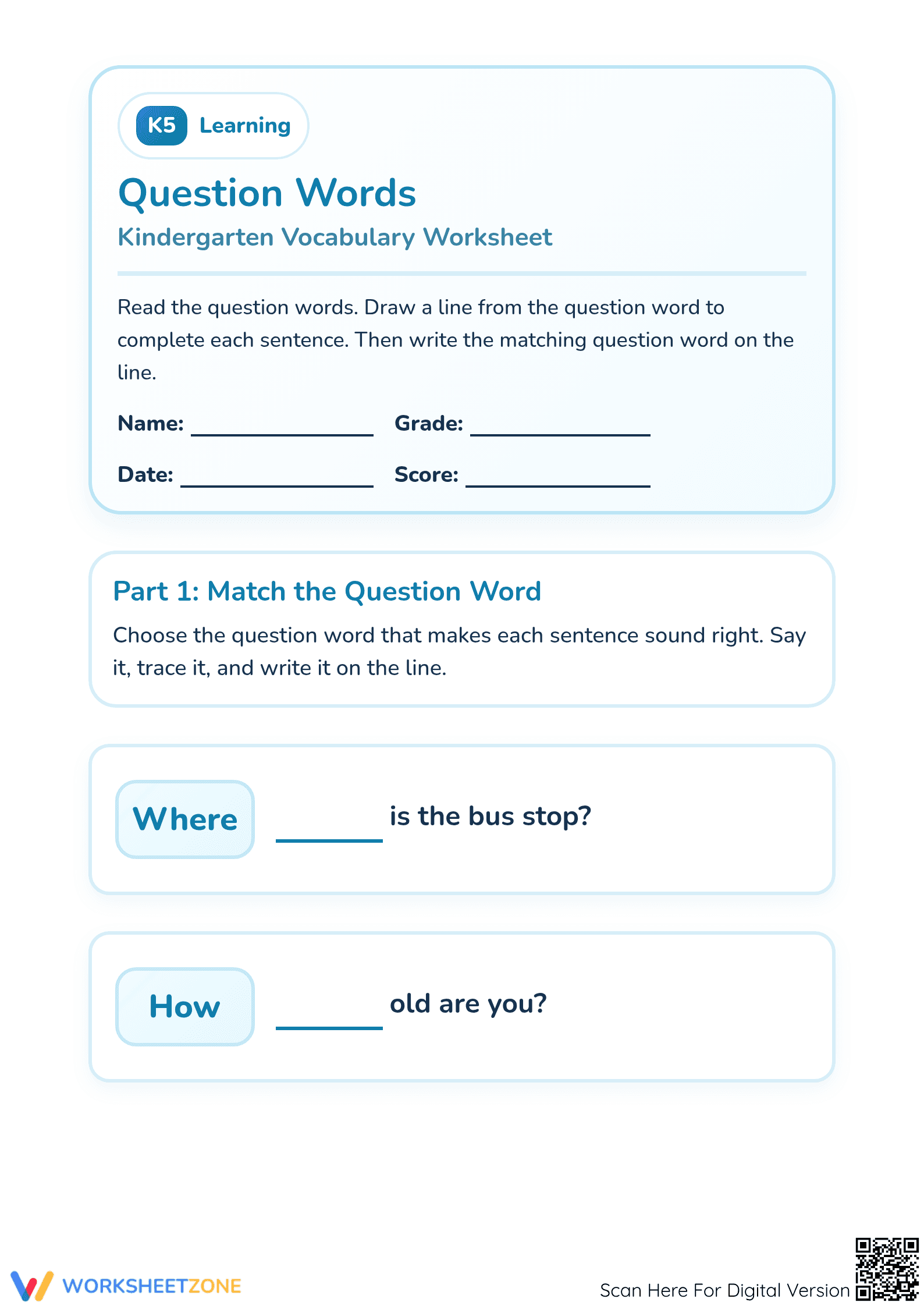
This printable Kindergarten question words worksheet helps young learners master basic interrogatives through structured matching and sentence completion. By engaging with common words like Who, What, Where, and How, students build the foundation for effective communication and inquiry. This resource ensures students can both recognize and use question words correctly in various contexts.
At a Glance
- Grade: Kindergarten · Subject: ELA
- Standard:
CCSS.ELA-LITERACY.L.K.1.D— Understand and use question words like who, what, where, and how- Skill Focus: Interrogative Word Recognition
- Format: 2 pages · 8 problems · Answer key included · PDF
- Best For: Early grammar and sentence structure practice
- Time: 15–20 minutes
What's Inside
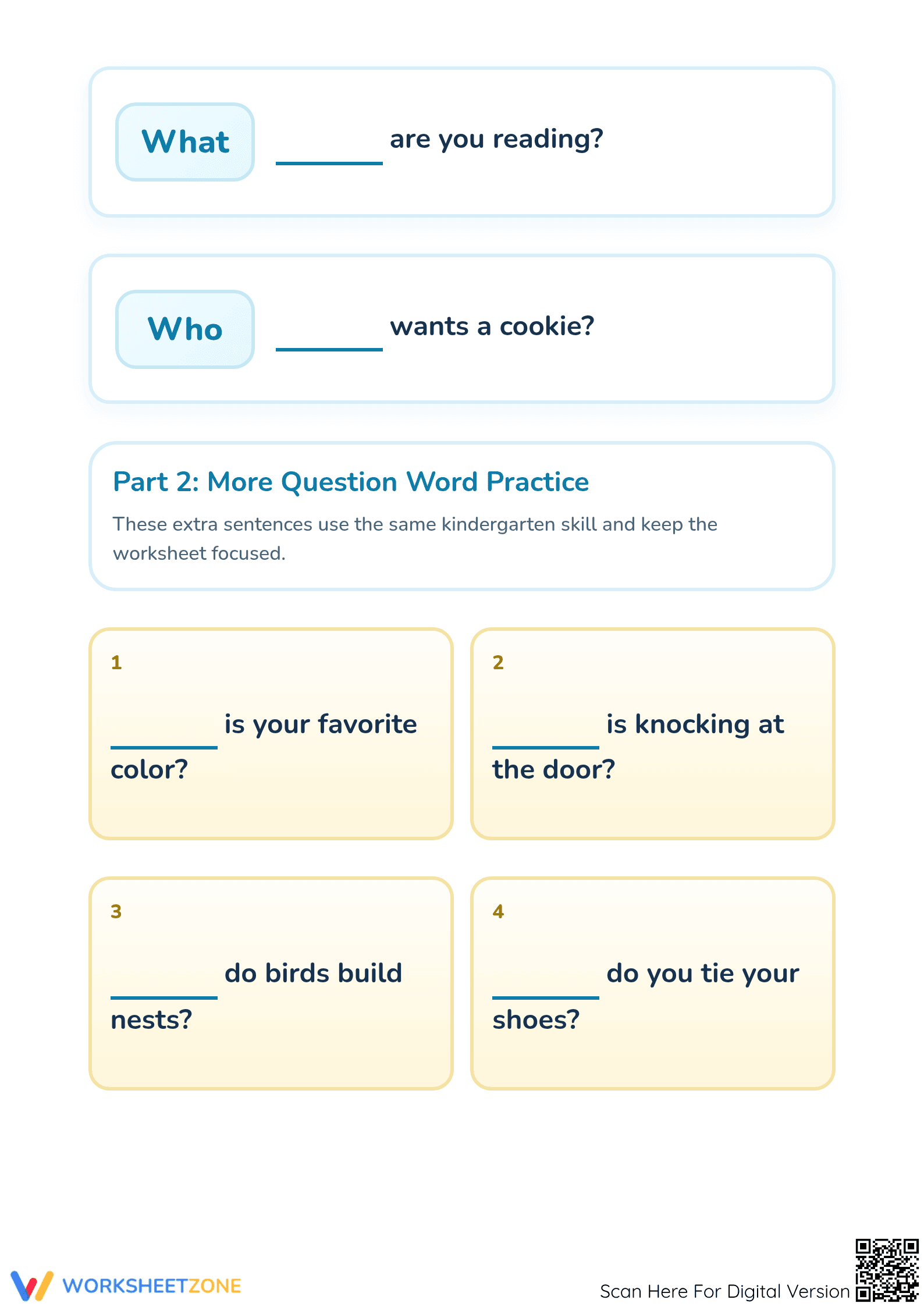
This two-page PDF includes eight focused practice problems divided into two distinct parts. Part one features large, clear text for tracing and matching, while part two provides additional sentence-level practice to reinforce learning. The layout is specifically designed for Kindergarten students, with ample spacing for handwriting and bold headers to guide independent work. A complete answer key is included for quick verification.
Skill Progression
- Guided Practice: Students trace 4 primary question words to match specific prompts, providing a direct model for sentence formation.
- Supported Practice: Visual cues and tracing lines scaffold the transition from word recognition to independent writing.
- Independent Practice: The second page challenges students to select the correct interrogative from their mental bank to complete 4 unique sentences.
This worksheet utilizes a gradual release model, moving students effectively from teacher-supported modeling to independent mastery.
Standards Alignment
This resource is directly aligned to CCSS.ELA-LITERACY.L.K.1.D, which requires students to understand and use question words (interrogatives). It also supports the broader language standard of using frequently occurring nouns and verbs to form simple sentences. Both standard codes can be copied directly into lesson plans, IEP goals, or district curriculum mapping tools.
How to Use It
Use this worksheet during your direct instruction unit on sentence types or as a center activity. After introducing the 5 Ws, have students complete the first page as a whole-group activity to model the tracing process. The second page serves as an excellent formative assessment to check for individual understanding. For a quick observation tip, listen for students saying the question word aloud as they write. Expected completion time is 15-20 minutes.
Who It's For
This activity is designed for Kindergarten students beginning to explore sentence structure. It is particularly helpful for English Language Learners who need visual and tracing support to master interrogative patterns. It pairs naturally with a Question Word anchor chart or a reading passage where students search for question marks before completing the practice.
The mastery of interrogatives is a critical milestone in early literacy, as outlined in the CCSS.ELA-LITERACY.L.K.1.D framework. According to research from Fisher & Frey (2014) on the gradual release of responsibility, providing scaffolded tracing and matching tasks helps move students from surface-level recognition to functional usage of question words. This worksheet provides 8 high-impact tasks that target the specific skill of interrogative selection within common sentence structures. By isolating the question word choice, students reduce cognitive load and can focus on the semantic relationship between the interrogative and the rest of the sentence. This approach is consistent with best practices for Kindergarten vocabulary development and syntactic awareness. Teachers can utilize this resource as a bridge between spoken language and formal written grammar, ensuring that foundational inquiry skills are solidified before students progress to complex sentence construction and reading comprehension tasks.


