


























Views
Downloads

Printable Linear Inequalities Worksheet | Grade 8-9 Math
Paste this activity's link or code into your existing LMS (Google Classroom, Canvas, Teams, Schoology, Moodle, etc.).
Students can open and work on the activity right away, with no student login required.
You'll still be able to track student progress and results from your teacher account.
This focused math worksheet helps Grade 8 and Grade 9 students master linear inequalities. By connecting algebraic expressions to their graphical representations on a number line, learners build essential problem-solving skills. Students will confidently solve compound inequalities and graph their solution sets with this comprehensive practice tool.
At a Glance
- Grade: 8-9 · Subject: Algebra
- Standard:
CCSS.MATH.CONTENT.HSA.REI.B.3— Solve linear inequalities in one variable- Skill Focus: Graphing and solving compound inequalities
- Format: 2 pages · 15 problems · Answer key included · PDF
- Best For: Independent practice and review
- Time: 25–35 minutes
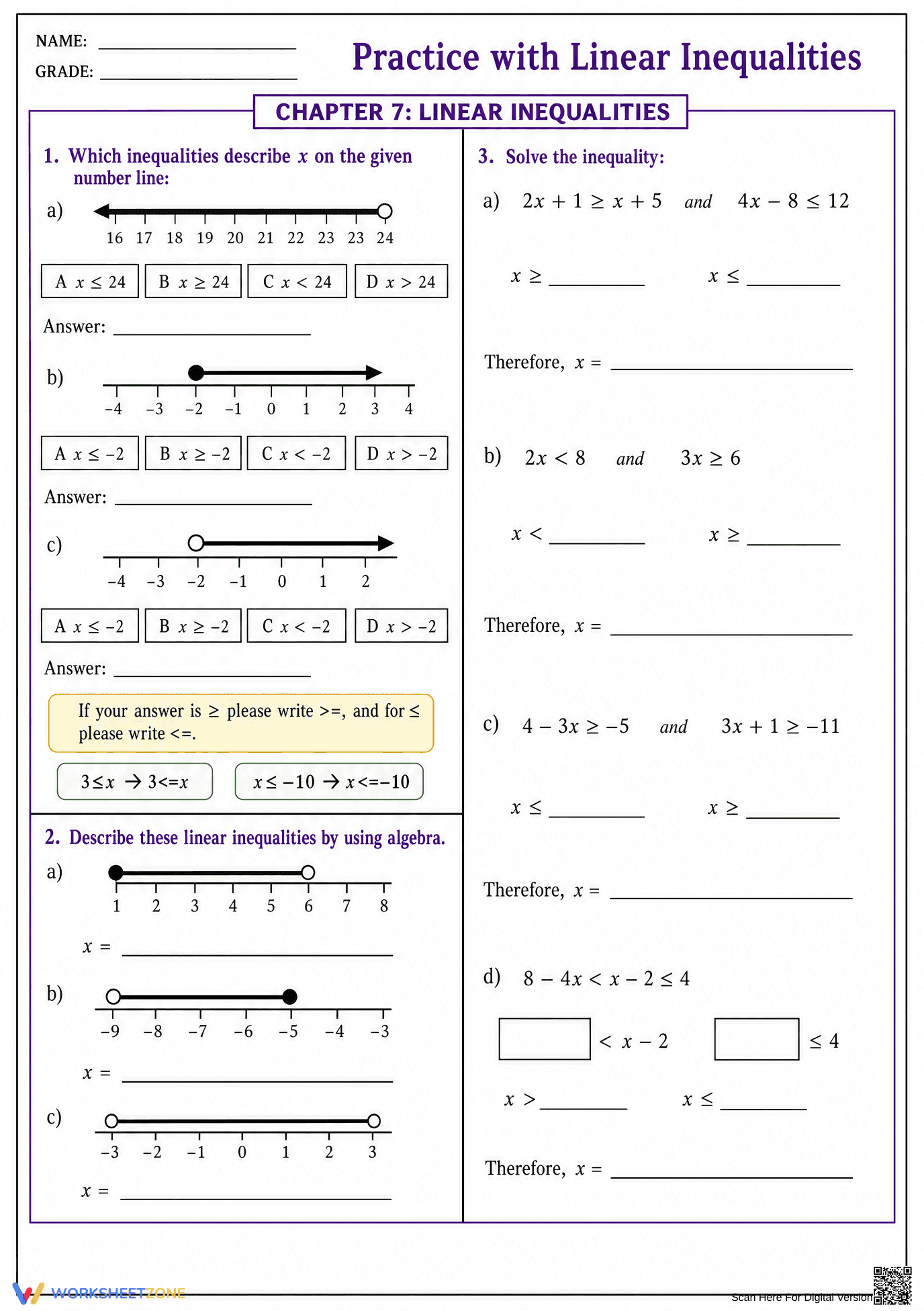
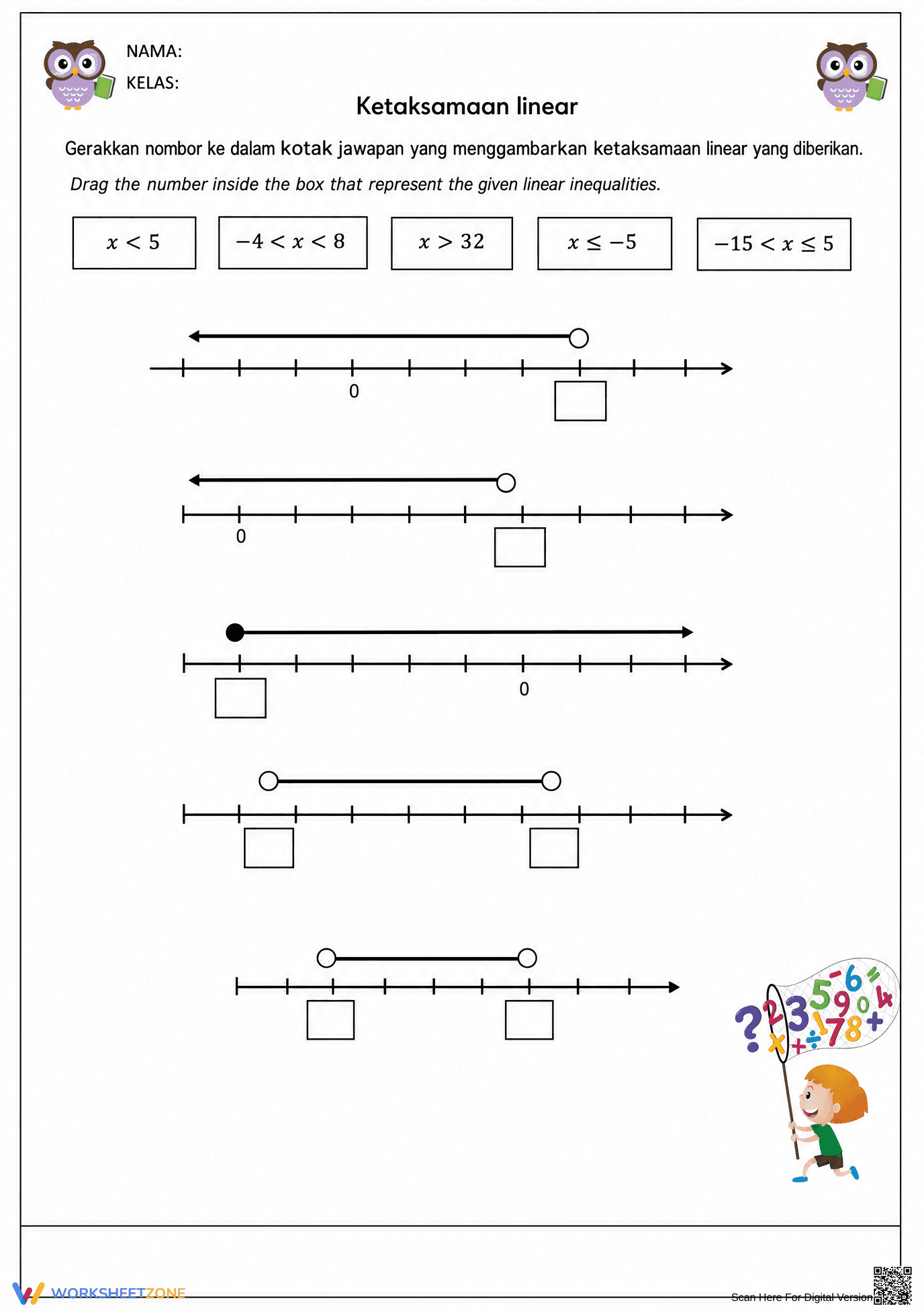
This two-page resource features 15 targeted problems designed to reinforce algebraic concepts. The first page includes multiple-choice questions for identifying inequalities from number lines, alongside structured spaces for solving compound "and" inequalities. The second page offers a matching activity where students connect algebraic notation to the correct graphical representation. A complete answer key is provided for quick grading.
- Guided practice: The worksheet begins with 3 visual identification tasks, allowing students to match basic inequalities to number lines with open and closed circles.
- Supported practice: Students then tackle 3 compound inequalities, translating visual segments into algebraic notation with clear structural prompts.
- Independent practice: The final sections require students to algebraically solve 9 multi-step compound inequalities and match them to their corresponding graphs.
This gradual-release approach ensures students build confidence as they transition from visual recognition to independent algebraic manipulation.
Aligned to CCSS.MATH.CONTENT.HSA.REI.B.3, this resource ensures students can "solve linear equations and inequalities in one variable, including equations with coefficients represented by letters." It also supports foundational skills for graphing solution sets on a number line. Both standard codes can be copied directly into lesson plans, IEP goals, or district curriculum mapping tools.
Deploy this worksheet during independent practice after direct instruction on compound inequalities. It serves as an excellent formative assessment; observe whether students correctly use open versus closed circles when graphing their solutions. Expected completion time is 25 to 35 minutes, making it ideal for a standard class period or a focused homework assignment.
This resource is designed for Grade 8 and Grade 9 Algebra students mastering linear inequalities. It provides clear visual scaffolds for learners who struggle with abstract algebraic notation. Pair this worksheet with an anchor chart detailing the difference between "greater than" and "greater than or equal to" symbols for maximum impact.
Mastering the connection between algebraic notation and graphical representation is a critical milestone in early algebra. Aligned with CCSS.MATH.CONTENT.HSA.REI.B.3, this resource requires students to solve linear inequalities in one variable and graph the resulting solution sets. According to EdReports 2024, instructional materials that explicitly link visual models, such as number lines, to abstract algebraic equations significantly improve student comprehension and retention of complex mathematical concepts. By practicing both the algebraic manipulation of compound inequalities and their visual graphing, learners develop a more robust mathematical foundation. This dual-modality approach ensures that students do not merely memorize procedural steps, but actually understand the underlying logic of inequality relationships. Providing structured, repetitive practice with these specific problem types prepares students for more advanced high school mathematics and standardized assessments.


