


























Views
Downloads



Quadratic Inequalities Worksheet | Essential Algebra Prep
Paste this activity's link or code into your existing LMS (Google Classroom, Canvas, Teams, Schoology, Moodle, etc.).
Students can open and work on the activity right away, with no student login required.
You'll still be able to track student progress and results from your teacher account.
This Grade 8 and 9 algebra worksheet provides a comprehensive framework for solving quadratic inequalities algebraically and graphically. Students move from identifying critical values to performing sign analysis on number lines, ensuring a deep conceptual understanding of solution sets. This resource transforms complex polynomial relationships into manageable, step-by-step mathematical procedures for high school learners.
At a Glance
- Grade: 8-9 · Subject: Algebra
- Standard:
CCSS.MATH.CONTENT.HSA-REI.B.4— Solve quadratic equations and inequalities in one variable using various algebraic methods- Skill Focus: Quadratic Inequalities & Discriminants
- Format: 3 pages · 12 problems · Answer key included · PDF
- Best For: High school algebra mastery and test prep
- Time: 45–60 minutes
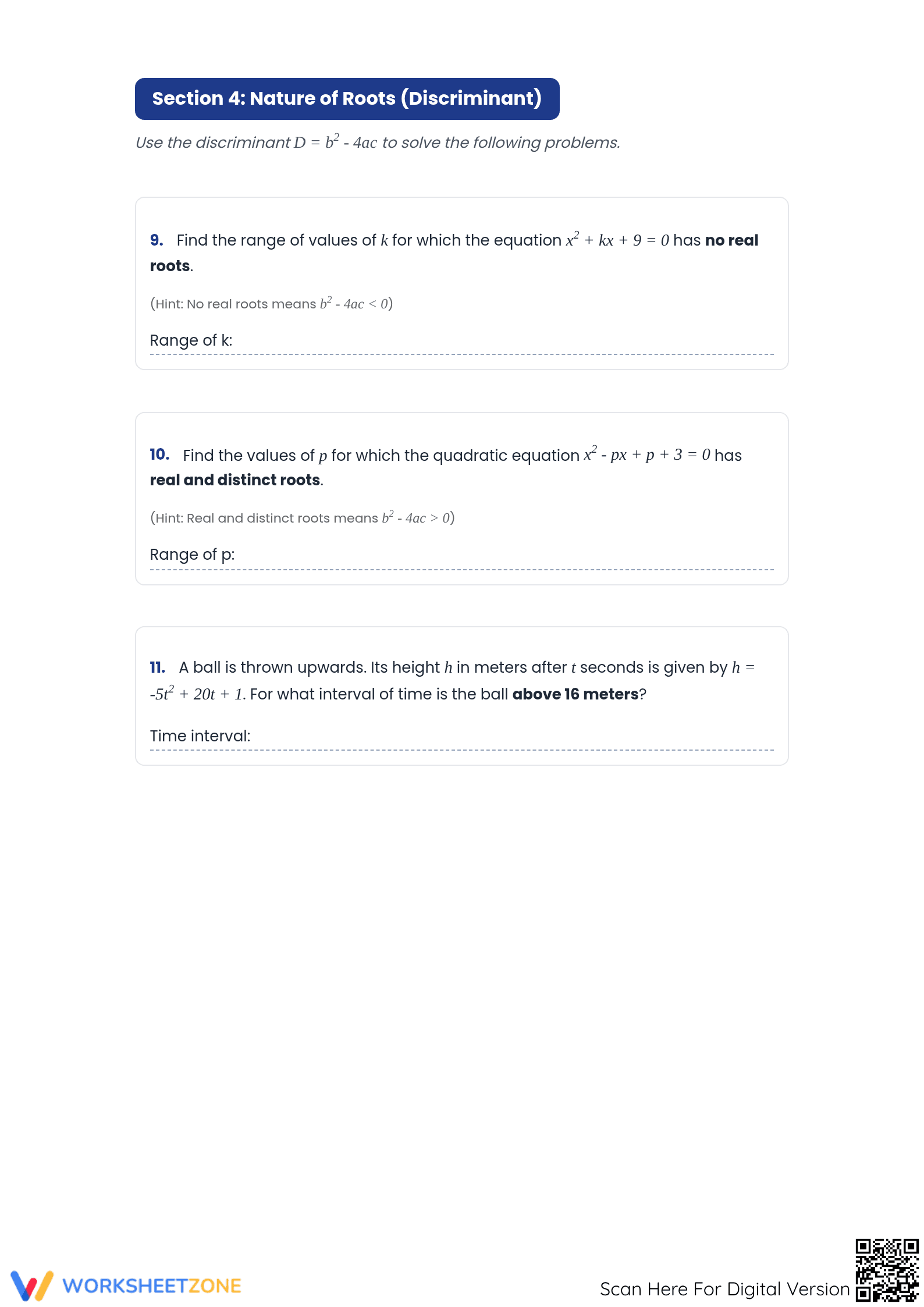
Inside this 3-page PDF, you will find a structured learning path beginning with a "Core Concept" anchor and "Essential Steps" checklist. The worksheet includes two scaffolded guided practice problems with pre-defined test points, six independent practice equations, a graphical connection table for interval notation, and three advanced problems focusing on the discriminant and real-world projectile motion. A full answer key is provided for immediate feedback.
Skill Progression
- Guided Practice: Two initial problems provide factors and test points (x=0, x=2.5, etc.) to help students visualize the sign analysis process before working independently.
- Supported Practice: Six independent problems challenge students to factor polynomials and identify critical values without prompts, building procedural fluency with varying inequality symbols.
- Independent Mastery: The final section introduces the discriminant (b² - 4ac) to determine the nature of roots and applies these concepts to a physics-based word problem.
This gradual-release model ensures students build confidence through an instructional sequence that moves from heavy scaffolding to independent application.
Standards Alignment
This resource is primarily aligned with CCSS.MATH.CONTENT.HSA-REI.B.4, which requires students to solve quadratic equations and inequalities. It also supports `HSA-CED.A.1` by asking students to interpret inequalities within the context of a real-world height-and-time scenario. Both standard codes can be copied directly into lesson plans, IEP goals, or district curriculum mapping tools.
How to Use It
Use this worksheet as a primary practice tool during your unit on non-linear inequalities. It works best after a direct instruction session on factoring quadratics. For a formative assessment, observe students during the graphical connection section; if they struggle to match the graph property to the solution region, they may need a visual review of parabola orientation. Expect completion within 45 to 60 minutes.
Who It's For
This worksheet is designed for Grade 8 and 9 Algebra I or Algebra II students. It is particularly effective for learners who benefit from structured checklists and clear section breaks. Pair this resource with a graphing calculator activity or a digital Desmos session to reinforce the connection between algebraic solution sets and visual parabolas.
According to the RAND AIRS 2024 report, structured mathematical scaffolding significantly improves student retention of abstract algebraic concepts like quadratic inequalities. By breaking down the process into critical value identification and sign analysis, this worksheet aligns with evidence-based practices for secondary mathematics instruction. The inclusion of the discriminant (b² - 4ac) further bridges the gap between basic computation and higher-order analysis required for college readiness. Research from Fisher & Frey (2014) emphasizes that the gradual release of responsibility—moving from guided test points to independent word problem application—is essential for mastering complex multi-step procedures. This 12-task resource provides the necessary repetition and cognitive demand to meet the rigorous requirements of CCSS.MATH.CONTENT.HSA-REI.B.4. By integrating graphical connections with algebraic solutions, students develop a dual-coded understanding of how inequalities represent specific regions on a coordinate plane, leading to greater success in subsequent calculus-preparatory courses.


