


























Views
Downloads
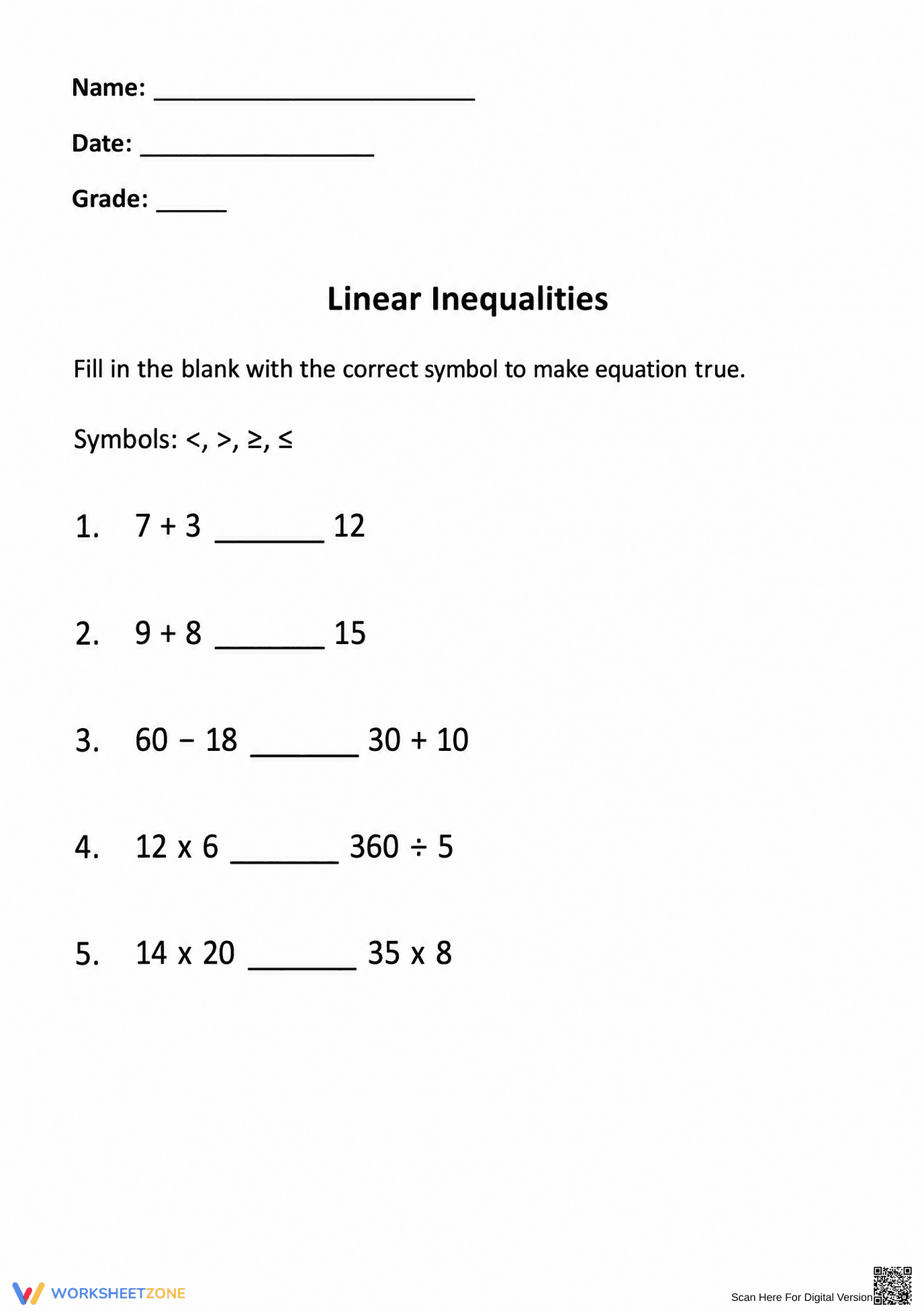

Linear Inequalities Worksheet | Grade 9-12 Essential
Paste this activity's link or code into your existing LMS (Google Classroom, Canvas, Teams, Schoology, Moodle, etc.).
Students can open and work on the activity right away, with no student login required.
You'll still be able to track student progress and results from your teacher account.
This linear inequalities worksheet provides immediate practice for students to evaluate and compare mathematical expressions using inequality symbols. By calculating values on both sides of a statement, learners develop a concrete understanding of how inequalities function as logical comparisons rather than just static equations. This resource ensures students master the foundational logic required for complex algebra.
At a Glance
- Grade: 9-12 · Subject: Algebra
- Standard:
HSA.REI.B.3— Solve linear equations and inequalities in one variable, including literal equations- Skill Focus: Comparing expressions with inequality symbols
- Format: 1 page · 5 problems · Answer key included · PDF
- Best For: Bell-ringers, quick checks, or sub plans
- Time: 10–15 minutes
What's Inside: This single-page PDF features 5 targeted problems that require students to perform arithmetic operations—including addition, subtraction, multiplication, and division—before selecting the appropriate symbol (<, >, ≥, or ≤). The layout is clean and uncluttered, providing ample white space for students to show their scratch work directly on the page for teacher review.
Zero-Prep Workflow: This resource is designed for maximum efficiency in busy classrooms. 1. Print: Select the single page and print enough copies for your roster (30 seconds). 2. Distribute: Hand out the sheets as a warm-up or exit ticket (30 seconds). 3. Review: Use the included answer key to grade or conduct a whole-class check (1 minute). Total teacher preparation time is under 2 minutes.
Standards Alignment: The primary focus is `CCSS.MATH.CONTENT.HSA.REI.B.3`, which requires students to solve linear equations and inequalities in one variable. While these problems are conceptual, they form the prerequisite foundation for more complex algebraic manipulation and variable isolation. Both standard codes can be copied directly into lesson plans, IEP goals, or district curriculum mapping tools.
How to Use It: Assign this worksheet during the "Guided Practice" phase of a lesson to ensure students can correctly interpret inequality symbols before moving to graphing on a number line. It also serves as an excellent formative assessment; observe if students struggle more with the arithmetic or the direction of the inequality sign to target your next instructional steps.
Who It's For: This is ideal for high school students in Algebra 1 who need a conceptual refresher or for students with IEPs requiring simplified numerical practice. It pairs naturally with a lesson on number line representation or a digital graphing calculator activity to bridge the gap between calculation and visualization for diverse learners.
According to the RAND AIRS 2024 report on mathematics instruction, high-quality supplemental materials that focus on the conceptual underpinnings of algebra—such as the relationship between expressions—are vital for long-term retention. This worksheet addresses the core requirements of HSA.REI.B.3 by forcing students to evaluate the truth of mathematical statements through comparison. Research from Fisher & Frey (2014) emphasizes that "check for understanding" tasks with low barrier-to-entry, like these 5 problems, allow teachers to identify misconceptions in real-time. By isolating the skill of symbol selection from complex multi-step solving, students build the cognitive stamina needed for advanced algebraic reasoning. This resource provides a structured, evidence-based approach to mastering linear inequalities, ensuring that learners can confidently navigate more rigorous mathematical modeling in subsequent units.


