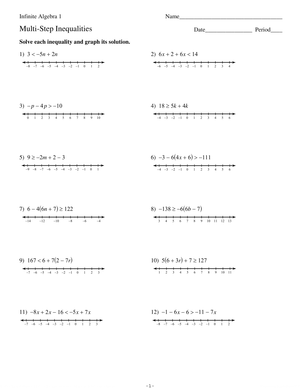
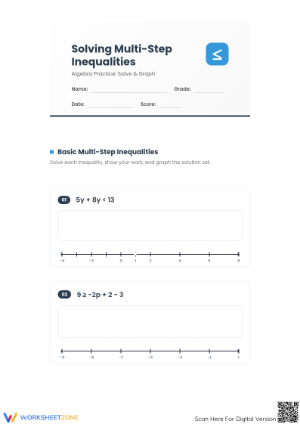
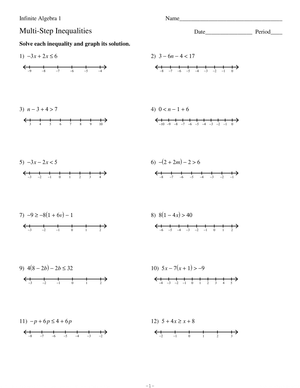
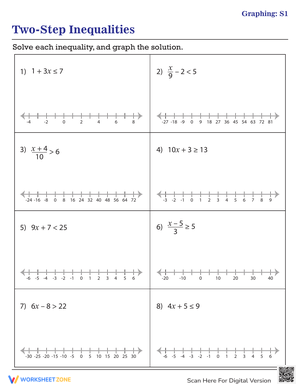
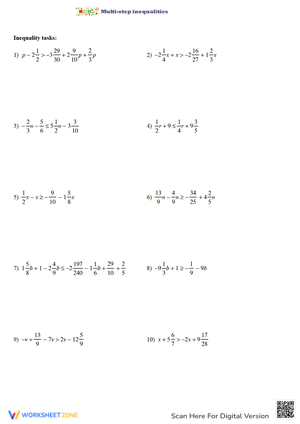
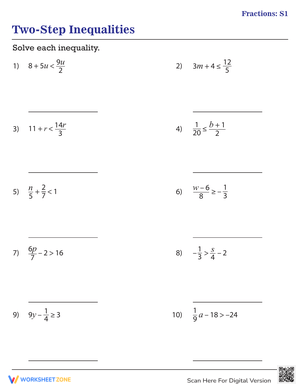
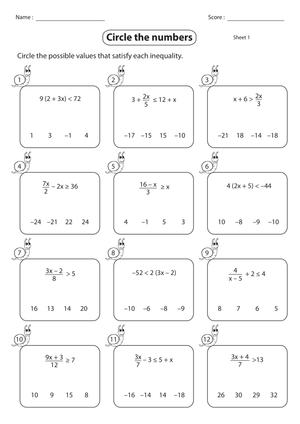
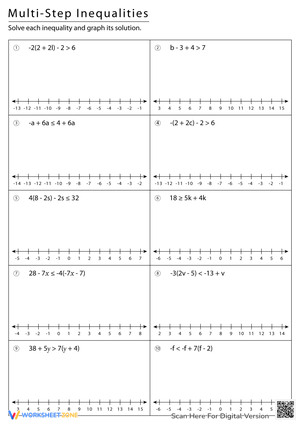
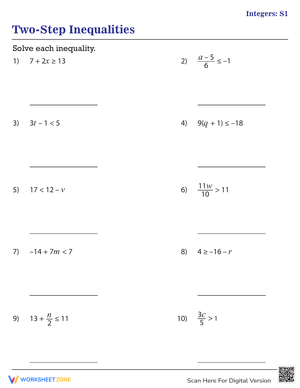
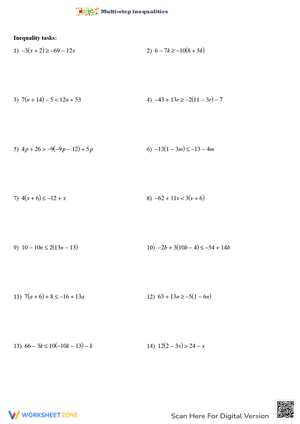
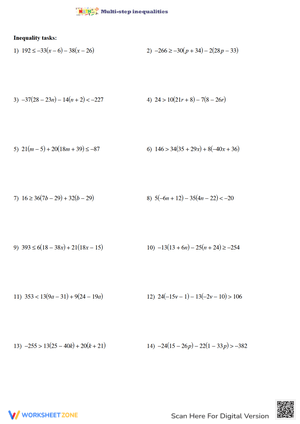
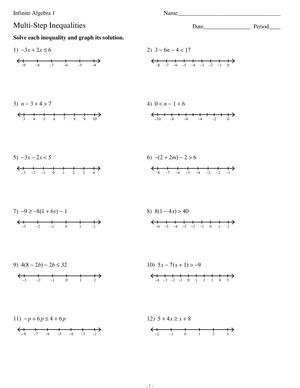
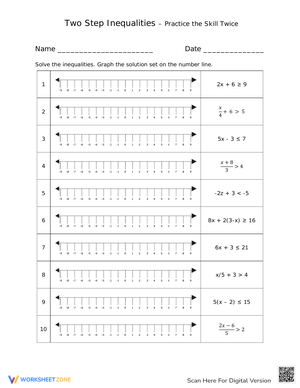
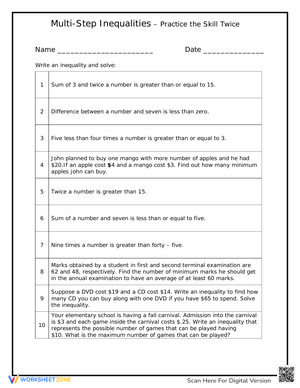
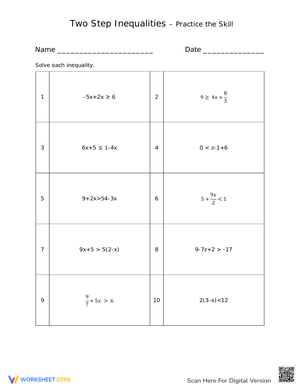
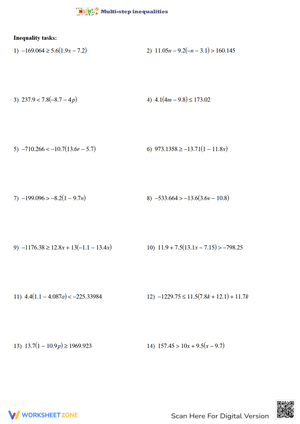
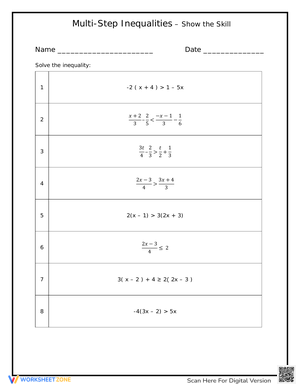
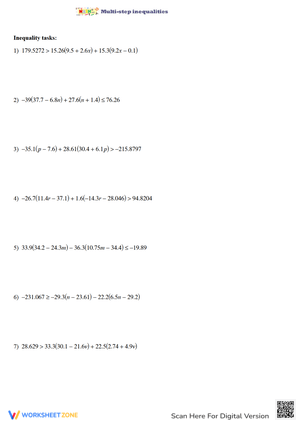
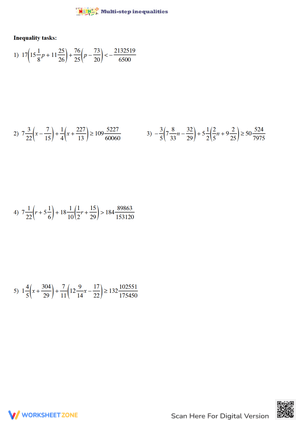
These 9th grade multi step inequalities printable worksheets give algebra teachers a targeted set of practice resources for the moment in a unit when students realize that solving inequalities is almost—but not quite—the same as solving equations. What distinguishes this set is its deliberate focus on the sign flip rule, error analysis, and graphical representation across worksheets that build in complexity without losing the foundational procedure work students need to stay grounded.
The Specific Skills Each Worksheet Targets
The set moves through four skill layers, each of which can be assigned independently or sequenced across a unit. Teachers often pull individual worksheets based on class performance on formative checks rather than assigning every piece in order.
- Two-step solving with positive coefficients: Students isolate the variable using addition, subtraction, multiplication, and division in problems where multiplying or dividing by a negative never occurs. This builds procedural fluency with the format before the sign flip enters the picture.
- Sign flip recognition: Problems requiring division or multiplication by a negative appear alongside problems that do not. Students must decide each time whether the sign changes direction—not apply the rule automatically on every problem.
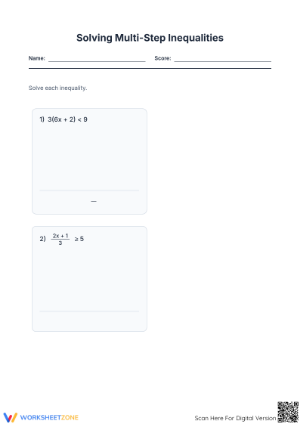
- Distributive property and combining like terms: Students simplify before isolating, adding the layer of algebraic manipulation that appears consistently on state assessments.
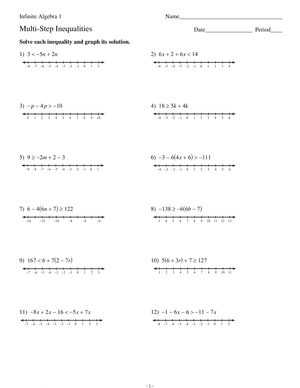
- Variables on both sides: An added decision point—consolidating variable terms before isolating—while tracking the inequality direction through every step.
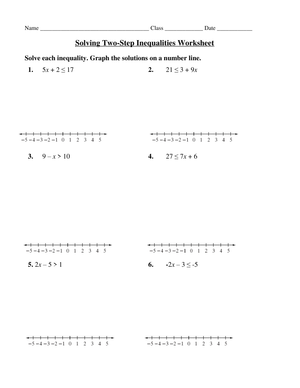
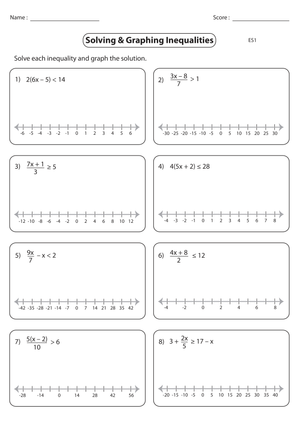
- Number line graphing: Each worksheet pairs algebraic solutions with a blank number line. Students choose between open and closed circles and shade the correct direction, making graphical representation a required step rather than an optional extension.
- Error analysis: Worked solutions containing deliberate mistakes give students practice identifying and correcting procedural errors, which deepens conceptual understanding more than additional solving problems alone.
Student Errors Worth Watching For and Correcting
The sign flip error is the most predictable mistake in this unit, but the form it takes in student work is worth examining closely. A student solving negative three x plus five is less than fourteen will typically subtract five from both sides correctly, reaching negative three x is less than nine. The error arrives at the division step: they divide both sides by negative three and write x is less than negative three, keeping the original sign. The result is a solution set that is exactly wrong—pointing left on the number line instead of right. Because the algebra looks procedurally correct at every other step, students who make this error rarely catch it without an explicit prompt to check the sign of the divisor.
Two other patterns show up consistently in collected student work. The first is open-versus-closed circle confusion, often triggered not by misunderstanding the rule but by the value at the endpoint. A student who correctly arrives at x is greater than or equal to negative two will sometimes draw an open circle, apparently because the negative sign makes the endpoint feel uncertain—a developmental quirk worth addressing directly. The second is distribution of a negative across parentheses before any inequality work begins: students expand negative two times the quantity three x minus four as negative six x minus eight instead of negative six x plus eight, which corrupts the entire solution from line one.
How to Fit These Worksheets Into Your Lesson Planning
The most reliable classroom entry point for these resources is the warm-up slot—the first eight minutes of class, before direct instruction begins. A half-worksheet with four problems surfaces lingering confusion from the previous day and tells the teacher which students need to be pulled during independent work time. This use also keeps the pacing honest: if three students out of twenty-eight cannot complete two problems in eight minutes, the class is not ready for the next worksheet in the sequence.
For days when the primary lesson targets the sign flip rule, error analysis worksheets work better as the independent practice than straight solving sets. Students slow down to examine the reasoning in each worked-out example rather than moving quickly from problem to problem—exactly the kind of deliberate processing that makes the sign flip rule stick. These 9th grade multi step inequalities printable worksheets also work well as Friday review material at the end of a unit week, when students have encountered all four skill layers and can move between them without teacher prompting about which strategy applies.
One underused approach: after completing a worksheet, ask each student to write one inequality that requires the sign flip and one that does not, then swap with a partner. The shift from solver to problem author forces students to think about inequality structure rather than just executing steps, and it generates peer-created review problems that can be reused in future classes.
Standard Alignment
These worksheets address CCSS.MATH.CONTENT.HSA.REI.B.3, the High School Algebra standard requiring students to solve linear equations and inequalities in one variable, including those with coefficients represented by letters. In practice, this standard gets introduced in 9th grade as students move from equation fluency into inequality reasoning—typically three to five weeks into an Algebra 1 unit on linear relationships. The skill appears on most state-level Algebra 1 end-of-course exams, and test items frequently require both an algebraic solution and a correct number line graph, which is why pairing both representations on each worksheet matters for assessment preparation.
Adjusting the Set for a Range of Learners
Students who are still shaky on equation solving benefit from a side-by-side format: a solved equation placed next to the same problem written as an inequality. Seeing that every step is identical until the sign flip arises removes much of the anxiety that comes from encountering a new symbol. For these students, a two-column organizer—one column for steps, one for the question "did I multiply or divide by a negative?"—gives them a concrete self-monitoring structure without reducing the cognitive demand of the math.
On-level students work through the standard sequence: positive-coefficient problems first, then mixed sign-flip and non-sign-flip problems, then distributive property and variables on both sides. Advanced students benefit most from the error analysis worksheets and word problem applications, where rate comparisons and budget scenarios require setting up the inequality before solving it. These 9th grade multi step inequalities printable worksheets include enough variation across the set that teachers running station rotations can assign different worksheets to different groups without overlap.
Frequently Asked Questions
Why does the inequality sign reverse when you multiply or divide by a negative number?
Multiplying or dividing by a negative number reverses the position of values on the number line. Consider that two is less than five. Multiply both sides by negative one and you get negative two and negative five—and negative two is greater than negative five. The flip preserves the truth of the original relationship. Students who understand this geometrically, by thinking about where values land on a number line rather than treating it as a memorized rule, are far less likely to forget the flip mid-problem.
How do students decide between an open circle and a closed circle when graphing?
The circle type depends on whether the endpoint belongs to the solution set. When the inequality is strict—less than or greater than—the endpoint is not included, so students draw an open circle. When the inequality includes equality—less than or equal to, or greater than or equal to—the endpoint is included, so the circle is filled in. The confusion arises most often when the endpoint is a negative number; students sometimes treat those as edge cases when the same rule applies without exception. Asking students to write "included" or "not included" next to the endpoint before drawing the circle reduces this error noticeably.
What is the general sequence of steps for an inequality with variables on both sides?
First, distribute and combine like terms on each side separately. Next, move all variable terms to one side using addition or subtraction, noting which direction the inequality points after each operation. Then move all constant terms to the opposite side. Finally, divide or multiply to isolate the variable—and check the sign of that divisor before writing the solution. These 9th grade multi step inequalities printable worksheets present this sequence consistently across every variables-on-both-sides problem so students internalize the procedure rather than improvising a different approach each time.
What is the most effective way to help students move from equation solving into inequality reasoning?
Place a solved equation and the same problem written as an inequality side by side, then work through both simultaneously. Students can see that every step matches until multiplication or division by a negative introduces the flip. This comparison makes the new skill feel like a small addition to something already familiar. Worksheets that show the parallel equation solution in a shaded reference box alongside the inequality workspace give students a cue they gradually stop needing as confidence builds—the goal being that they eventually work the inequality without glancing at the equation at all.














 Interactive Worksheet Maker
 Quiz Maker
 Word Search Maker
 Crossword Puzzle Maker
 Word Scramble Generator
 Sentence Scramble Generator
 Handwriting Worksheet Generator
 Name Tracing Generator
 Fill In The Blank Generator




 BACK TOSCHOOL