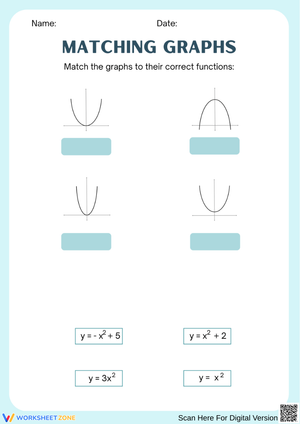
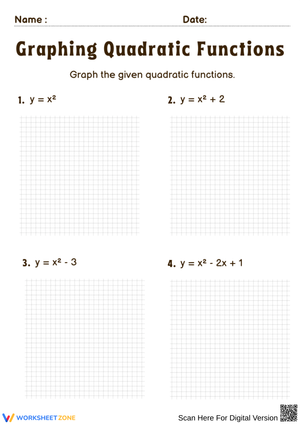
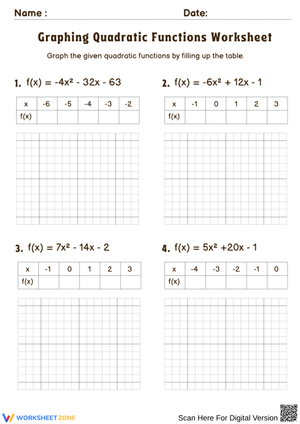
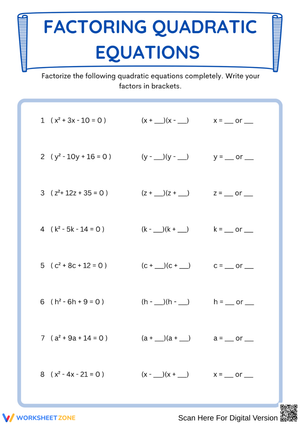
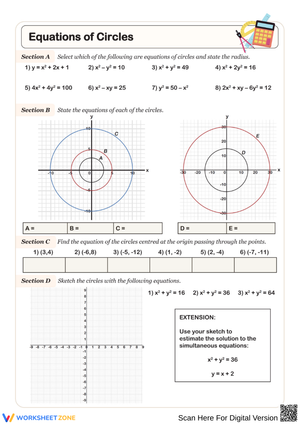
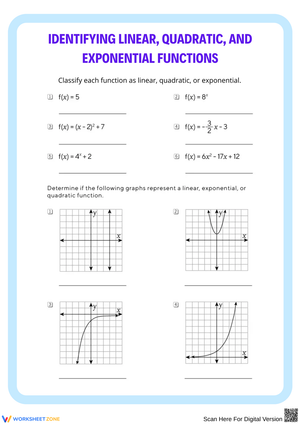
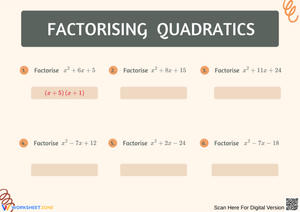
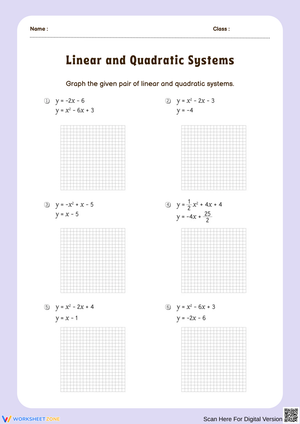
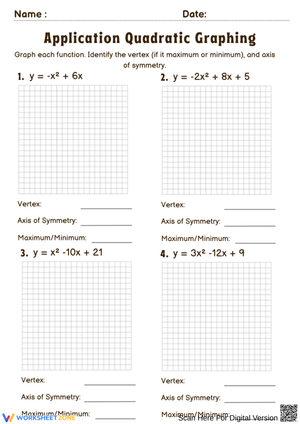
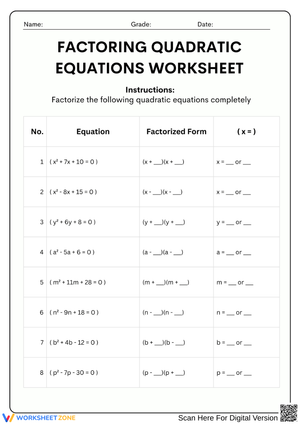
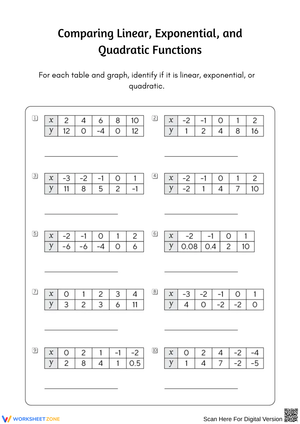
These 9th grade quadratic function worksheets cover the full arc of Algebra 1's quadratic unit: translating between standard, vertex, and factored forms; graphing parabolas by identifying key features; and solving equations through factoring, completing the square, and the quadratic formula. Teachers get resources they can drop into the lesson at the right moment rather than working through a fixed sequence. The set is built around the premise that students need to see connections across all three forms — not just master each one in isolation.
What Each Worksheet Targets
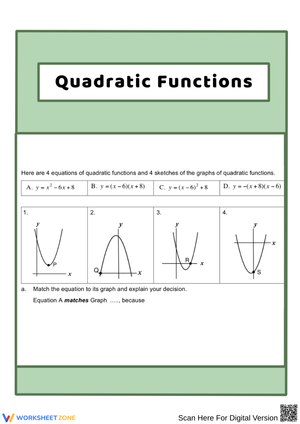
The worksheets address the three algebraic representations of quadratic functions and the relationships between them, because that translation work is where most 9th graders lose traction. Students who can solve x² + 5x + 6 = 0 by factoring will still stumble when asked to rewrite the same function in vertex form and locate the turning point on a graph. Each worksheet isolates one of the following skill clusters so teachers can assign precisely what a class needs:
- Reading the leading coefficient a to determine concavity and relative width before applying any formula
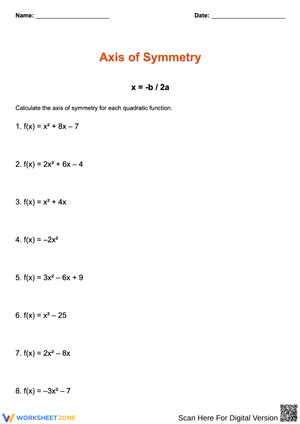
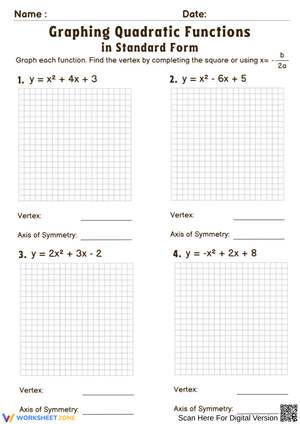
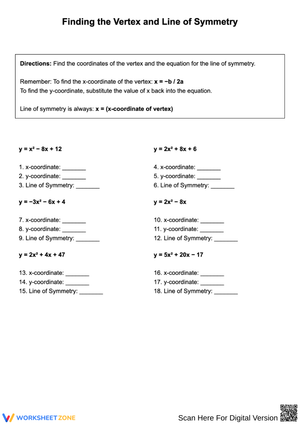
- Using the axis of symmetry formula x = -b / 2a to find the vertex from standard form
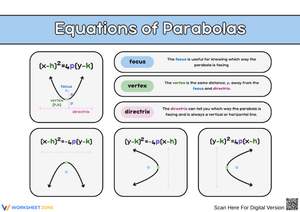
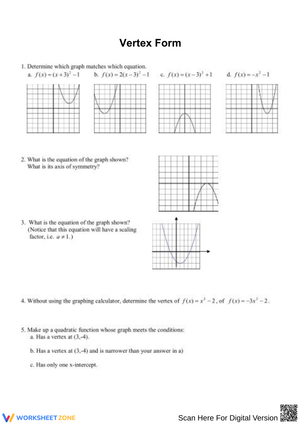
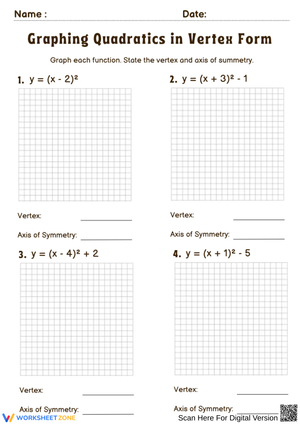
- Identifying the vertex directly from vertex form and understanding why the sign of h reverses
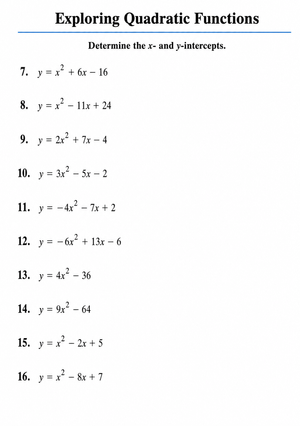
- Locating x-intercepts and y-intercepts from all three forms
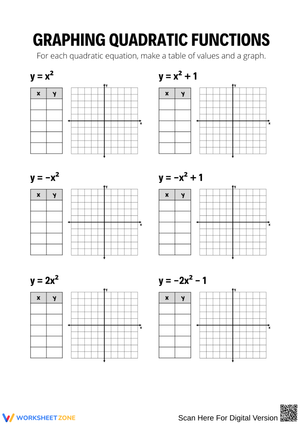
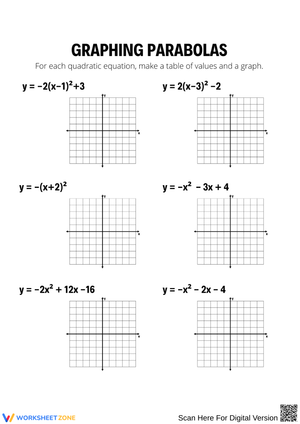
- Graphing parabolas from a vertex, axis of symmetry, and two to three additional plotted points
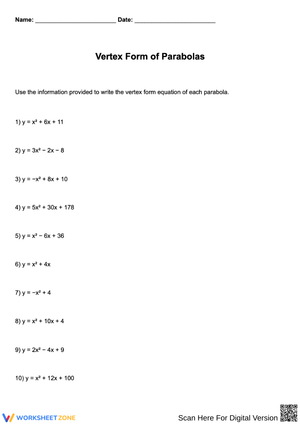
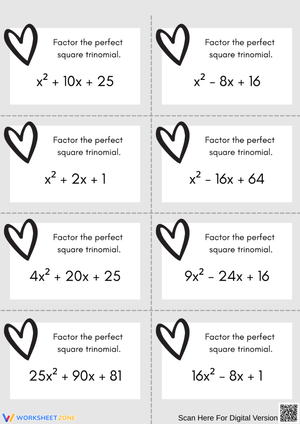
- Converting between standard form and vertex form by completing the square
- Applying the quadratic formula and reading the discriminant before calculating roots
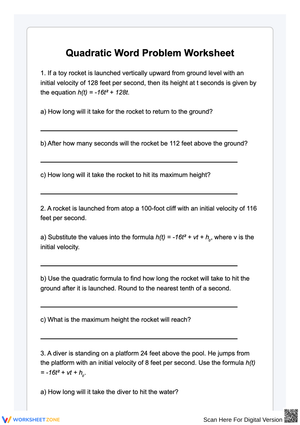
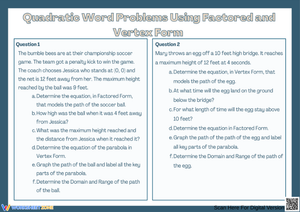
- Interpreting vertex and intercepts in context — maximum height, break-even quantity, time of landing
The move from graphing lines to graphing curves hits students harder than most teachers anticipate. The parabola's symmetry is new, the vertex is an unfamiliar concept, and students track three formulas simultaneously. Keeping each worksheet focused on one skill cluster reduces the number of ideas students have to hold in working memory at once — and gives teachers a cleaner signal about what each student actually understands.
Errors Students Make That These Worksheets Help You Catch
The most persistent mistake at this level involves the sign of h in vertex form. When students see f(x) = 2(x + 3)² - 1, a significant portion will record the vertex as (3, -1) rather than (-3, -1). They read the number inside the parentheses and write it directly — the subtraction structure is invisible to them. An effective correction in the moment: write f(x) = 2(x - (-3))² - 1 next to the original and ask students to name the vertex again. The error typically disappears once they see why the sign flips.
A second pattern shows up with the axis of symmetry formula. Students compute -b correctly, then divide only by 2 instead of by 2a — treating the formula as -b/2 rather than -b/(2a). This is a parentheses-handling error more than a conceptual one, but it compounds badly: a wrong axis of symmetry produces a wrong vertex, which produces a misplaced graph. Having students write the full denominator as a product before they simplify catches this before it cascades.
There's also a conceptual gap worth naming explicitly. Many students who correctly state that an a value less than 0 produces a downward-opening parabola will still calculate a large positive vertex y-value and accept it without question. Teaching students to identify the direction the parabola opens before touching any algebra gives them a reference point — if the vertex returns a positive y-value on a downward-opening parabola, they know something went wrong in substitution and re-check before moving on. That habit, built through repeated practice, functions as a self-correction mechanism across the entire unit.
Building These Worksheets Into Your Algebra 1 Pacing
The graphing worksheets hold up well as Monday warm-ups during the unit — five minutes of locating key features from a graph reinforces the previous lesson before the new one begins. Teachers running a workshop model get more mileage by rotating students through three stations simultaneously: one worksheet set on graphing from equations, one on converting between forms, and one on solving methods. The factored form and zero product property work pairs naturally with the solving-methods worksheets as an exit ticket because the answer is immediately verifiable — students substitute their roots back into the original equation and know at once whether the work is right.
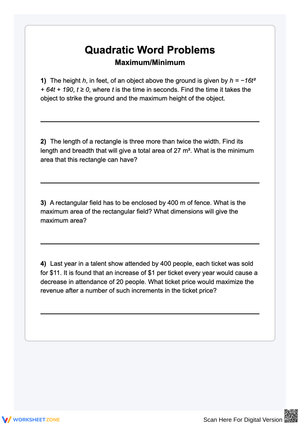
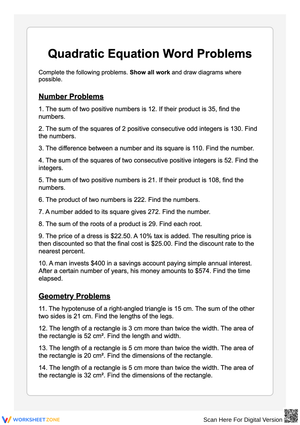
9th grade quadratic function worksheets built around real-world contexts — projectile motion, rectangular area optimization — hold up better as formative assessments than as introductory practice. Students who haven't fully internalized the vertex and intercept concepts will read the word problem and stop before reaching the math. Wait to deploy those worksheets until the procedural mechanics are stable; then use them to check whether students can attach meaning to calculations they already know how to perform.
Standard Alignment
The graphing worksheets map to CCSS.MATH.CONTENT.HSF.IF.C.7.A, which requires students to graph quadratic functions expressed symbolically and identify intercepts, maxima, and minima. In classroom terms, this standard lands mid-unit, after students can locate a vertex from standard form but before they're solving with the quadratic formula. The solving-method worksheets address CCSS.MATH.CONTENT.HSA.REI.B.4, which covers solving quadratic equations by inspection, completing the square, and the quadratic formula — including interpreting a negative discriminant as the absence of real solutions. The context and interpretation work also connects to HSF.IF.B.4, the standard requiring students to interpret key features of a function's graph relative to a real-world situation. Teachers in Illustrative Mathematics Algebra 1 classrooms will find these resources align closely with Units 6 and 7.
Adjusting the Practice for Mixed-Readiness Classes
Students who arrive in Algebra 1 without fluent integer arithmetic hit a ceiling quickly on standard form worksheets — particularly when the axis of symmetry calculation involves a negative b and a non-unit a. For those students, start with vertex form worksheets exclusively: identifying the vertex and graphing from it requires no formula, just careful reading of the equation. Once they can plot the vertex and reflect two points across the axis of symmetry confidently, they're ready to work with the formula.
Students who move through factoring quickly often stall at completing the square — not because the algebra is too hard, but because they don't see why it connects to vertex form. Pairing the completing-the-square worksheet with a vertex form identification worksheet lets those students run both procedures side by side and build the connection themselves rather than being told it. For students who need an additional challenge, assign worksheets where the leading coefficient a is a non-integer, or where the task is to determine the number of real solutions from the discriminant alone — before solving the equation at all.
Frequently Asked Questions
What prior skills do students need before starting these worksheets?
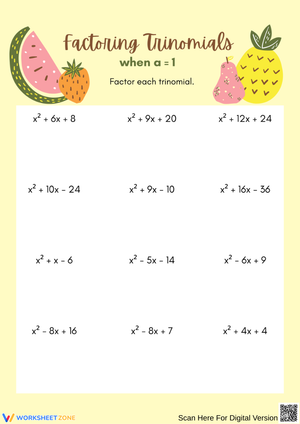
Students need to evaluate expressions with integer exponents, distribute across parentheses, and combine like terms reliably. Fluent factoring of trinomials where a = 1 is helpful before the solving-methods worksheets, but graphing and form-identification work can begin while factoring skills are still developing.
How are the worksheets organized within the set?
The worksheets are grouped by skill cluster rather than locked into a single sequence. Teachers assign them based on where students are in the unit — there's no requirement to work through the set in order. A class that moves quickly through graphing from vertex form might jump to conversion work before circling back to graphing from standard form as reinforcement.
Are these appropriate for Algebra 2 review?
The 9th grade quadratic function worksheets in this set target Algebra 1 content — the three forms, graphing key features, and the three primary solving methods, with no introduction to complex roots or systems involving quadratics. They work well for on-level 9th-grade Algebra 1, honors 8th-grade courses covering the same material, and for Algebra 2 teachers who want a focused review at the start of the quadratic unit before extending into more advanced territory.
Can these be used in the weeks before a standardized assessment?
Yes. State Algebra 1 assessments regularly test graphing quadratics, identifying key features, and solving by the quadratic formula — and many include applied items that ask students to interpret what the vertex or x-intercept means in a real-world scenario. These 9th grade quadratic function worksheets are particularly useful in that two-week stretch before assessment when students need practice across the full range of quadratic skills rather than only the most recent lesson's content.














 Interactive Worksheet Maker
 Quiz Maker
 Word Search Maker
 Crossword Puzzle Maker
 Word Scramble Generator
 Sentence Scramble Generator
 Handwriting Worksheet Generator
 Name Tracing Generator
 Fill In The Blank Generator




 BACK TOSCHOOL