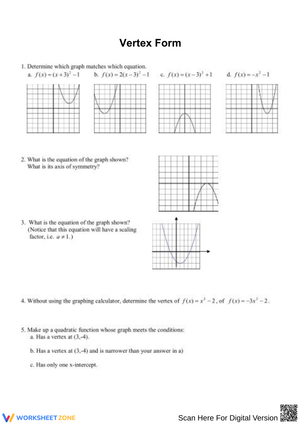
Axis of Symmetry and Vertex worksheets for 9th Grade
These axis of symmetry and vertex worksheets for 9th grade give algebra teachers a structured set of practice problems targeting one of the quadratic unit's most procedurally demanding skills. Students work with both standard form and vertex form equations, moving between algebraic calculation and graphical interpretation in ways that build the fluency they need before optimization problems and projectile motion show up later in the year.
What Goes Wrong Before It Goes Right
The errors students make on these problems cluster around two moments: applying the formula and reading vertex form. On the formula side, the most persistent mistake involves sign handling. When b is already negative—say, y = 2x² - 5x + 1—students apply x = -b/(2a) and should arrive at -(-5)/(2·2), but a significant portion write -5 in the numerator anyway, canceling the negation. A concrete intervention: require students to write the substitution step with explicit parentheses around b before simplifying. That single structural habit eliminates most sign errors within a few practice rounds.
Vertex form produces its own misconceptions. In y = a(x - h)² + k, students consistently report the x-coordinate of the vertex as the negative of h. They see (x - 3)² and write h = -3. The subtraction symbol reads to them as a marker of negativity rather than part of the structural form. Repeated targeted practice with vertex form problems—exactly the kind these worksheets provide—does more to fix this than restating the definition.
A third error, less discussed in curriculum materials: students find x = -b/(2a), call that result the vertex, and stop there. They report a single number instead of a coordinate pair. Each worksheet in the set requires both h and k in every answer, which catches this omission systematically rather than letting it drift unnoticed.
The Specific Skills Targeted
Each worksheet concentrates on a defined portion of the quadratic functions strand. Across the set, students practice the following:
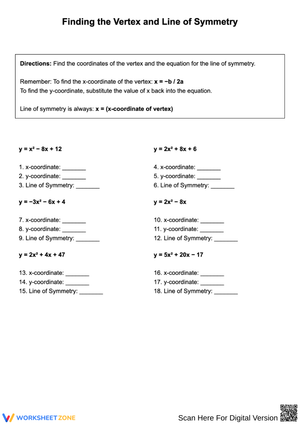
- Identifying a, b, and c from equations in standard form y = ax² + bx + c
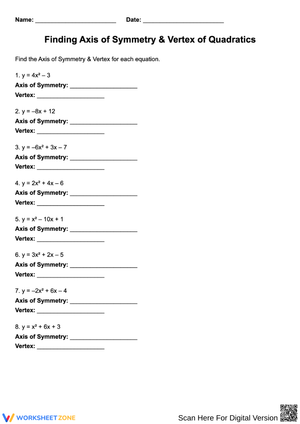
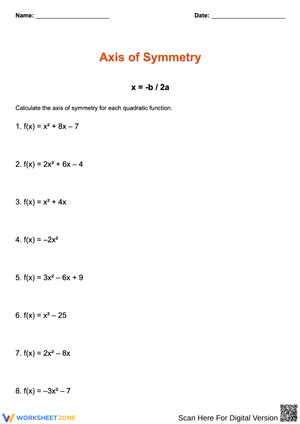
- Applying x = -b/(2a) to find the axis of symmetry
- Substituting that x-value back into the original equation to calculate the y-coordinate of the vertex
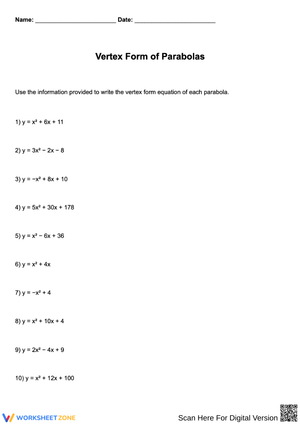
- Reading h and k directly from vertex form y = a(x - h)² + k
- Determining whether the vertex is a minimum (a is greater than 0) or a maximum (a is less than 0)
- Plotting the vertex and axis of symmetry on coordinate grids
- Identifying the y-intercept from standard form as (0, c) to anchor the graph
Several worksheets in the set mix standard form and vertex form within the same problem list. This is deliberate—it forces students to recognize which approach is appropriate before reaching for a procedure, rather than applying the same steps by rote.
Standard Alignment
These worksheets address HSF.IF.C.7a, which calls for students to graph quadratic functions and identify key features including intercepts, maxima, and minima. In a typical 9th grade algebra course, this standard lands mid-unit—after students have encountered quadratic expressions but before they begin solving formally. Teachers who pull axis of symmetry and vertex worksheets for 9th grade at this instructional moment are positioning students to understand parabola behavior before root-finding enters the picture. That sequence matters: students who can locate the vertex and axis of symmetry first have a conceptual reference point for interpreting the solutions they find later. State assessments aligned to HSF.IF.C.7a regularly include items asking students to identify or plot key features without a calculator, so procedural fluency with the vertex formula is directly testable.
Where These Worksheets Fit in the Quadratic Unit
The most reliable use of axis of symmetry and vertex worksheets for 9th grade is as targeted independent practice immediately following direct instruction—when students have seen the procedure once and need enough examples to surface their own errors before the lesson ends. Assign four to six problems in the last fifteen minutes of class, circulate, and note which substitution steps are producing consistent mistakes. That information shapes the next day's warm-up more precisely than any pre-planned review activity.
For station rotations, divide the set by form: standard form problems at one station, vertex form at another, and graphing at a third where students use their calculated vertex and axis of symmetry to sketch a parabola on a provided grid. At the graphing station, having students physically fold their printed worksheet along the axis of symmetry—when a curve is shown—takes about five seconds and lands the concept more concretely than any definition. When the two halves of the parabola align, students understand what "line of symmetry" actually means in a way that sticks.
Exit tickets drawn from the set work well at the end of any introductory lesson on this topic. One standard form problem and one vertex form problem, collected at the door, tell you who is ready for the next step and who needs another pass before roots and factoring enter the picture.
Adjusting the Set for Different Readiness Levels
Students who struggle with fraction arithmetic hit a wall when coefficients like a = 1/2 appear before they've automated the formula steps. Start those students on problems where b is even and a equals 1, so the formula consistently yields a clean integer. Once they can execute the procedure without arithmetic friction, introduce odd values of b that produce fractional x-values—at that point, the fraction doesn't derail the whole calculation because the surrounding steps are already automatic.
For students who move through the standard problems without difficulty, reverse the task: give a vertex and one additional point on the parabola and ask them to write the equation. This requires working backward through the formula and demands a qualitatively different level of understanding. It also connects forward to later work on writing equations from graphs, a skill that appears on many state assessments.
Pairing coordinate grids with the algebraic problems serves students at multiple readiness levels. Students who need to verify their answers visually can graph the result immediately and see whether the vertex placement looks right. Students who are further along use the graph as a quick check—and occasionally notice something in the shape that prompts a question worth following during class discussion.
Frequently Asked Questions
Can these worksheets be used before students have learned vertex form?
Yes. The standard form problems in the set stand on their own. Teachers introducing quadratic functions for the first time can work through those worksheets first and return to vertex form problems once that representation has been formally introduced. The set doesn't require any particular sequence, so teachers select whichever worksheets match their current instructional position in the unit.
My students can execute the formula but don't understand what the axis of symmetry actually is. What helps?
Procedural fluency often outpaces conceptual understanding in algebra—this is a common gap, not a sign that instruction has failed. The most effective repair is graphical: have students draw the axis of symmetry on a parabola by eye first, then verify with the formula. Reversing the usual sequence makes students commit to a visual interpretation before the algebra confirms it. The folding activity described above reinforces the same idea through a different channel.
How many problems does each worksheet in the set contain?
Problem counts vary by skill focus. Worksheets targeting a single procedure—finding the axis of symmetry from standard form, for example—tend to run longer than mixed-format worksheets that combine both forms and include graphing. Teachers using axis of symmetry and vertex worksheets for 9th grade as exit tickets typically pull one or two problems from whichever worksheet matches the day's objective rather than assigning the full set.
Are answer keys included?
Answer keys are included with the set. For formula-based problems, the keys show the substitution step in addition to the final answer, which makes them useful for diagnosing exactly where a student's work diverged from the correct procedure—not just whether the final answer was right or wrong.
Clear All