9th Grade Quadratic Function Word Problems worksheets for Algebra Practice
These 9th grade quadratic function word problems worksheets resources give algebra teachers a ready-to-use set that moves students from reading a real-world situation to building a model, solving it, and explaining what the answer actually means. The contexts — projectile motion, area optimization, revenue scenarios, and fixed-perimeter fencing — give the vertex, zeros, and direction of the parabola a concrete purpose instead of treating them as abstract features to memorize. Each worksheet targets a distinct part of the modeling process, making it easier to pace the work across several days rather than collapsing the whole topic into one session.
What Each Worksheet Targets
Grade 9 students often arrive knowing how to solve a quadratic equation in isolation but stall the moment a paragraph precedes it. These worksheets address that gap directly: students define the variable, identify the known quantities, write a function in the appropriate form, solve or graph, and then interpret the result in a complete sentence. That interpretation step is built into every prompt — not optional, not tacked on as a bonus.
- Defining variables: Students write a clear statement about what quantity is changing before setting up any equation.
- Translating to a model: Problems ask students to choose among standard, vertex, and factored forms based on what information the situation provides.
- Finding key features: Each worksheet requires students to locate the vertex, zeros, and axis of symmetry and connect those values to what the situation describes.
- Applying solving methods: Factoring, completing the square, and the quadratic formula all appear — different problems call for different approaches, and students must decide which.
- Interpreting results: Students write a sentence that answers the actual question, not just reports a number.
Problem Situations Covered in the Set
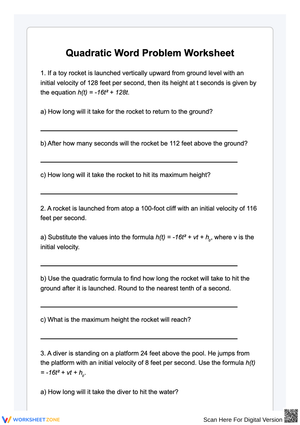
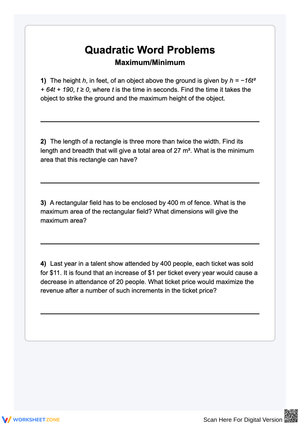
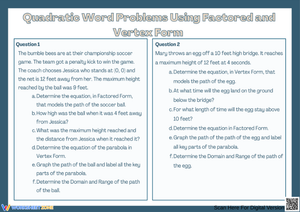
Projectile motion works as an entry point because the graph features map onto physical reality in ways students can verify: the vertex gives maximum height, and the positive zero gives the time the object returns to the ground. A negative time or a height greater than 500 meters in a tennis ball problem signals an error students can catch without teacher prompting. Area problems shift the demand — students must recognize that the equation yields two solutions, determine which one makes geometric sense, and reject the negative root without being told to. Revenue scenarios add a stronger setup requirement: students often need to build the function from a table or verbal rule before any solving can begin. Fixed-perimeter fencing problems are worth including specifically because they show how a quadratic model emerges from combining two linear constraints, giving students a clearer sense of where these equations come from rather than treating them as given.
Where Students' Work Falls Apart — and What to Address
The most persistent error on this topic is interpretive, not algebraic. A student can factor x² − 5x − 14 = 0 to get x = 7 or x = −2 and still write both values in the answer box without determining which one the situation requires. In a fencing context, that means accepting a negative side length. In a projectile context, it means reporting a time before the object was launched. A second consistent gap: students find the x-coordinate of the vertex and stop there, missing that a problem asking for maximum profit needs the y-value — the actual profit figure — not the unit quantity that produces it. Both errors reflect the same underlying confusion between solving an equation and answering the question the problem posed.
A short classroom routine that cuts through both patterns is a three-prompt check after every solution: What does my answer represent? Is this value reasonable for the situation? Did the problem ask for one answer, two, or only the maximum? This takes roughly ninety seconds and surfaces the majority of these errors before the worksheet is submitted.
How to Work These Worksheets Into Your Week
The two-pass approach pays off consistently here. On the first day, students handle the algebra — write the function, find the zeros, locate the vertex. On the second day, they return to the same problems with one question: does every answer make sense in context? That second pass turns up misconceptions that a completion grade would never flag. For warm-ups, two short prompts outperform one long problem — ask students to name what the variable represents and predict whether the parabola opens upward or downward before any solving begins. For independent practice, pairing one projectile problem, one area problem, and one revenue problem on a single worksheet forces students to notice that the same methods apply across very different situations — which is exactly the transfer teachers are working toward.
These 9th grade quadratic function word problems worksheets resources also fit station rotations well. One group matches written scenarios to parabola graphs, a second writes and solves equations from context, and a third critiques pre-written solutions that contain deliberate errors in the interpretation step. That third station tends to produce the most useful discussion in the entire unit — students argue about what the answer should have been and why the reported value makes no sense in the situation.
Different Entry Points, Same Mathematical Goal
The objective stays fixed for every student: read a situation, write a quadratic model, solve it, interpret the result. What varies is the amount of structure on the worksheet. Students who struggle with setup benefit from a guided organizer that prompts them to list known values, state what the variable represents, and complete a sentence frame after solving — The vertex means... or The zero at x = ___ tells me... — so the reasoning stays intact without requiring students to generate academic language from scratch. On-level students work from the standard format: situation, work space, and an open-ended interpretation prompt. Students ready for extension can compare two quadratic models for the same scenario, explain which form is most efficient for a given purpose, or write a situation of their own that produces a specified vertex.
- Students needing additional structure: Guided organizer with labeled steps, provided diagram, and sentence frames for interpretation.
- On-level students: Standard problem format with work space and an open interpretation prompt.
- Extension students: Comparison tasks, form-selection justifications, or student-generated problems with given constraints.
Because PDF resources print consistently, preparing a version with additional structure and a standard version of the same problem set takes far less planning time than rebuilding the lesson from scratch. A small pull-out group and the rest of the class can work from different versions during the same period.
Standard Alignment
These worksheets align primarily to CCSS.MATH.CONTENT.HSF.IF.B.4, which requires students to interpret key features of functions — intercepts, maximums, minimums — in terms of a context. This standard sits in the Algebra I pathway, placing it squarely in Grade 9 scope for most course sequences. Secondary alignment to CCSS.MATH.CONTENT.HSA.CED.A.1 applies whenever students write a quadratic model from a described situation rather than working from an equation already provided, which most problems in this set require.
Frequently Asked Questions
What problem types are most appropriate for Grade 9 quadratic word problem practice?
Projectile motion, area optimization, and revenue scenarios form the core of a well-built set. Each type gives the vertex and zeros a distinct, checkable real-world meaning — maximum height, largest possible dimension, greatest profit. Fixed-perimeter fencing problems add an important structural lesson: students see how a quadratic arises from two linear constraints working together, which deepens understanding beyond solving technique alone.
How do these worksheets handle the shift from solving equations to interpreting functions?
Every problem prompt includes a required interpretation step — students finish by writing a sentence that answers the actual question, not by circling a number. Some worksheets also include a structured organizer that separates defining variables, writing the function, solving, and explaining the result into distinct steps. Interpretation is treated as part of the mathematical task, not a writing exercise appended at the end.
Can these be used with intervention or small-group reteach?
The 9th grade quadratic function word problems worksheets format makes it straightforward to print two or three problems per session for a small group working at a slower pace. Sentence frames for the interpretation step keep the mathematical demand in place while removing the blank-page pressure. Teachers can also split the cognitive work across two sessions — one focused on writing the model, a separate session on solving and interpreting — without needing to create new materials for each group.
In what order should the worksheets be assigned across a unit?
Most teachers find success starting with graph reading — identifying key features from a given parabola — then moving to equation writing from context, then assigning mixed application problems. That sequence lets students interpret a visual model before they are asked to build one from text alone. Paced that way, 9th grade quadratic function word problems worksheets resources slot into a two-to-three-week Algebra I unit without leaving gaps that require supplemental materials to fill.
Clear All