


























Views
Downloads
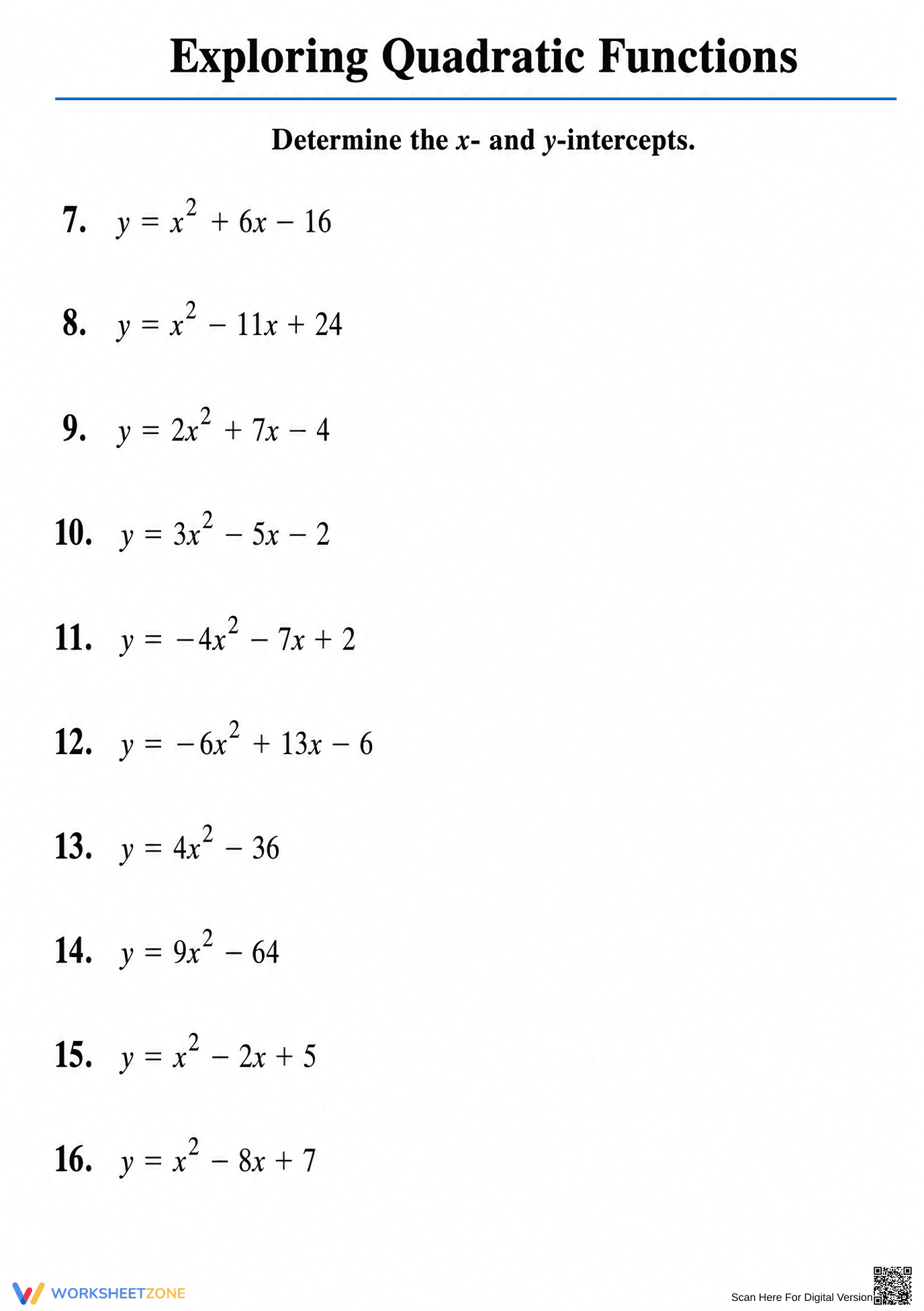

Exploring Quadratic Intercepts | Essential Grade 9 Math
Paste this activity's link or code into your existing LMS (Google Classroom, Canvas, Teams, Schoology, Moodle, etc.).
Students can open and work on the activity right away, with no student login required.
You'll still be able to track student progress and results from your teacher account.
This Grade 9 algebra worksheet provides targeted practice in identifying the key features of quadratic functions. Students will master the process of calculating both x-intercepts and y-intercepts from standard form equations. By solving these 10 problems, learners bridge the gap between algebraic manipulation and graphical understanding of parabolas.
At a Glance
- Grade: 9 · Subject: Algebra
- Standard:
HSF-IF.C.7.A— Graph quadratic functions and show intercepts, maxima, and minima- Skill Focus: X- and Y-Intercept Calculation
- Format: 1 page · 10 problems · Answer key included · PDF
- Best For: Independent practice and formative assessment
- Time: 20–30 minutes
This single-page PDF features 10 quadratic equations presented in standard form (y = ax² + bx + c). The layout provides clear spacing for students to show their algebraic work, whether using factoring, the quadratic formula, or completing the square to find roots. A comprehensive answer key is provided to facilitate quick grading or student self-correction.
- Guided practice: The first few problems feature monic quadratics with easily factorable trinomials to build initial confidence and reinforce the concept of setting y to zero.
- Supported practice: Middle problems introduce non-monic coefficients and negative leading terms, requiring more rigorous factoring or use of the quadratic formula.
- Independent practice: The final set includes equations with larger constants and potential non-integer roots to test mastery of the calculation process.
This sequence follows a gradual-release model, moving from simple root identification to complex algebraic solving.
Standards Alignment
This resource aligns with HSF-IF.C.7.A: "Graph functions expressed symbolically and show key features of the graph, by hand in simple cases and using technology for more complicated cases." It specifically targets the identification of intercepts. Both standard codes can be copied directly into lesson plans, IEP goals, or district curriculum mapping tools.
How to Use It
Use this worksheet as a mid-unit formative assessment after students have learned the quadratic formula and factoring. It is ideal for a "You Do" phase of a lesson. Teachers should observe if students correctly set x=0 for the y-intercept versus y=0 for the x-intercept. Expected completion time is 20 to 30 minutes.
Who It's For
Designed for Grade 9 Algebra 1 students, this resource is also suitable for Grade 10 or 11 students in Algebra 2 needing a refresher on parabola properties. It pairs naturally with a graphing calculator activity or an anchor chart detailing the standard form of quadratic functions.
According to the RAND AIRS 2024 report on secondary mathematics, repetitive procedural practice in identifying function intercepts is a critical precursor to successful graphical analysis and higher-order modeling. This worksheet addresses the HSF-IF.C.7.A standard by requiring students to algebraically determine the x- and y-intercepts of ten distinct quadratic equations. By isolating this specific skill, the resource allows educators to identify precise misconceptions in solving for roots before moving into complex graphing tasks. Research from Fisher & Frey (2014) emphasizes that such targeted practice supports the scaffolding necessary for students to achieve mastery in algebraic functions. This printable PDF serves as a reliable tool for classroom instruction, homework, or intervention groups, ensuring students can fluently transition between symbolic representations and the coordinate plane.


