9th Grade Factor Trinomial Worksheets
These factor trinomial printable worksheets for 9th grade give algebra teachers a focused set of practice resources for one of the most technically demanding transitions in first-year algebra — moving from multiplying binomials to reversing that process. The set covers the full range of quadratic expressions students encounter in Algebra 1, from simple trinomials with a leading coefficient of one through cases that require identifying and removing a GCF before any other method applies.
The Specific Skills Each Worksheet Targets
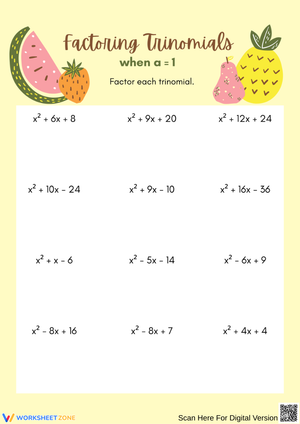
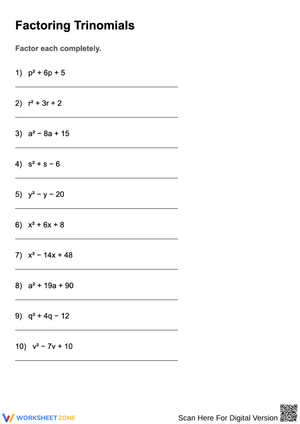
The progression across the set mirrors how most Algebra 1 teachers sequence the unit. Early worksheets have students work with trinomials of the form x² + bx + c, identifying two integers that multiply to the constant term and sum to the middle coefficient. That sounds straightforward until students hit cases where both b and c are negative — which is where initial confusion reliably lives.
Later worksheets address trinomials where the leading coefficient is greater than one, using the AC method: multiply a and c, find the factor pair that sums to b, rewrite the middle term, then factor by grouping. Each worksheet in that section keeps the four-step structure visible so students can track exactly where they are in the process. The set also includes worksheets focused entirely on pulling out a GCF before factoring — a step many students skip when they see a factorable quadratic and want to jump straight to binomials.
Mistakes Students Make That These Worksheets Help You Catch
Sign errors dominate the mistake log at this stage. When c is positive and b is negative — as in x² − 7x + 12 — students consistently write (x + 3)(x + 4) because they found numbers that multiply to 12 and add to 7 without attending to sign. They've been chasing magnitude, not signed value. The answer-check column built into each worksheet catches this immediately: when a student expands (x + 3)(x + 4) and gets x² + 7x + 12, the mismatch is undeniable and the correction is right there in front of them.
A second pattern worth watching: when the leading coefficient is greater than one, some students skip the GCF step and launch straight into the AC method. They'll arrive at a factored form that still has a common factor hiding inside — writing (2x − 6)(x + 1) instead of 2(x − 3)(x + 1). Building a GCF check as step zero on every AC-method worksheet addresses this before it calcifies into habit.
Standard Alignment
These worksheets align with CCSS HSA-SSE.B.3, which asks students to choose and produce an equivalent form of an expression to reveal properties of the quantity it represents. Factoring a quadratic trinomial to find its zeros is the direct classroom application of that standard — students aren't just manipulating symbols; they're uncovering the x-intercepts of a parabola. The set also supports HSA-APR.B.3, identifying zeros of polynomials and using them to construct rough graphs, a standard that typically appears several weeks after factoring is introduced. Teachers who plan ahead can use the factoring worksheets early in the unit and return to them when graphing quadratics, reinforcing the connection between factored form and x-intercepts without reteaching from scratch.
Fitting These Worksheets Into Lesson Plans Without Losing Momentum
The most reliable pattern is one worksheet at the start of class as a focused warm-up — not the full set in a single sitting. A focused eight-problem worksheet targeting one case type, such as leading coefficient greater than one with all positive coefficients, takes about twelve minutes and leaves enough class time for direct instruction on the next variation. Running multiple case types together in one long session tends to produce rushed work and procedural confusion rather than resolving it.
For the factor trinomial printable worksheets for 9th grade that use the AC method, try cutting each worksheet into rows of three or four problems and handing students one strip at a time. They bring the completed strip to your desk for a quick check before getting the next one. It converts a standard practice worksheet into a self-paced formative loop with zero additional prep. It also surfaces the student who's on strip five before most classmates have finished strip two — and the student who's been staring at strip one for ten minutes and needs a different entry point entirely.
Paired work adds another layer on the AC-method worksheets specifically. One student calls out the steps aloud while the other writes and watches for sign errors. Switching roles at the midpoint keeps both students active. This isn't group work in the loose sense; it's structured accountability at the problem level, and it makes sign errors audible before they get written down.
Adjusting These Worksheets for a Mixed-Ability Classroom
For students who are still shaky on integer operations — a genuine issue in 9th grade when arithmetic gaps haven't fully closed — the early worksheets work best with a multiplication table kept visible. That's not a shortcut; it directs cognitive effort toward the factoring logic rather than toward fact recall. Once the process is secure, remove the table.
Students who move quickly through the a = 1 problems need problems where a GCF is a binomial, or trinomials that are prime and require students to identify and state that no factorization exists. Including un-factorable trinomials on a worksheet is one of the more honest challenges available: students who only encounter trinomials that factor neatly develop false confidence, and the first time they hit a prime trinomial on a test, they'll stall and second-guess themselves on everything after it.
The factor trinomial printable worksheets for 9th grade that use error-analysis problems work well across all levels. Presenting a completed problem with a sign error embedded in it and asking students to locate and correct the mistake requires reconstructing the reasoning rather than just executing a procedure — which reveals understanding that standard practice problems don't always surface.
Frequently Asked Questions
Which method should I teach first — trial and error or the AC method?
Most Algebra 1 teachers introduce trial and error for the a = 1 case because it keeps the cognitive load manageable at the start of the unit. The AC method becomes necessary when the leading coefficient is greater than one, and students who learned a systematic approach early tend to transfer to it more smoothly. Teaching trial and error for a = 1, then explicitly connecting that logic to the AC method for a greater than 1, gives students a coherent progression rather than two disconnected procedures.
How do I decide where to start in the set?
A short diagnostic — eight to ten problems covering GCF identification, basic multiplication of binomials, and integer operations with signed numbers — tells you exactly which worksheet is the right entry point. Assigning a leading-coefficient-greater-than-one worksheet to a student who is still unsure about multiplying binomials creates frustration that looks like a factoring problem but isn't.
Do the worksheets include answer keys?
Yes. Each worksheet comes with a full answer key. For the AC-method worksheets, the key shows the intermediate step — the rewritten four-term polynomial before grouping — not just the final factored form. When a student's answer is wrong, you need to see where the process broke down. A key that shows only the endpoint doesn't help with that diagnosis.
Are these suitable for test prep?
The mixed-review worksheets, which combine a = 1 cases, a greater than 1 cases, and expressions requiring a GCF step, mirror the format students see on most Algebra 1 unit tests and state assessments. The factor trinomial printable worksheets for 9th grade that incorporate error analysis are particularly strong for test prep because they require the verification thinking that prevents careless errors on an exam — students learn to distrust a quick answer and check it before moving on.
Clear All