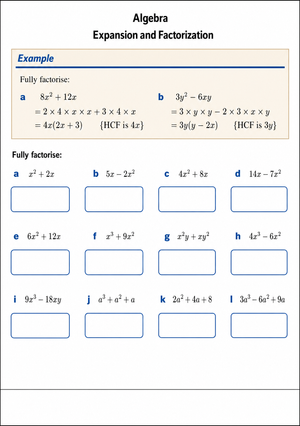
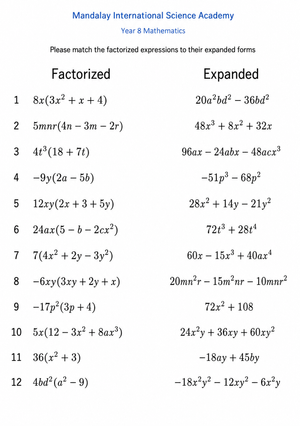
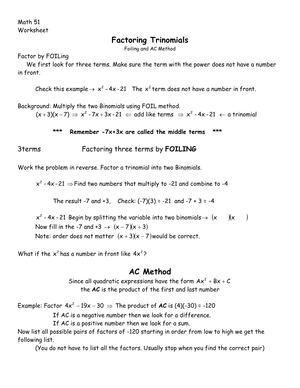
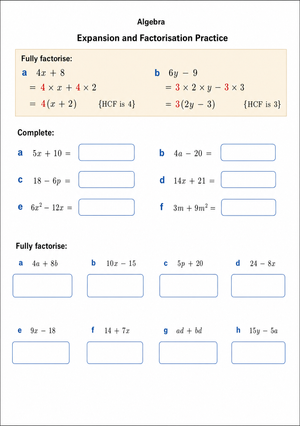
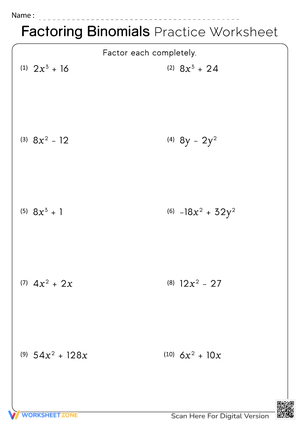
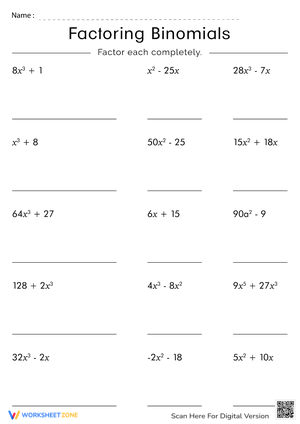
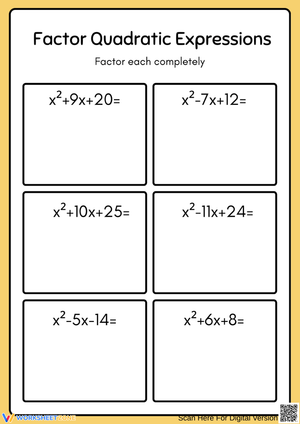
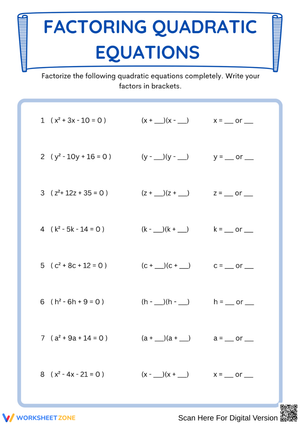
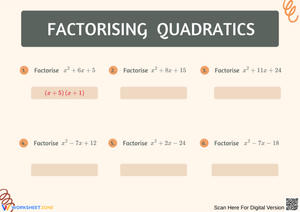
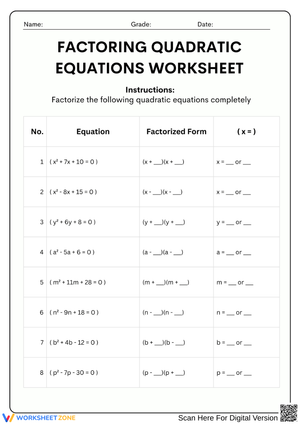
These factoring expressions printable worksheets for 9th grade cover the four methods Algebra 1 students need to master: extracting the greatest common factor, factoring monic trinomials, applying the difference of squares pattern, and working through four-term polynomials by grouping. Each worksheet targets one method before the set moves into mixed practice, so students build pattern recognition before they're asked to choose among techniques.
The Specific Skills Targeted
The set works through methods in the sequence most Algebra 1 teachers already follow:
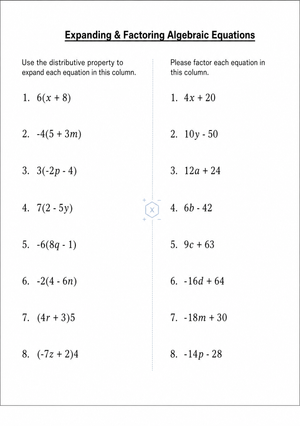
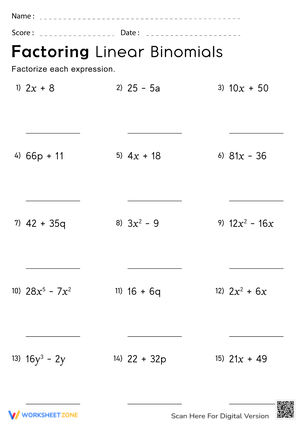
- Greatest Common Factor: Students identify the largest factor shared by all terms and rewrite the expression — the step every other method depends on being done first.
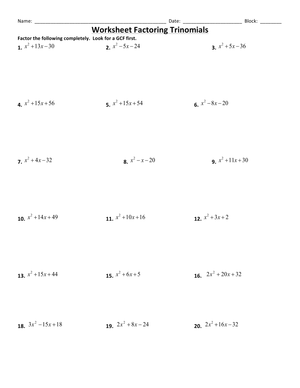
- Monic trinomials (leading coefficient of 1): Students find factor pairs of the constant term that add to the middle coefficient, then write the two binomial factors.
- Non-monic trinomials (leading coefficient greater than 1): Problems include expressions like 3x^2 + 10x + 8 and 2x^2 - 5x - 3, where students must account for how outer and inner FOIL products combine — not just first and last terms.
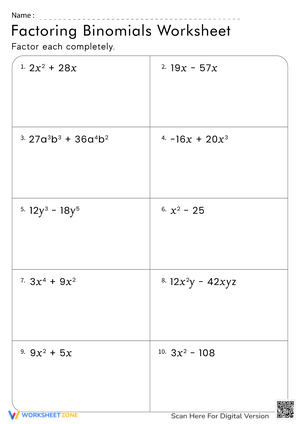
- Difference of squares: Students recognize a^2 - b^2 and factor it as (a + b)(a - b), including cases where the perfect square involves a coefficient rather than a single variable.
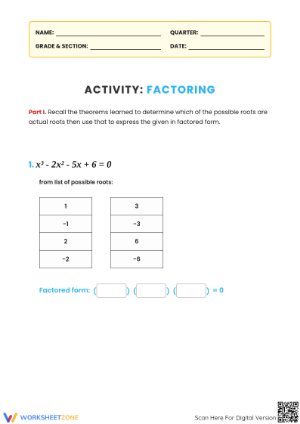
- Factoring by grouping: Four-term polynomials where students pull a GCF from each pair of terms, then factor out the shared binomial factor.
The mixed-method worksheet that closes the set carries no method labels. Recognizing which approach applies is the skill the entire unit builds toward, and that worksheet is where students find out whether they've actually internalized that judgment.
Common Misconceptions to Watch For and Correct
The most consistent sign error in student work: a 9th grader who correctly factors x^2 + 7x + 10 as (x + 2)(x + 5) will often write (x - 2)(x - 5) for x^2 - 7x + 10 — which happens to be right — and then fail on x^2 - 3x - 10 because the logic breaks down. The underlying confusion is that they're mimicking sign placement rather than applying a rule. A negative constant in a trinomial means opposite signs in the binomial factors; the sign of the middle term tells them which factor is larger in absolute value. Without that principle explicitly learned, sign errors are predictable, and you can trace exactly where they'll surface across the trinomial worksheet.
A separate problem appears in the difference of squares section. Students sometimes apply the pattern to x^2 + 49 and write (x + 7)(x - 7), treating a sum of squares as though it factors. It doesn't, over the integers, and the confusion carries consequences: when students reach quadratic equations, a non-factorable sum of squares requires completing the square or the quadratic formula. A student who's been misapplying this pattern will reach for factors that don't exist. Catching it on a worksheet is far more useful than discovering it mid-assessment.
In grouping problems, the most persistent error is failing to factor out a negative GCF from the second pair of terms. In x^3 - 2x^2 - 3x + 6, the correct grouping gives x^2(x - 2) - 3(x - 2), and the shared binomial is visible. But students who write the second pair as + 3(-x + 2) lose the common factor entirely and conclude the expression doesn't factor — missing the result (x^2 - 3)(x - 2) completely.
Standard Alignment
These worksheets align to CCSS HSA-SSE.A.2, which asks students to use the structure of an expression to identify ways to rewrite it. In instructional terms, this standard calls for students to look at 6x^2 - 54 and recognize 6(x^2 - 9) before they see 6(x + 3)(x - 3) — the GCF step isn't a preliminary formality, it's the move that makes the next pattern visible. The standard appears in the Algebra 1 sequence after polynomial multiplication, and these worksheets sit precisely at that junction: students who've practiced expanding via FOIL and the distributive property now reverse the process across structured problems. The same structural thinking carries directly into rational expressions and polynomial division in later units.
How to Work These Worksheets Into Your Lesson Planning
The single-method format makes the planning decision straightforward: assign the matching worksheet the same day you introduce each method. Work the first four to six problems with the class under direct instruction, release students to finish independently, and use the last few minutes on class discussion of any disagreements. One worksheet per day keeps the unit moving without overcrowding any single lesson.
Teachers who download factoring expressions printable worksheets for 9th grade often use the mixed-method worksheet twice — once as a mid-unit formative check and again as a take-home review the night before the unit test. The two attempts rarely look identical, which is informative. Students who perform well in class and less well at home often reveal that they've been relying on proximity to their notes more than they realized.
Station rotations fit this set naturally. One method per station, four to six students at each, rotating every twelve to fifteen minutes. Students who need more time with monic trinomials can stay for a second rotation while others advance to grouping — a differentiation move that doesn't require producing separate materials on the spot.
Adjusting the Set for Mixed-Ability Classrooms
When using the factoring expressions printable worksheets for 9th grade with students who need more support, the most practical adjustment is narrowing the integer range. Problems where both binomial constants are small, single-digit positive numbers reduce working-memory load without changing what's actually being learned. Once those feel automatic, introduce negative constants in the trinomial before adding a negative middle term — each sign change is its own cognitive step, and introducing them together at once is precisely what causes students to freeze and guess.
For students who move through the standard problems quickly, ask them to produce the fully factored form of every expression — including pulling out any GCF before applying a second method. An expression like 2x^2 + 10x + 12 factors to 2(x + 2)(x + 3), not (2x + 4)(x + 3). Students who stop at partial factoring won't catch that distinction without an explicit expectation to go further. Pairing this requirement with the mixed-method worksheet is a challenge that holds up for most advanced students through the end of the unit.
Frequently Asked Questions
Do these worksheets address non-monic trinomials, or only cases where the leading coefficient is 1?
The set includes a dedicated worksheet for non-monic trinomials, with problems like 3x^2 + 11x + 6 and 4x^2 - 4x - 3. Problems are sequenced by difficulty within that worksheet — expressions with a leading coefficient of 2 appear before those with larger coefficients, and all-positive cases come before mixed-sign problems. Answer keys are included for every worksheet in the set.
What should I do if students are stuck on GCF before the trinomial work even begins?
Assign the GCF worksheet on its own before any trinomial work begins, and read the results diagnostically. Students who struggle there likely have gaps in integer factor knowledge — they can't quickly confirm that 12 and 18 share a GCF of 6. A ten-minute warm-up listing factor pairs for numbers through 60 usually closes that gap in a single class period. The GCF worksheet then becomes a confidence builder rather than a roadblock, and students approach trinomials without carrying unresolved confusion about divisibility into a more complex task.
How directly do these resources connect to solving quadratic equations by factoring?
Factoring expressions printable worksheets for 9th grade build the exact prerequisite skills for solving ax^2 + bx + c = 0 by factoring: students must recognize the factorable structure of a quadratic, factor it correctly — GCF first — and then apply the zero-product property to each binomial factor. A student who can reliably factor non-monic trinomials is ready for the equation-solving lessons that follow. The connection is direct enough that many teachers assign a quick review of the factoring worksheets the day before introducing the zero-product property, using student performance there to decide how much reteaching, if any, the class needs before moving on.














 Interactive Worksheet Maker
 Quiz Maker
 Word Search Maker
 Crossword Puzzle Maker
 Word Scramble Generator
 Sentence Scramble Generator
 Handwriting Worksheet Generator
 Name Tracing Generator
 Fill In The Blank Generator




 BACK TOSCHOOL