




























Views
Downloads


Grade 9 Polynomial Theorems — Printable No-Prep Worksheet

Paste this activity's link or code into your existing LMS (Google Classroom, Canvas, Teams, Schoology, Moodle, etc.).
Students can open and work on the activity right away, with no student login required.
You'll still be able to track student progress and results from your teacher account.
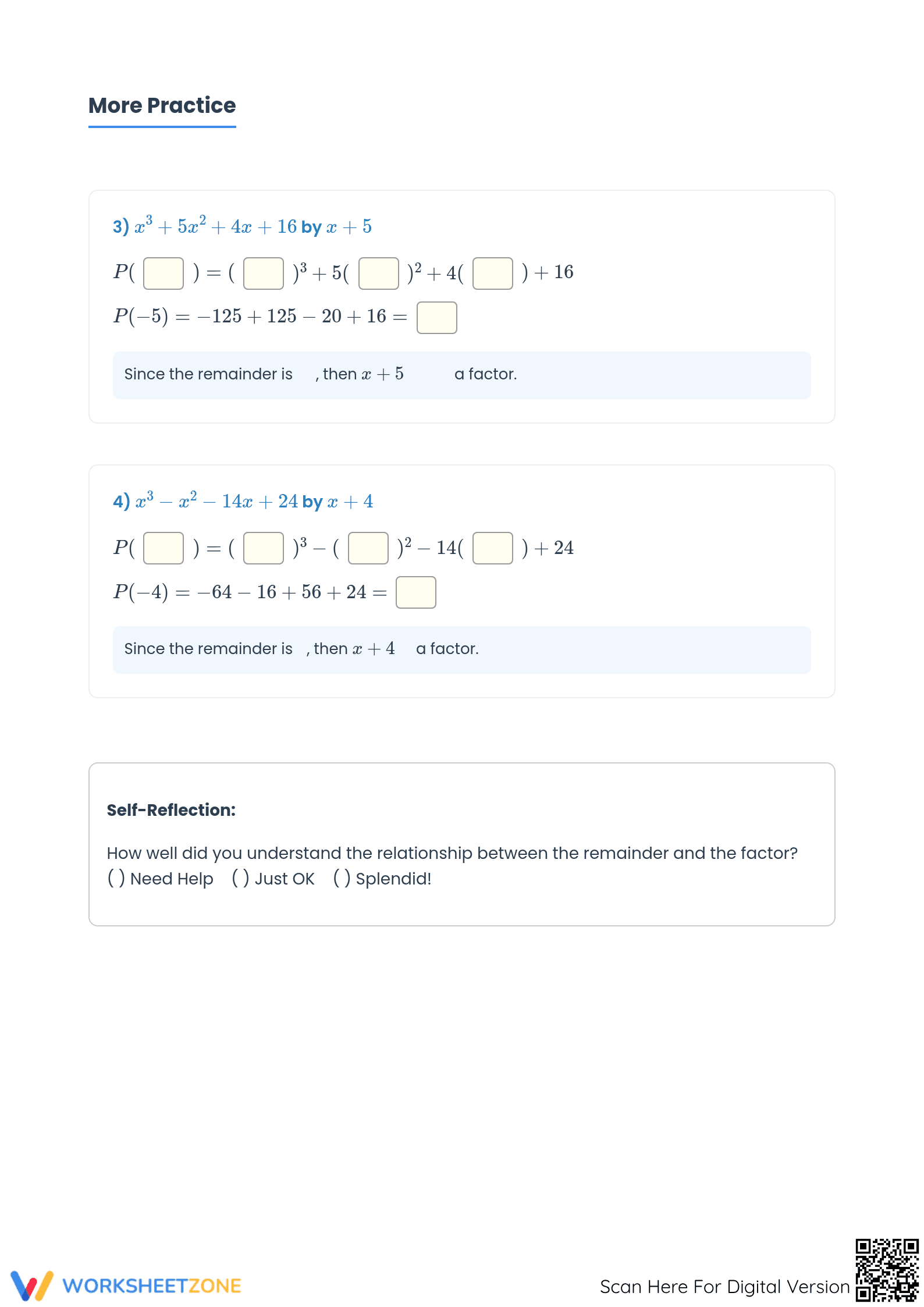
This Grade 9 math worksheet provides students with structured practice applying the Remainder and Factor Theorems to evaluate polynomials. By using fill-in-the-blank scaffolding, learners can confidently determine remainders and identify factors without performing long division. The built-in concept review makes this an ideal resource for immediate classroom application.
At a Glance
- Grade: 9 · Subject: Math
- Standard:
HSA.APR.B.2— Apply the Remainder Theorem to find factors of polynomials.- Skill Focus: Remainder and Factor Theorems
- Format: 2 pages · 4 problems · Answer key included · PDF
- Best For: Independent practice and review
- Time: 15–20 minutes
This two-page resource features a "Key Concepts" reference box defining both theorems. It includes four scaffolded problems where students substitute values into polynomial functions to find the remainder and determine if the binomial is a factor. The fill-in-the-blank format guides students through algebraic steps, reducing cognitive overload. A self-reflection check encourages metacognition, and an answer key is provided.
Zero-Prep Workflow
This resource requires under two minutes of total teacher prep time. Because definitions are printed directly on the page, it is highly suitable for substitute plans.
- Print (1 minute): Download the PDF and print double-sided copies for your class roster.
- Distribute (1 minute): Hand out the worksheets. Students can read the Key Concepts box to immediately start working without a preliminary mini-lesson.
- Review (5 minutes): Use the included answer key to quickly check student work or project it on the board for self-correction.
Standards Alignment
This worksheet is directly aligned to CCSS.MATH.CONTENT.HSA.APR.B.2: "Know and apply the Remainder Theorem: For a polynomial p(x) and a number a, the remainder on division by x - a is p(a), so p(a) = 0 if and only if (x - a) is a factor of p(x)." The scaffolded tasks ensure students master this exact algebraic relationship. Both standard codes can be copied directly into lesson plans, IEP goals, or district curriculum mapping tools.
How to Use It
Formative Assessment: Assign this after direct instruction on polynomial division. Observe whether students correctly identify the sign of the constant 'c' when substituting. This is a common misconception the fill-in-the-blank format catches early.
Substitute Plan: Because the worksheet includes a review of the core theorems, it functions perfectly as an independent assignment. Students can complete the four problems and self-reflection in 15 to 20 minutes.
Who It's For
This resource is optimized for Grade 9 Algebra or Pre-Calculus students who are learning polynomial functions. The heavy scaffolding makes it particularly effective for students who struggle with multi-step algebraic procedures or those who need IEP accommodations for guided notes. It pairs perfectly with an introductory direct instruction lesson on synthetic division, providing a simpler alternative method for finding remainders.
Mastering algebraic rules requires structured repetition and clear examples. This worksheet targets HSA.APR.B.2, helping students apply the Remainder Theorem to find factors of polynomials. According to a 2024 report by EdReports, instructional materials that provide explicit scaffolding and embedded concept reviews significantly improve student retention of complex algebraic theorems. By integrating the definitions directly onto the practice page, this resource reduces the cognitive load required to switch between textbooks and practice sheets. The fill-in-the-blank format ensures students focus on the specific mechanism of substitution rather than getting lost in basic arithmetic errors. This targeted approach allows learners to build confidence and accuracy simultaneously, creating a solid foundation for more advanced graphing, factoring, and rational expression tasks later in the high school math curriculum unit.


