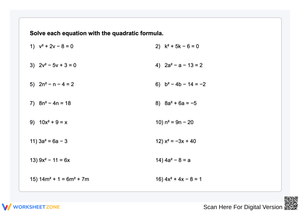
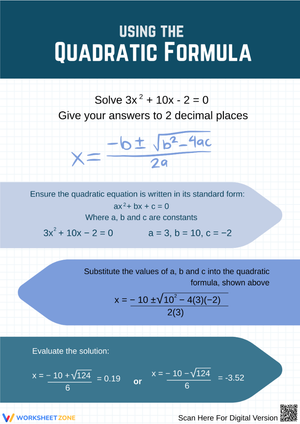
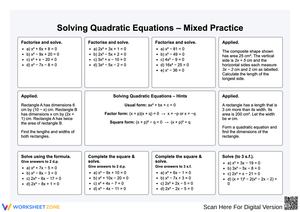
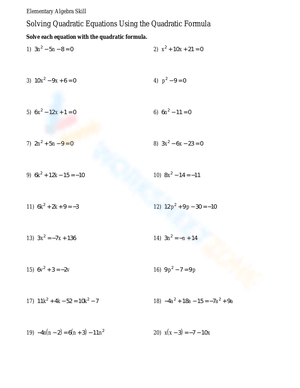
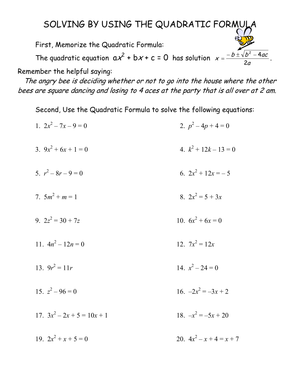
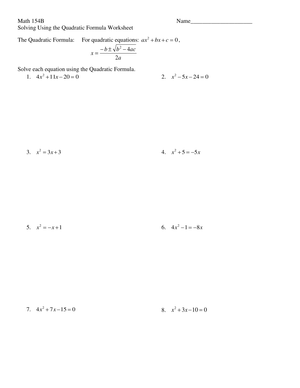
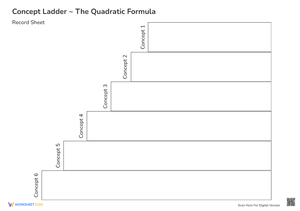
These 9th grade quadratic formula pdf worksheets give Algebra 1 teachers a direct route to procedural fluency on one of the most consistently tested skills in the high school math curriculum. The collection spans entry-level coefficient identification, discriminant evaluation, full formula application, and error analysis — enough range that teachers can revisit the same topic across three different lesson days without repeating a problem set.
What's Covered Across the Set
Each worksheet targets one clearly defined phase of the solving process. That specificity matters in practice: it lets teachers address a particular gap directly rather than assigning a general review that mixes levels and slows down students who already have part of it. The resources cover:
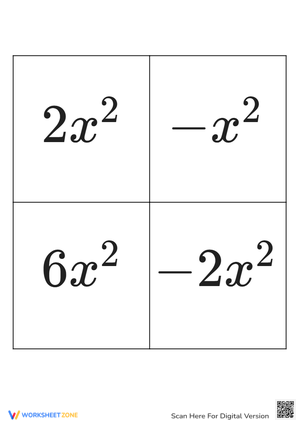
- Identifying coefficients a, b, and c from equations already in standard form, including cases where b or c equals zero
- Evaluating the discriminant (b² − 4ac) as a standalone step and classifying the number of real solutions before computing any roots
- Applying the full formula to equations with integer coefficients and positive or zero discriminants
- Rearranging equations not yet in standard form — terms on both sides of the equal sign, or binomials not yet expanded — before solving
- Simplifying irrational roots that result from non-perfect-square discriminants
- Analyzing intentionally flawed worked examples to locate and correct errors in substitution and simplification
Teaching the Discriminant Before the Full Formula
Several worksheets in the set isolate b² − 4ac as a standalone exercise before students compute any roots. The reason is practical: if a student evaluates the discriminant and arrives at a negative value on a problem where that shouldn't happen, that result is a signal to recheck the substitution rather than push forward into an imaginary result they can't interpret in Algebra 1. Sign errors during substitution can manufacture a false negative discriminant even when the actual answer is real. Teaching students to treat this step as a checkpoint — and to name the result as positive, zero, or negative before continuing — builds self-monitoring habits that carry into every subsequent algebra unit.
The discriminant worksheets ask students to classify each equation before continuing: two distinct real roots (positive discriminant), one repeated real root (discriminant equal to zero), or no real roots (negative discriminant). Naming the category before computing the full solution is also a question type that appears on Algebra 1 end-of-course assessments, making this practice doubly useful in the weeks before testing.
Where Students Go Wrong With the Quadratic Formula
Two errors appear in student work far more often than anything else. The first is the negative-b problem: when b = −6, students write −6 in the numerator of the formula instead of +6. They see the negative in the original coefficient and carry it forward without applying the formula's own negation. The formula already has −b built in — if b = −6, then −b = −(−6) = +6. Students who aren't tracking signs carefully substitute the raw coefficient value rather than its negation, and the mistake is easy to miss because the wrong sign produces a result that looks structurally reasonable. The second error is about the fraction bar: students split the calculation and divide only the ±√discriminant portion by 2a, leaving −b sitting above the denominator untouched. The expression that results resembles the formula closely enough that students don't notice the arithmetic has gone wrong.
The 9th grade quadratic formula pdf worksheets that target these patterns require students to use parentheses at every substitution point as a non-negotiable step. Writing (−6) in place of b during substitution forces the arithmetic into the open rather than letting it vanish inside a mental shortcut. The error analysis worksheets go further: students receive a finished-but-wrong solution and must find the mistake, explain the reasoning error, and redo the problem correctly. Correcting someone else's sign error turns out to be more effective preparation than simply being told to avoid making one.
Fitting These Worksheets Into Your Weekly Instruction
Error analysis worksheets work well as Monday warm-ups or exit tickets — they take eight to ten minutes and immediately reveal whether students retained the formula mechanics from the previous class. Coefficient identification and discriminant classification worksheets fit the closing ten minutes of an introductory lesson, when students have seen one or two worked examples and need to practice the entry step before the lesson ends. The rearranging problems belong later in the unit, once the formula itself feels automatic, because managing algebraic manipulation and formula application simultaneously places more cognitive demand than either task alone.
These 9th grade quadratic formula pdf worksheets also support structured small-group work with assigned roles: one student identifies and records a, b, and c; a second evaluates the discriminant and names the expected number of solutions; a third carries out the full calculation. That structure slows down students who rush and make careless substitutions, and it gives every group member a specific contribution. When the discriminant prediction doesn't match the final solution count, the three-minute discussion that follows is worth the class time.
Standard Alignment
These resources align to CCSS HSA-REI.B.4b, which requires students to solve quadratic equations using the quadratic formula and to recognize when solutions involve complex numbers. In Algebra 1, the instructional focus stays on cases where the discriminant is zero or positive — real solutions only — with complex roots introduced by name but not practiced formally until Algebra 2. Every equation in this set yields real solutions, which keeps students working on formula mechanics without the interruption of a number system they haven't formally studied. That matches the assessment reality: 9th-grade standardized tests and end-of-course exams test the real-solution cases almost exclusively at this level.
Differentiating the Set Across Ability Levels
Students who need more time with the foundation do well staying on the coefficient identification worksheets until they can name a, b, and c quickly from any standard-form equation — including equations with an implicit coefficient of 1 that goes unmarked, or equations missing one term entirely. The obstacle for these students is usually not the formula mechanics but the reading step: they misidentify which term belongs where, especially when the constant appears first or the middle term is absent. Clearing that up before introducing the formula removes one significant source of downstream arithmetic error.
The 9th grade quadratic formula pdf worksheets in this set divide cleanly by skill, which means teachers running a tiered lesson can hand different worksheets to different groups without making the distinction visually obvious to students. Everyone is working on quadratic formula practice; the entry point just differs. For students ready to move further, the rearranging problems and applied word problems add real difficulty without requiring separate materials. Asking an advanced student to write a plausible-but-wrong worked example for a partner to catch extends the work even further and reinforces the same error-awareness the rest of the class is building through analysis.
Frequently Asked Questions
When should 9th graders reach for the quadratic formula instead of factoring?
Factoring is faster when it works cleanly, and students should attempt it first — but the practical test is whether they can find integer factor pairs within about thirty seconds. When roots are irrational, or coefficients are large enough that factor pairs aren't obvious, the formula is the right call. A reliable classroom guideline: if the factors don't surface quickly, stop and switch. Using the formula on a factorable equation adds a few steps but costs nothing in accuracy.
What helps students actually memorize the formula?
Writing the formula from memory at the top of every worksheet — before working a single problem — is more effective than any mnemonic strategy used in isolation. After two weeks of that habit, most students no longer have to think about where the negative b or the 2a belongs. For students who want an additional hook, singing the formula to the melody of "Pop Goes the Weasel" tends to stick quickly. The key is that the formula needs to be produced repeatedly in active use, not just recognized when it appears on a reference sheet.
Do any worksheets in the set include equations that need rearranging before solving?
Yes. The intermediate and advanced worksheets present equations where terms appear on both sides of the equal sign or where a product hasn't been expanded yet. Students must collect and combine terms to reach standard form before they can identify coefficients and apply the formula. This reflects what students encounter on end-of-year assessments, where equations are rarely pre-arranged as a convenience.














 Interactive Worksheet Maker
 Quiz Maker
 Word Search Maker
 Crossword Puzzle Maker
 Word Scramble Generator
 Sentence Scramble Generator
 Handwriting Worksheet Generator
 Name Tracing Generator
 Fill In The Blank Generator




 BACK TOSCHOOL