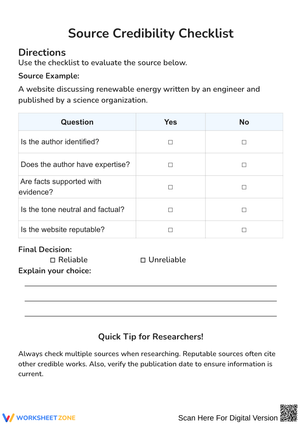
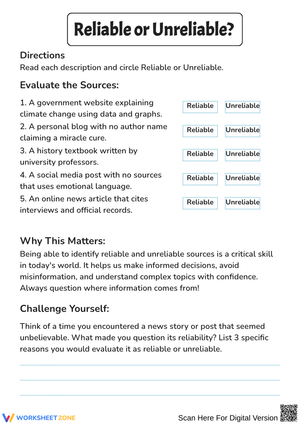
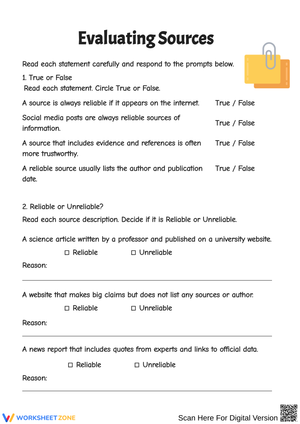
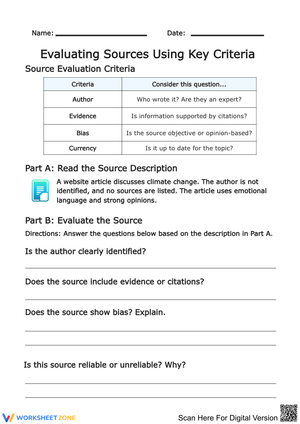
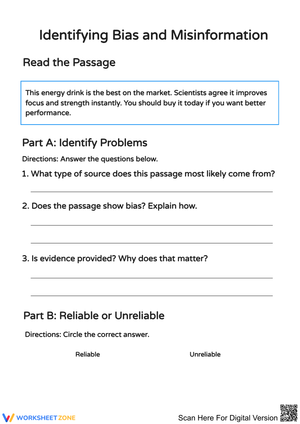
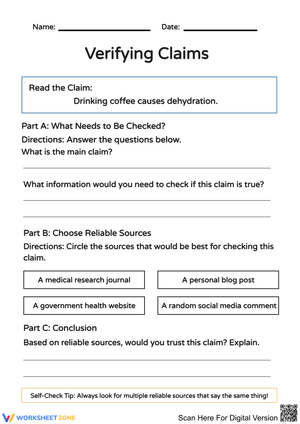
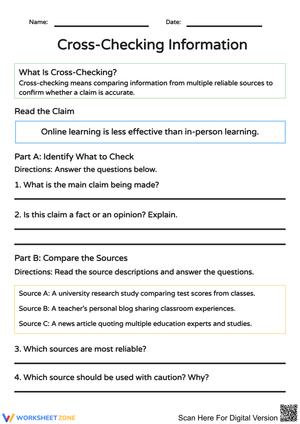
These 9th grade reliable and unreliable sources worksheets give ELA teachers a structured, printable way to move students beyond gut-level judgments and into systematic source analysis — the kind of work W.9-10.8 actually requires. Each worksheet targets a discrete step in the evaluation process, so teachers can sequence them across a research unit rather than handing students a single all-in-one checklist and hoping it sticks.
What Students Practice Across the Set
The worksheets address source evaluation as a cluster of distinct skills, not a single act of judgment. Students work through the CRAAP framework — Currency, Relevance, Authority, Accuracy, and Purpose — applying each criterion to a real source and recording textual evidence before arriving at a credibility rating. A separate worksheet introduces lateral reading: rather than judging a site by its own About page, students open additional sources to verify the author's credentials and check whether independent outlets have cited or challenged the site's claims. This mirrors how professional fact-checkers actually work, and it's a meaningful departure from the standard "look for .gov or .edu" heuristic most 9th graders arrive with.
Other worksheets address primary versus secondary classification, sponsored content identification, and editorial bias recognition. Students underline language that signals opinion, flag missing perspectives in article excerpts, and annotate passages where funding disclosures are buried or absent. One worksheet presents a matched pair — one reliable source and one unreliable source covering the same topic — and asks students to write a short paragraph defending which they would cite. That side-by-side format forces students to name specific evaluation criteria rather than defer to surface impressions like "it looks professional."
Standard Alignment
These worksheets align to CCSS.ELA-LITERACY.W.9-10.8, which requires students to gather information from multiple authoritative print and digital sources, assess the credibility and accuracy of each source, and integrate the information selectively while avoiding plagiarism. The standard sits at the intersection of research and argumentation — students are expected to evaluate sources not in the abstract but in service of a specific claim or inquiry. Each worksheet in the set reinforces this connection by asking students to explain not just whether a source is credible but whether it is credible enough for a stated research purpose. That distinction matters for 9th graders who are just beginning to manage multi-source research assignments independently.
Frequent Student Errors Worth Anticipating Before the Lesson
The most consistent error is treating domain extension as a credibility proxy. Students who know ".gov is good" will mark a government database entry as automatically credible without reading for accuracy or currency — a problem that surfaces immediately when they cite an archived policy page that was superseded three years ago. A worksheet prompt that asks "What is the publication or last-updated date, and does it matter for your research question?" addresses this directly.
A subtler error appears when students evaluate sponsored content. Many 9th graders read a disclosure label like "Paid Partnership" or "Sponsored" and still rate the source as reliable because the article is well-written and the claims sound plausible. They're conflating production quality with editorial independence. Worksheets that include a real example of native advertising — where the sponsored nature is disclosed but easy to overlook — and ask students to explain how funding source affects purpose tend to surface this confusion clearly enough to address in discussion.
Students also struggle with the lateral reading step specifically. The instinct is to stay on the page being evaluated. Building in an explicit instruction — "Before rating this source, open two additional tabs and record what you find there" — helps, but expect to model this process at least twice before students do it unprompted.
Fitting These Worksheets Into Your Lesson Planning
The most effective placement for introductory worksheets is a 15-minute whole-class modeling block before any independent research begins. Project a source, walk through the evaluation criteria aloud, and fill in one worksheet together before releasing students to complete a second one independently. That gradual release sequence keeps students from treating the worksheet as busywork — they've seen what a completed, evidence-based evaluation actually looks like.
For research paper units, attaching a completed evaluation worksheet to each bibliography entry as a submission requirement changes how students select sources. They stop choosing the first result that confirms their thesis and start asking whether the source can withstand scrutiny. The worksheets also give teachers a formative window into students' research reasoning, not just the final citation list.
Station rotations work particularly well with this set. Assign one source type per station — a peer-reviewed journal abstract, a news article, a blog post, a government database entry, a social media thread — and give students five to seven minutes per station to complete an evaluation sheet. The debrief conversation after all rotations generates the most useful discussion: students frequently disagree on credibility ratings, and working through those disagreements out loud is where the real learning happens.
Frequently Asked Questions
How do these worksheets fit into a larger research unit, and where should they appear in the sequence?
Introduce the evaluation worksheets before students begin independent source gathering, not after. If students collect sources first and evaluate them second, they've already committed to a set and tend to rationalize credibility rather than assess it. Using an evaluation worksheet during the selection phase — while students still have the option to discard a source — produces more honest analysis and better final bibliographies.
Can these worksheets be used for digital sources as well as print materials?
Yes. The evaluation criteria apply to both, and the lateral reading prompts are specifically designed for digital sources, where checking author credentials and cross-referencing claims across tabs is both practical and fast. For print materials like textbooks or journal articles, the currency and sponsorship prompts still apply — the publication date, the funding source listed in an academic abstract, and the editorial policies of a journal are all checkable details students should record.
What makes a source evaluation worksheet strong enough to double as a formative assessment?
A worksheet functions as formative assessment when it requires students to record specific evidence — a quoted phrase, a date, a named author credential — rather than circling "yes" or "no" on a checklist. The synthesis question at the end, asking students to make and defend a credibility judgment in two or three sentences, gives teachers a direct look at whether students can connect evaluation criteria to a reasoned conclusion. That paragraph tells you more than any checkbox grid.












 Interactive Worksheet Maker
 Quiz Maker
 Word Search Maker
 Crossword Puzzle Maker
 Word Scramble Generator
 Sentence Scramble Generator
 Handwriting Worksheet Generator
 Name Tracing Generator
 Fill In The Blank Generator