These 8th grade heat transfer printable worksheets resources give middle school teachers a ready set of targeted practice for the exact moment in a unit when students have seen demonstrations and lab results but still struggle to put what they observed into writing. At Grade 8, the expectation isn't identification alone — students need to explain why a temperature difference drives thermal energy movement, and that requires structured practice across varied question types and everyday contexts. The set covers conduction, convection, and radiation through diagram labeling, scenario sorting, and short constructed-response tasks.
The Specific Skills Each Worksheet Targets
The strongest worksheets ask students to do more than match a transfer mode to a definition. Each worksheet pushes students to classify examples, explain the mechanism, and interpret diagrams — not just retrieve vocabulary. That distinction matters because the gap between "students can name conduction" and "students can explain why a pan handle heats up" is exactly where Grade 8 understanding tends to stall.
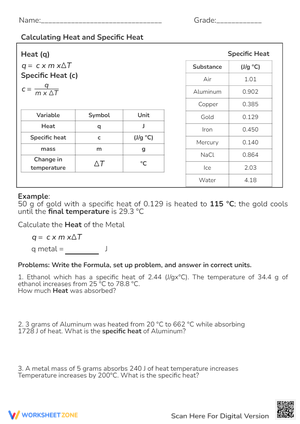
Question types across the set include diagram labeling, scenario sorting with written justification, compare-and-contrast prompts, and short CER-style constructed responses. Students identify the heat source, trace the direction of energy movement, and describe what causes the transfer. They also work through comparison tasks — which material slows energy transfer more effectively? what happens to the rate if the sample size increases? — that build toward the design-thinking applications the NGSS asks of 8th graders.
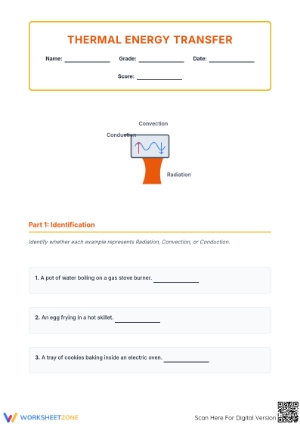
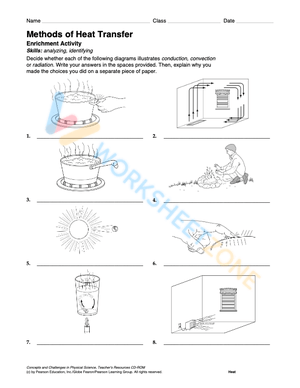
- Classify situations as conduction, convection, or radiation and justify each choice in writing.
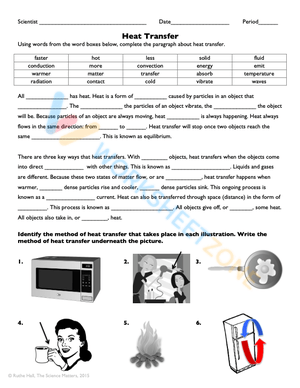
- Interpret diagrams showing particle movement, fluid circulation patterns, or radiant energy paths.
- Compare two materials, container designs, or environmental conditions and predict which transfers thermal energy faster.
- Write short evidence-based responses after a demonstration or lab investigation.
- Apply transfer concepts to familiar contexts: insulated cups, oven mitts, building materials, sea breezes, sunlight on asphalt.
Mistakes Students Make That These Worksheets Help You Catch
The most persistent error isn't mislabeling radiation. It's that students conflate "heat transfer" with "heat production." When shown a diagram of a stove burner heating a pot, many write that the burner "creates heat in the pot" rather than explaining that thermal energy moves from a region of higher temperature to lower temperature. That wording difference signals a real conceptual gap — they haven't internalized that the direction of transfer is governed by temperature difference, not by a source "making" heat inside an object.
A second pattern shows up with radiation specifically. Students tend to associate radiation with very hot objects — the Sun, an open flame — and get thrown off when asked whether a warm cup or a human body transfers energy radiantly. Questions that use body heat or room-temperature surfaces as the source surface that misconception quickly, and they're worth including in any review set.
Convection in liquids produces its own reliable error. Students who correctly describe warm air rising will often describe the bottom of a heated pot "pushing" water upward rather than explaining that less dense warm water rises while cooler, denser water sinks to replace it. Diagram questions showing fluid circulation arrows reveal exactly that confusion — and give teachers a clean reteach target before the assessment.
Building These Worksheets Into Your Weekly Instruction
The most efficient bell-ringer use is a single scenario at the start of class during the middle of an energy unit. Give students a situation — a cast-iron skillet left on a gas burner — and ask them to name the transfer type and write one sentence explaining the mechanism. That takes eight minutes at most and gives a clear read on where each student stands before the lesson begins. Students who write "the pan gets hot" without mentioning temperature difference need a different entry point that day than students who correctly describe particle-to-particle energy movement.
Multi-question worksheets work well as lab debriefs. Students annotate diagrams first, then use their observations to complete the short-response items. That sequence keeps writing grounded in what they actually saw rather than what they think they're supposed to say — a distinction that matters for NGSS-style explanation tasks, where "I know the answer" and "I can explain what I observed" are not the same thing.
The 8th grade heat transfer printable worksheets format fits naturally into station rotations. One station uses diagram labeling, a second uses scenario sorting with written justification, and a third asks students to compare two materials and predict which slows thermal energy transfer more effectively. Three stations, one prep, and each produces written evidence teachers can review before the next class.
Standard Alignment
The NGSS performance expectation MS-PS3-4 asks students to plan an investigation to determine how thermal energy transfer is affected by material type, sample size, and surrounding environment. When 8th grade heat transfer printable worksheets tasks ask students to compare how changing material or container conditions affects the rate of transfer, they're doing exactly what MS-PS3-4 requires — not as a lab, but as the written explanation that connects lab observations to scientific reasoning.
In classroom terms, MS-PS3-4 belongs in 8th grade because this is when students are expected to shift from descriptive observation ("the water got warmer") to causal explanation ("thermal energy transferred from the burner to the water because of the temperature difference between them"). A worksheet that asks students to write that causal sentence — after a lab, after a demonstration, or after sorting examples — gives teachers written evidence of whether that conceptual shift has happened. A multiple-choice quiz cannot show that distinction.
Adapting Each Worksheet for a Range of Learners
For students still building their grasp of the three modes, limit the sorting field. Rather than presenting ten mixed examples all at once, give them five examples alongside a labeled reference diagram showing one clear example of each mode. Students still classify and justify — the reasoning task stays intact — but the working-memory demand drops enough that the conceptual work becomes more accessible. Keeping the task structure the same while reducing the volume is usually more effective than switching to a simpler worksheet altogether.
On-level classes handle the full question range well: classify, justify, interpret diagrams, write a short constructed response. For extension, push toward design-thinking comparisons — ask students to explain why two materials transfer heat at different rates, then write a claim about which design choice (insulation type, container material, the presence of a lid) would be most effective under specific conditions. That application level goes beyond the standard without requiring a separate resource.
One honest limitation: worksheets that use particle-model diagrams — showing fast-moving particles near a heat source versus slow-moving particles farther away — will frustrate students who haven't seen that representation before. If the class hasn't worked with particle models in direct instruction, preview the diagram format explicitly before asking students to interpret one independently. Skipping that step produces confused answers that reflect unfamiliarity with the diagram convention, not gaps in understanding of heat transfer itself.
Frequently Asked Questions
Can these worksheets be used before students have done a lab on heat transfer?
Yes, and the purpose shifts depending on timing. Before a lab, a prediction-focused worksheet asks students to sort scenarios and anticipate outcomes — that surfaces prior knowledge and existing misconceptions. After the lab, a response-focused worksheet asks students to explain what they observed using thermal energy vocabulary. Pre-lab use reveals what students already believe; post-lab use asks them to build a written explanation from evidence. The same worksheet can sometimes serve both purposes if teachers use only selected items at each stage.
What's a practical way to check student work without using the whole class period?
For diagram labeling and sorting tasks, display a completed answer and give students 90 seconds to self-check before class discussion. For short-response items, pull two or three student responses — one solid, one incomplete, one with a clear misconception — and discuss what makes each one work or fall short. That targeted review takes fewer than ten minutes and gives students a concrete model of what a complete explanation includes. It also makes the common errors visible to the whole class, which tends to produce better corrections than individual written feedback alone.
Are these appropriate for a substitute day?
The 8th grade heat transfer printable worksheets set works well as a sub plan because each worksheet is self-contained with clear directions. Print an answer key with brief notes on what makes a response acceptable, and plan a short class discussion for the following day to address anything students found confusing. Sorting and labeling tasks need no special setup — students can work independently or with a partner, which gives a substitute a manageable routine without requiring any science background.
How do these worksheets support students who find science writing difficult?
The set includes diagram labeling and scenario sorting tasks alongside short-response items, so students who struggle with writing have a genuine entry point that doesn't start with a blank response field. Once students have worked through the visual and sorting tasks, the written questions have a clearer foundation to build on. A useful two-step move: ask students to annotate the diagram first, then use their annotations as reference when they write the response. That approach reduces the blank-page freeze that slows many 8th graders on constructed-response tasks — and usually produces more specific answers than asking students to write cold.












 Interactive Worksheet Maker
 Quiz Maker
 Word Search Maker
 Crossword Puzzle Maker
 Word Scramble Generator
 Sentence Scramble Generator
 Handwriting Worksheet Generator
 Name Tracing Generator
 Fill In The Blank Generator