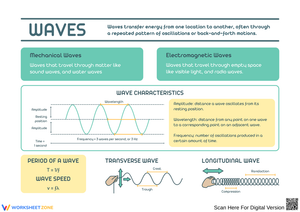
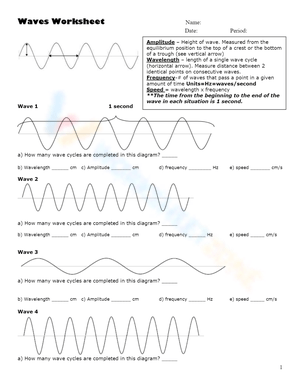
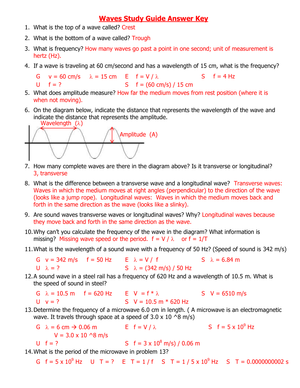
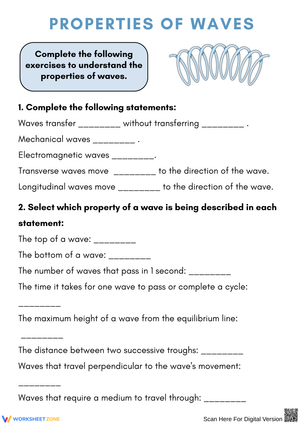
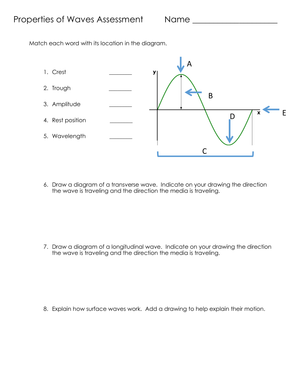
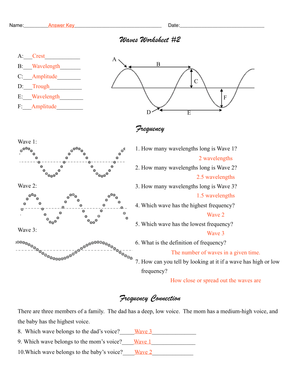
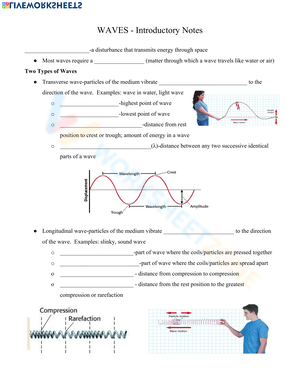
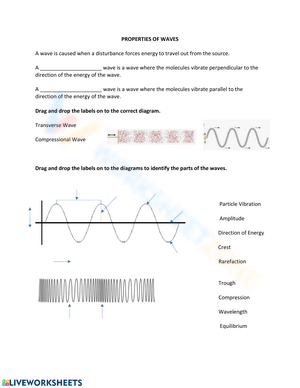
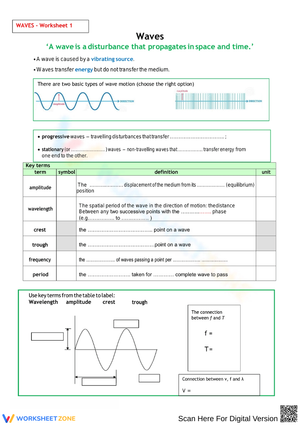
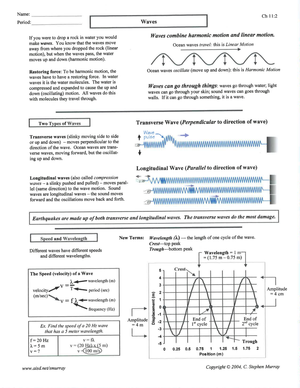
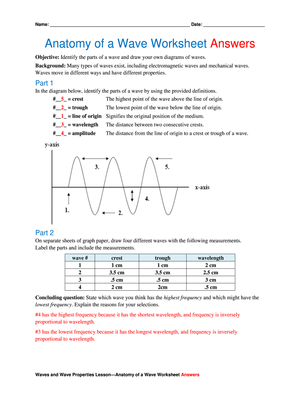
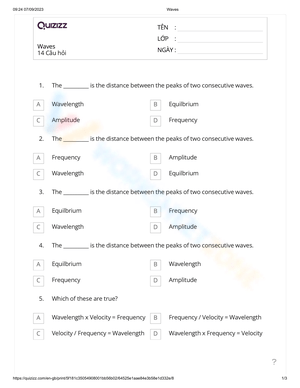
These waves printable worksheets for 8th grade give science teachers ready-to-use practice across the full arc of a middle school wave unit — from labeling crest, trough, wavelength, and amplitude on a diagram to writing short explanations of why sound echoes in a hallway or why light reflects off a glass surface differently than it transmits through one. The set addresses both mechanical and electromagnetic waves, so a single resource block carries students from foundational property work through the interactions that appear on NGSS performance tasks and end-of-unit assessments.
The Specific Skills These Worksheets Target
Each worksheet focuses on a narrow slice of the wave content 8th graders are expected to control by the end of the unit. That range spans diagram interpretation, property comparison, category sorting, and short constructed responses that ask students to connect a wave model to an observed phenomenon.
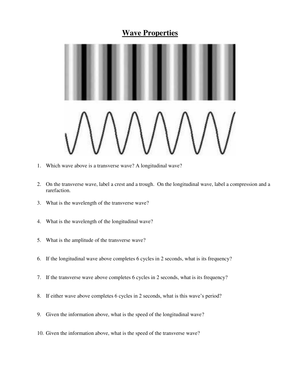
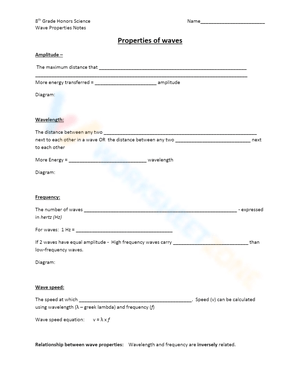
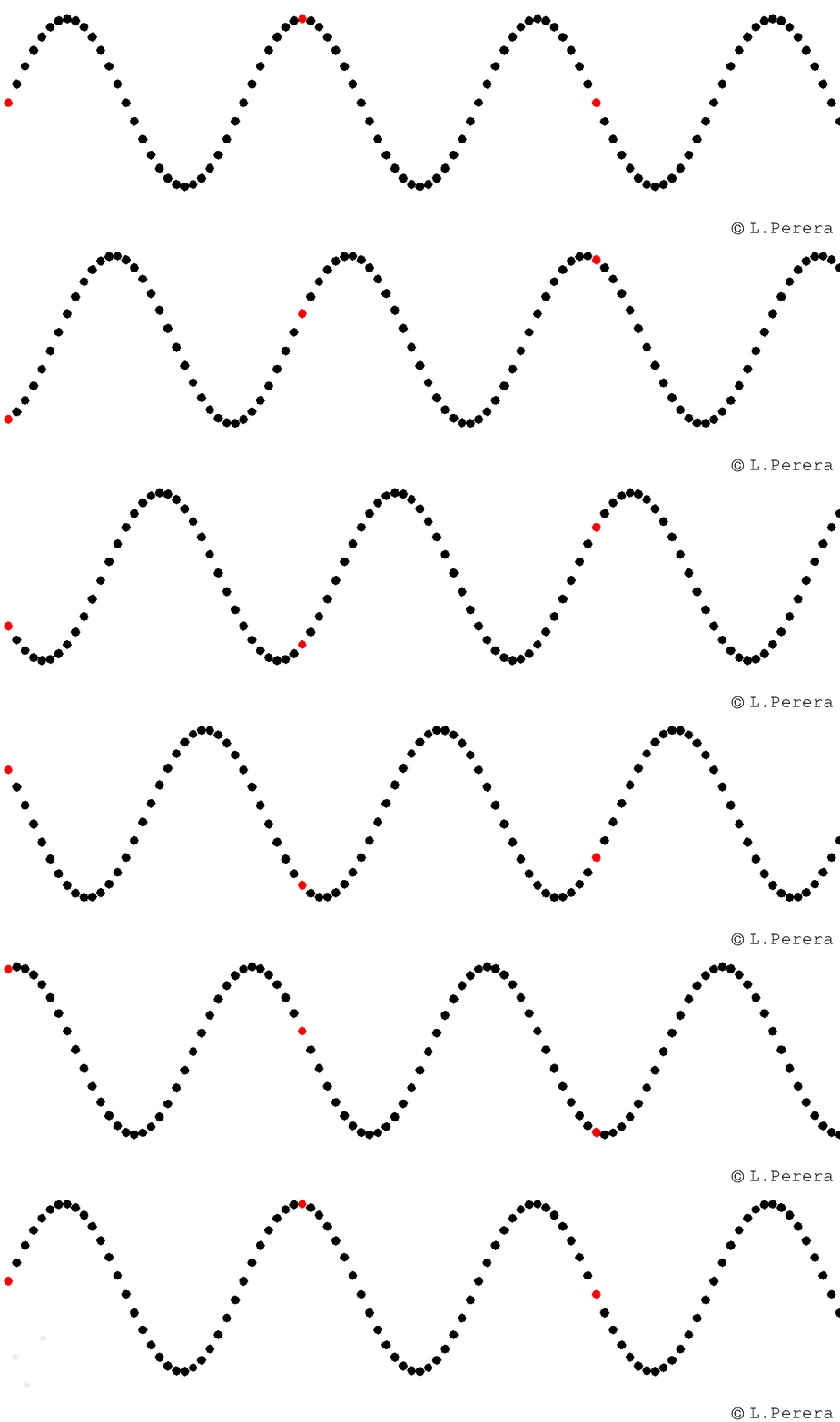
- Labeling crest, trough, wavelength, and amplitude from a diagram — without the word bank, not just with it
- Comparing two waves and identifying which carries more energy based on amplitude, or which has higher frequency based on wavelength spacing
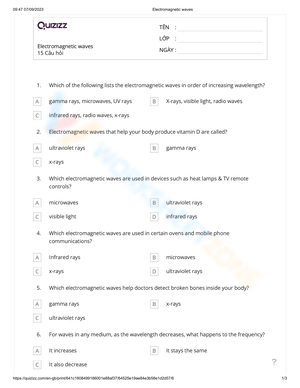
- Sorting wave examples into mechanical and electromagnetic categories using defining characteristics rather than memorized lists
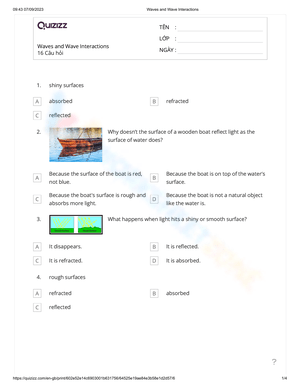
- Explaining reflection, absorption, and transmission through familiar phenomena — mirrors, curtains, windows, acoustical tile
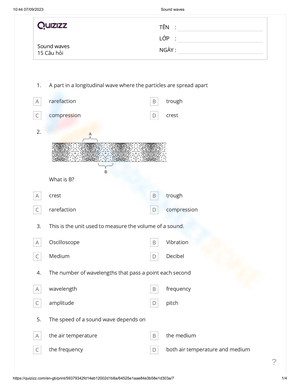
- Connecting frequency and pitch, or amplitude and volume, in written sentences rather than column-matching tasks
- Describing why light travels through space while sound requires a medium, with evidence drawn directly from a diagram
The constructed-response items earn their place. Students who correctly circle the higher-amplitude wave on a diagram will sometimes still write that "a louder sound has more frequency" in a sentence answer. Short written prompts surface that kind of error in a way that diagram identification alone cannot, and they give teachers something to act on before the unit test.
Mistakes Students Make That These Worksheets Help You Catch
The amplitude-frequency confusion is the most consistent error in wave units at this grade level, and it is worth naming precisely. Students see both properties displayed on the same diagram and assume they are related — so when asked what causes a higher-pitched sound, they sometimes point to the taller wave rather than the more compressed one. This is not carelessness. It reflects genuine ambiguity in how wave diagrams present two independent variables side by side. Worksheets that hold amplitude constant while changing frequency — or vice versa — make that independence explicit in a way that a single mixed diagram does not.
A second durable misconception involves the medium requirement for wave travel. After learning that sound needs matter to move through, students often extend that rule to all waves. Ask a class why astronauts can see the sun but cannot hear explosions in space, and a noticeable portion will explain that "waves can't travel that far" rather than identifying the absence of a medium as the reason sound fails and the electromagnetic nature of light as the reason it succeeds. Short-response items that require students to cite wave type — not just describe the observation — catch this before it calcifies into a permanent confusion.
Standard Alignment
This set targets NGSS MS-PS4, Waves and Their Applications in Technologies for Information Transfer. Two performance expectations are most directly addressed. MS-PS4-1 asks students to use mathematical representations of amplitude and wavelength to describe wave properties and their relationship to wave energy — the foundation of every diagram comparison task in the set. MS-PS4-2 asks students to develop and use a model to describe how waves are reflected, absorbed, or transmitted through various materials, which anchors the constructed-response and real-world scenario items. Teachers working with a state-adopted framework that adapts NGSS will find the content maps cleanly, since wave properties and interactions are standard middle school physical science across most state frameworks.
Building These Worksheets Into Your Wave Unit Plan
Treat each worksheet as a functional tool for a specific moment in the lesson rather than a linear assignment to work through in sequence. Diagram labeling works well as an entry task at the start of a class period — five minutes gives students a concrete reference point before discussion begins. A short comparison item (two waves, a question about frequency, a question about amplitude) makes a clean formative stop at the end of direct instruction. The constructed-response items are best saved for the end of a lesson or for a Friday retrieval block, when the goal is consolidation rather than first encounter.
Waves printable worksheets for 8th grade are also practical for station rotations and sub plans. In a four-station rotation, one worksheet on diagram labeling, one on sorting mechanical and electromagnetic examples, and one on written reflection and transmission explanations give each group a different cognitive task without requiring the teacher to build three separate activities from scratch. A substitute can manage diagram-based practice with response prompts reliably — and the collected worksheets give the classroom teacher real data to work from the next day rather than a blank space where instruction should have happened.
Adjusting the Set for a Mixed-Ability Classroom
Differentiating a wave unit is more manageable when the core content stays constant and the task demand shifts. Selecting among waves printable worksheets for 8th grade by task type rather than by difficulty label gives teams a practical way to serve multiple groups without developing separate materials. Students who are still building foundational understanding do better starting with identification tasks — labeling a diagram, selecting the wave with higher frequency from two visual options — before moving to explanation. Students who have the basic model handled need prompts that push into transfer: explain why noise-canceling headphones use absorption rather than reflection, or describe what would happen to a sound's pitch if its wavelength doubled while everything else stayed the same.
For students who stall on written prompts even when they understand the concept, the fix is usually a format adjustment rather than content removal. Letting students annotate directly on the diagram — drawing arrows, labeling with phrases instead of full sentences — reveals genuine understanding that a strict written-response format would obscure. That is an honest tradeoff of short-response items, and it is worth planning for rather than discovering at grading time.
Frequently Asked Questions
Do these worksheets cover both sound and light, or one at a time?
Both. Some worksheets focus on one wave type in depth — the amplitude-frequency relationship in sound, for example — while others place sound and light side by side so students work through the comparison directly. The mixed items are especially useful for the mechanical-versus-electromagnetic distinction because students encounter the contrast in context rather than as an isolated definition.
What grade level are these materials written for?
The content and language target 8th grade, aligning with middle school physical science expectations under NGSS MS-PS4. The diagram tasks and sorting activities work for intervention groups in 8th grade or strong 7th graders finishing a wave unit early. The constructed-response items assume students have had instruction in wave properties first — these are practice and review resources, not first-instruction materials.
How should these worksheets be used for formative assessment rather than just practice?
The short constructed-response items are the strongest formative tool in the set. After students complete one, collect the responses and sort them by error type — amplitude-frequency confusion, medium-dependency overgeneralization, and correct understanding typically cluster visibly. That sorting takes about four minutes and produces clearer instructional direction than a multiple-choice score does. Waves printable worksheets for 8th grade work particularly well in this role because the format makes student thinking visible without the scoring overhead of a formal quiz.












 Interactive Worksheet Maker
 Quiz Maker
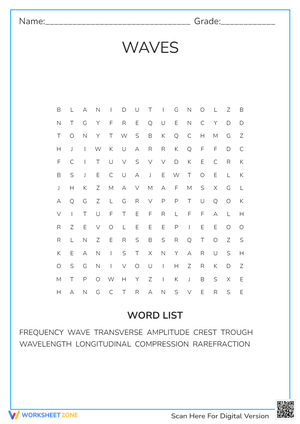
 Word Search Maker
 Crossword Puzzle Maker
 Word Scramble Generator
 Sentence Scramble Generator
 Handwriting Worksheet Generator
 Name Tracing Generator
 Fill In The Blank Generator