Printable Conservation of Energy Practice for 8th Grade Science Teachers
8th grade conservation of energy printable worksheets give science teachers a concrete tool for the moment when students can recite the law but cannot yet account for where the energy actually went. These resources cover energy transfer, energy transformation, and the evidence-based reasoning NGSS expects at the middle school level — ready to print and use the same day.
The Specific Skills These Worksheets Target
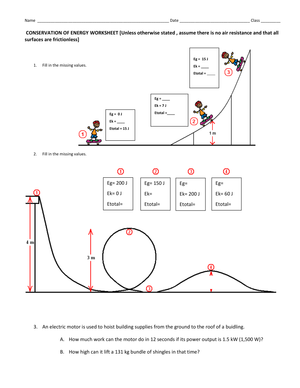
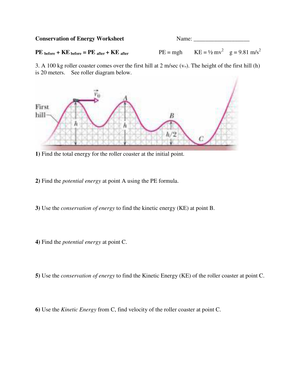
Each worksheet asks students to work inside a defined system — a roller coaster run, a bouncing ball, a simple circuit, a speaker — and trace energy as it changes form or moves between objects. The tasks go beyond term matching. Students label diagrams showing gravitational potential energy converting to kinetic energy, identify where friction introduces thermal energy into a mechanical system, and explain in writing why the total energy in a closed system stays constant even when motion visibly decreases.
The energy forms students work with across the set include gravitational potential, kinetic, thermal, sound, electrical, and light energy. The scenarios are chosen because they make otherwise invisible transfers arguable from evidence. A student analyzing a roller coaster must account for the heat and sound produced by the wheels and track, not just the speed at the bottom of the hill. That accounting step is what separates surface-level recall from genuine scientific reasoning at this grade.
Errors Students Make That These Worksheets Help Surface
The most persistent error in grade 8 energy work is what might be called the disappearance assumption: students write that energy was "lost" when an object slows down or a bouncing ball reaches a lower height on each rebound. They accept "energy is conserved" as a slogan without connecting it to a physical account. In written responses, this shows up as explanations that stop at the last visible form — "the ball slowed down because it lost energy" — rather than tracing that motion into the thermal and sound energy produced by impact and air resistance.
A second pattern appears specifically with circuits. Students who correctly identify electrical energy as the input often forget that a bulb produces thermal energy alongside light — they describe a flashlight as converting electricity to light, full stop. Asking students to annotate an energy-flow diagram forces that omission into view. A third error, subtler, is treating each energy transformation as a discrete event rather than a continuous process. Students mark "kinetic energy to thermal energy" as if the conversion happens at a single moment, rather than understanding it as ongoing throughout the motion itself. The written-response format on these worksheets makes all three errors visible in student work before a unit test does.
Fitting These Worksheets Into Your Lesson-Planning Routine
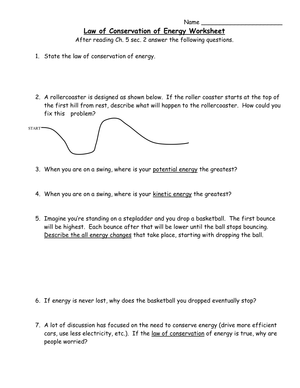
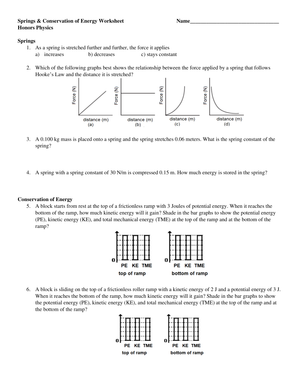
The format fits common grade 8 routines without much setup. Early in a unit, a diagram-only worksheet — where students label energy forms and draw transfer arrows — gives a low-stakes entry before any extended writing is required. After direct instruction on the law of conservation of energy, a scenario worksheet asking for a two-sentence claim-and-evidence response works as a formative check. You can read through a class set in roughly four minutes at the end of the period and know immediately which students still need the "energy doesn't disappear" conversation the next morning.
- Bell ringer: one diagram prompt opening a kinetic-versus-potential-energy lesson, taking about eight minutes before instruction starts.
- Station rotation: assign a different real-world system at each station — roller coaster, circuit, bouncing ball, speaker — so groups rotate without repeating the same task.
- Intervention group: pull two or three scenario prompts with guided sentence frames for students who froze on the written-explanation tasks during whole-class instruction.
- Spaced review: return to a conservation worksheet during a sound or light unit so students apply the same reasoning in a new context weeks later.
- Friday formative: collect short written-response worksheets at the end of the week and use the responses to group students for the following Monday's reteaching block.
One practical move worth noting: sequence tasks by cognitive demand within each worksheet. Start with a labeled diagram, move to a multiple-choice scenario where students identify the missing energy form, and close with a short written explanation. Students who still need support complete the first two tasks with confidence while stronger students have to justify their reasoning at the end. Grading goes faster, too, because you can see exactly where the thinking breaks down.
Standard Alignment
The 8th grade conservation of energy printable worksheets in this set align directly with NGSS MS-PS3-5, which asks students to construct arguments supported by evidence about how energy is transferred to or from objects and how those transfers relate to changes in kinetic energy. In classroom terms, this is the standard where energy stops being a vocabulary lesson and starts requiring students to build an explanation from evidence. The written-response and diagram tasks here generate exactly that kind of artifact — a student's annotated diagram or two-sentence justification shows whether they can reason about energy transfer, not just name it.
Adjusting the Set for a Range of Learners
8th grade conservation of energy printable worksheets can serve a wide span of readiness without major modification. Students still building their understanding of energy forms do well when the worksheet provides a labeled word bank alongside the diagram — they can match the correct term to the correct location in the system rather than retrieving vocabulary under pressure. For those students, completing two scenarios with guided sentence frames ("The energy changed from ___ to ___ because ___") produces more usable thinking than attempting an open-ended explanation from scratch.
For students who finish the standard tasks quickly, the same scenarios extend into comparison work: "Explain why the bouncing ball loses height on each rebound, and explain why this does not mean energy was destroyed." Asking students to argue against the disappearance assumption — rather than simply describe a transfer — pushes reasoning to the analytical level that stronger 8th graders are ready for. Pairing students of different readiness levels for a short scenario discussion, then separating them for independent written responses, is one way to get both groups working at the right depth without preparing two entirely different materials.
Frequently Asked Questions
What should 8th graders be able to do with conservation of energy, beyond defining it?
They should apply it to observable systems — naming the energy forms present, tracing where energy transfers or transforms, and explaining what evidence supports their account. Defining the law is a starting point; using it to explain why a roller coaster slows, why a ball does not return to its original height, or where a circuit's electrical energy ends up is the actual grade-level expectation.
Do these worksheets require lab materials or special equipment?
No. Each worksheet is self-contained — students analyze written scenarios, label diagrams, and write explanations directly on the worksheet. They pair well with a demonstration or lab, but they do not depend on one. That makes them practical for sub plans, homework, or any lesson where equipment is not available.
How long does each worksheet take to complete in class?
Diagram-and-label tasks typically take ten to twelve minutes. Worksheets with a full written-explanation prompt at the end run closer to fifteen to twenty minutes, especially if students briefly discuss reasoning with a partner before writing independently. Most fit within a standard class period when used alongside direct instruction.
Can these be used for quiz review or assessment preparation?
The written-response format asks students to construct an argument rather than select an answer, which mirrors the reasoning required on science assessments. Using 8th grade conservation of energy printable worksheets for review works especially well when the scenario differs from the one used during initial instruction — students apply the same reasoning to a new system, which reveals whether they understand the principle or just memorized one example.
Clear All