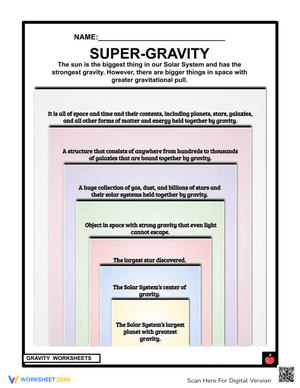
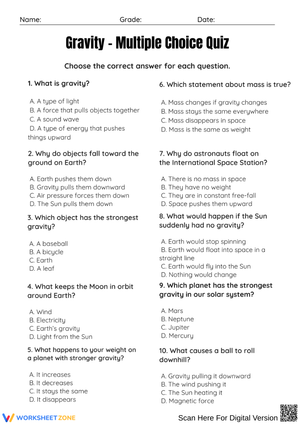
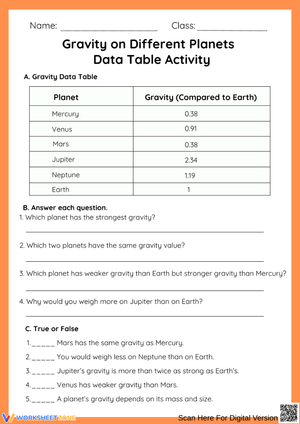
These gravity worksheets for 8th grade give teachers print-ready practice that moves well past the "pulls things down" understanding students carry from elementary school. Each worksheet treats gravity as a force between masses, asks students to compare scenarios involving different masses and distances, and pairs selection items with short written explanations. The resources span NGSS force-and-interaction concepts and the orbital-motion ideas from Earth's Place in the Universe, so teachers can draw on the same set across two connected instructional units without building separate materials from scratch.
The Specific Skills Targeted
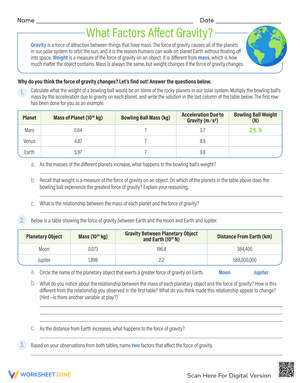
At the 8th grade level, gravity instruction requires students to do more than identify a force. They need to compare how changing mass or changing distance shifts the strength of gravitational attraction and apply those comparisons to space contexts — not just objects falling near Earth's surface. The worksheets move through that progression in a deliberate sequence.
- Identifying gravity as an attractive force between any two objects with mass
- Comparing gravitational strength when one or both masses change
- Explaining how increasing distance between objects weakens the gravitational force
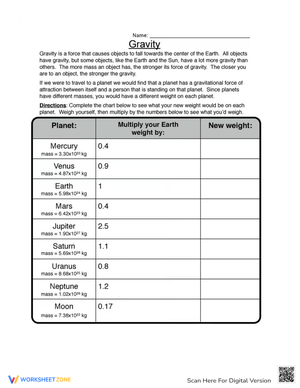
- Distinguishing mass from weight across different planetary surfaces
- Describing why moons, planets, and satellites follow orbital paths instead of flying off or falling straight down
- Correcting written misconceptions about gravity in space
Short explanation prompts appear throughout the set. A student might first select which planetary pair has stronger gravitational attraction and then write two sentences explaining why. That combination separates students who can match a correct answer from those who can actually construct a reason — a distinction that shows up clearly in written responses and matters for 8th grade science proficiency.
Student Errors These Worksheets Help Teachers Catch
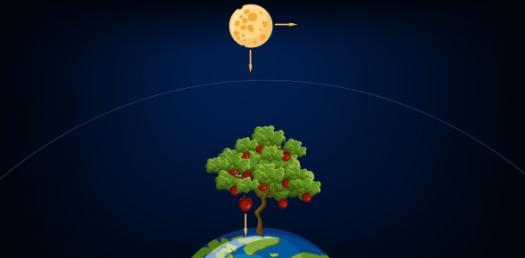
The most persistent misconception in 8th grade gravity instruction is the orbital reasoning error: students believe the Moon stays in space because it is "too far away for Earth's gravity to reach." This appears in student writing constantly — even after instruction on distance and force. Students correctly learn that gravity weakens with distance, then overapply that idea to conclude the Moon must be beyond gravity's influence entirely. What they're missing is that the Moon is in continuous free fall toward Earth; its sideways velocity is large enough that it keeps curving around rather than hitting the surface. Worksheets that include orbit explanation prompts draw this reasoning out directly, giving teachers something concrete to address in class discussion rather than discovering the error only on the unit test.
Two more errors surface in nearly every class. First, students conflate mass and weight — they write that an astronaut on Mars "has less mass" because the gravitational force acting on them there is smaller. Second, many students treat gravity as something that exists only near Earth, writing "there's no gravity on the Moon" when they mean lunar surface gravity is about one-sixth of Earth's. Error-analysis items, where students read a flawed claim and rewrite it correctly, catch both of these much faster than standard multiple-choice formats do.
Standard Alignment
The worksheets address two NGSS middle school performance expectations that 8th grade teachers commonly teach in the same instructional window. MS-PS2-4 asks students to construct arguments using evidence that gravitational interactions are attractive and depend on the masses of interacting objects. Every comparison item and explanation prompt in the set builds exactly that reasoning — students are not labeling gravity as a force but explaining what changes when mass or distance changes.
MS-ESS1-2 asks students to develop and use a model describing gravity's role in solar system and galactic motion. The orbit questions in the set address this by requiring students to explain why a planet's path curves rather than drops straight down and why a moon remains connected to a larger body. These two standards form a natural instructional pairing: the first grounds gravity in the physics of force and mass; the second extends the same concept into the motion patterns that organize the solar system.
Fitting These Worksheets Into Your Unit Plan
The worksheets work at three distinct points in a gravity unit. Early in instruction, a shorter worksheet surfaces what students already believe about force and falling — and makes visible the misconceptions worth addressing before new material takes hold. Mid-unit, after a PhET simulation or classroom demonstration, a worksheet gives students a structured way to anchor what they observed in writing while the experience is still fresh. At the close of the unit, a full gravity worksheets for 8th grade review consolidates both the force-comparison reasoning and the space-system ideas before a quiz or performance task.
One classroom routine worth trying: students discuss which factors change gravitational pull in pairs for about five minutes, then move into a worksheet independently. After they finish, teachers display three or four student responses anonymously and sort them by reasoning quality — not simply correct versus incorrect. That sorting discussion takes about eight minutes and turns the worksheet into part of an instructional loop rather than an isolated practice task.
Adjusting the Worksheets Across Ability Levels
For students who need more support, the Earth-based falling-object questions serve as a natural entry point. Students who can describe what happens when a ball drops have enough prior knowledge to begin working through comparison items, even if orbital mechanics are still out of reach. Teachers working in intervention settings often stop at the first explanation prompt, discuss it as a group, and then continue — which builds vocabulary alongside reasoning instead of leaving students to guess through writing tasks they haven't yet internalized.
Students who move through the material quickly benefit most from the error-analysis items and the orbit explanation prompts. Those questions require a complete causal chain: mass produces a gravitational force, that force curves the path of a moving object, and the object enters orbit when the curve matches the planet's curvature. Assigning those items as discussion starters or written extensions provides genuine challenge without requiring a separate resource. Teachers who co-teach with a special education colleague often divide the worksheet at the Earth gravity and space gravity sections, letting each group pace through its half without losing the content connection between the two parts.
Frequently Asked Questions
Do these worksheets require students to calculate using the inverse square law formula?
No. The worksheets build conceptual understanding of how mass and distance affect gravitational force without asking students to calculate. Students compare scenarios and explain relationships in words, which is what NGSS MS-PS2-4 calls for at this grade level. Teachers who want to extend into the formula can use the comparison items as a conceptual foundation before introducing the mathematical version in a separate lesson.
Can these be used as formative assessment during the unit rather than only for review?
That's where they tend to do the most work. The short explanation prompts give teachers written evidence of student reasoning mid-unit, which reveals far more than a quick thumbs-up check-in. Teachers running a gravity worksheets for 8th grade review at the close of a unit often discover that student responses on the orbital explanation items expose the same misconceptions that surfaced earlier — a sign that direct instruction addressed vocabulary but not the underlying mental model of how orbit actually functions.
Are the worksheets appropriate for students who are below grade level in science?
The scenario-based items work for most reading levels because the language stays close to classroom vocabulary without assuming prior exposure to formal physics notation. Students who struggle with extended writing can start with comparison and selection items, then attempt short-answer prompts with sentence starters added during instruction. Key terms — mass, force, orbit, weight — do need to have been introduced before students work through explanation items, but the set doesn't depend on students having memorized formulas or completed formal lab procedures first.
How do the space-system questions fit a physical science course that isn't formally covering Earth science?
Gravity sits explicitly at the intersection of NGSS force concepts and Earth's Place in the Universe, so orbit and space-system questions belong in physical science instruction even without a dedicated space unit. The questions use orbital motion as an application of force ideas rather than treating it as separate Earth science content. That means the same gravity worksheets for 8th grade set can support a physical science course that uses space examples to reinforce force-and-motion reasoning, without requiring teachers to reframe the materials or pull from a different curriculum.












 Interactive Worksheet Maker
 Quiz Maker
 Word Search Maker
 Crossword Puzzle Maker
 Word Scramble Generator
 Sentence Scramble Generator
 Handwriting Worksheet Generator
 Name Tracing Generator
 Fill In The Blank Generator