


























Views
Downloads

Nervous System Anatomy Worksheet | Grade 8 Printable
Paste this activity's link or code into your existing LMS (Google Classroom, Canvas, Teams, Schoology, Moodle, etc.).
Students can open and work on the activity right away, with no student login required.
You'll still be able to track student progress and results from your teacher account.
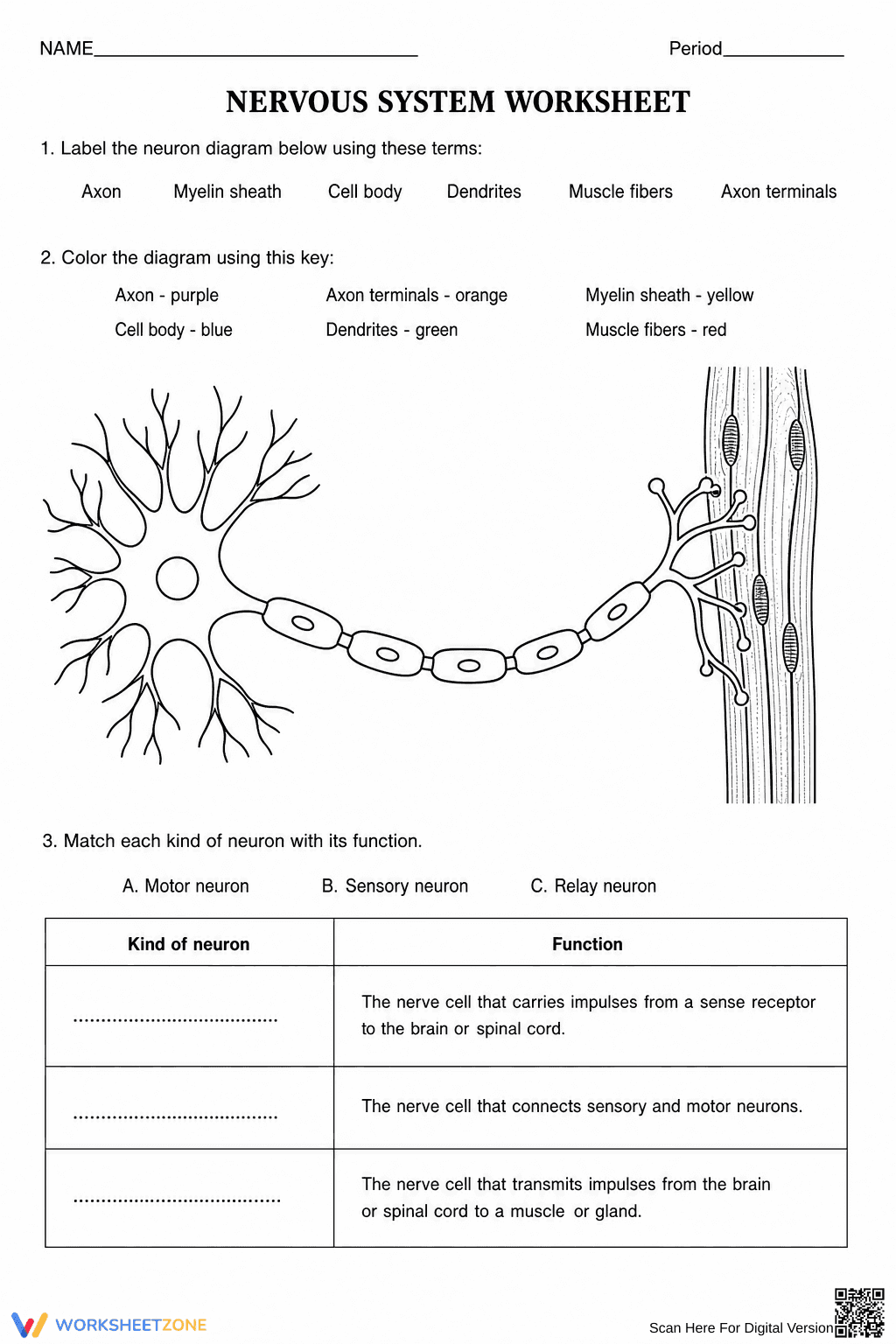
This comprehensive Grade 8 science worksheet helps students master the anatomy and function of the nervous system. By labeling neuron diagrams, matching key vocabulary, and categorizing system components, students will build a strong foundational understanding of how sensory information is processed and transmitted throughout the human body.
At a Glance
- Grade: 8 · Subject: Science
- Standard:
MS-LS1-8— Understand how sensory receptors send messages to the brain- Skill Focus: Nervous System Anatomy
- Format: 2 pages · 35 problems · Answer key included · PDF
- Best For: Independent practice
- Time: 25–35 minutes
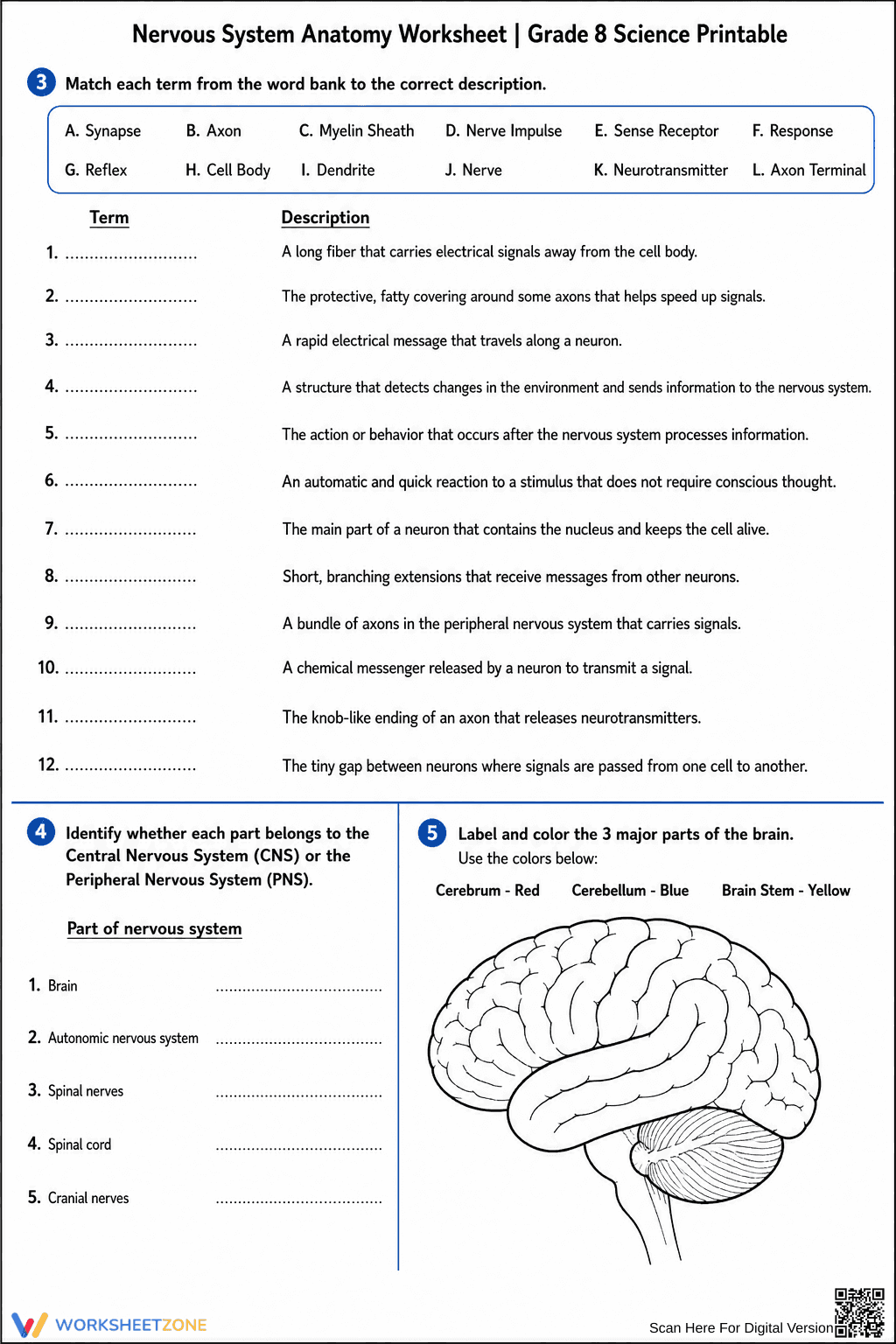
This two-page resource features five distinct task types designed to reinforce biological concepts. Students will begin by labeling and coloring a detailed diagram of a neuron, identifying parts like the myelin sheath and axon terminals. The worksheet also includes a comprehensive vocabulary matching section with 12 key terms, a categorization task for the Central and Peripheral Nervous Systems, and a final brain anatomy labeling exercise. A complete answer key is included for easy grading.
- Guided practice: Students start with visual labeling and coloring tasks for the neuron (12 problems), providing a low-barrier entry point to complex anatomy.
- Supported practice: The matching sections (15 problems) connect structural terms to their specific functions, reinforcing visual data with academic vocabulary.
- Independent practice: Finally, students categorize components into the CNS or PNS and label major brain regions (8 problems) to demonstrate mastery.
This gradual-release approach ensures students confidently build their knowledge from basic cell structures to macro-system organization.
This resource is aligned to MS-LS1-8: Gather and synthesize information that sensory receptors respond to stimuli by sending messages to the brain for immediate behavior or storage as memories. It also supports general life science curricula focusing on human body systems. Both standard codes can be copied directly into lesson plans, IEP goals, or district curriculum mapping tools.
Deploy this worksheet during the middle of a human body systems unit after direct instruction on the nervous system. It serves as an excellent independent practice activity or homework assignment to solidify vocabulary. As a formative assessment tip, circulate while students are coloring the neuron diagram to ensure they correctly identify the direction of the nerve impulse from dendrite to axon terminal. Expected completion time is 25 to 35 minutes.
This worksheet is ideal for middle school life science and biology students. The visual nature of the labeling and coloring tasks provides built-in differentiation for visual learners and English Language Learners (ELLs) who benefit from connecting terms to images. Pair this resource with a 3D brain model demonstration or an interactive lesson on human reflexes to maximize student engagement.
Aligning instructional materials to specific biological mechanisms, such as MS-LS1-8, is crucial for developing scientific literacy. When students understand how sensory receptors send messages to the brain, they can better conceptualize the human body as a series of interacting subsystems. According to a ScienceDirect TpT Analysis, worksheets that combine visual diagramming with vocabulary reinforcement significantly improve retention of complex anatomical structures compared to text-only resources. By engaging multiple modalities—such as coloring, labeling, and matching—students process the information more deeply, leading to stronger neural connections about the nervous system itself. This resource provides the structured, multi-modal practice necessary for students to transition from basic memorization to a working understanding of physiological processes, ensuring they are well-prepared for more advanced high school biology coursework.


