




























Views
Downloads
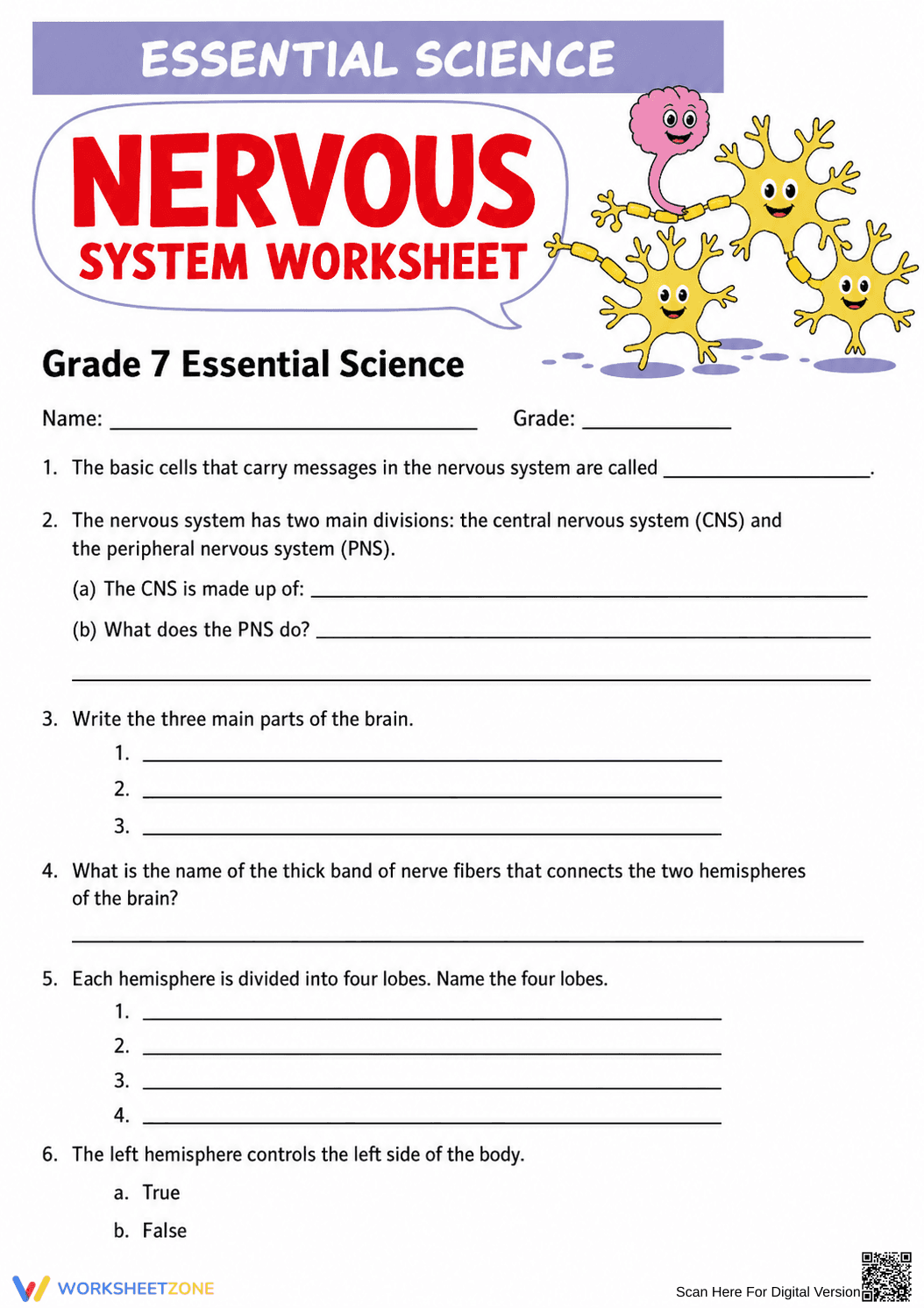


Printable Nervous System Worksheet | Grade 7 Science

Paste this activity's link or code into your existing LMS (Google Classroom, Canvas, Teams, Schoology, Moodle, etc.).
Students can open and work on the activity right away, with no student login required.
You'll still be able to track student progress and results from your teacher account.
This Grade 7 science worksheet provides a comprehensive review of the human nervous system, helping students identify key anatomical structures and explain physiological processes. By completing these 12 targeted tasks, learners will demonstrate a clear understanding of how the brain, spinal cord, and nerves coordinate body actions and respond to external stimuli.
At a Glance
- Grade: 7 · Subject: Science
- Standard:
MS-LS1-8— Gather and synthesize information on how sensory receptors respond to stimuli- Skill Focus: Nervous system anatomy and signal transmission
- Format: 3 pages · 12 problems · Answer key included · PDF
- Best For: Mid-unit review or independent practice
- Time: 25–35 minutes
What's Inside: This three-page PDF includes a two-page student activity sheet and a full-page answer key. The worksheet features a variety of question formats, including fill-in-the-blank terminology, short-answer explanations of the CNS and PNS, identification of brain lobes, and a critical sequencing task where students order the steps of a pain reflex. The clear layout and professional diagrams ensure that complex biological concepts remain accessible to middle school learners.
Zero-Prep Workflow
- Print (1 minute): Simply select the student pages and print enough copies for your class. The high-contrast design ensures clear legibility even on standard school copiers.
- Distribute (1 minute): Hand out the sheets as a bell-ringer, a main lesson activity, or a reliable sub plan that requires no prior teacher setup.
- Review (5 minutes): Use the included answer key to facilitate a quick whole-class check or to allow students to self-correct their work, providing immediate feedback on their understanding of neural pathways.
Standards Alignment: This resource is primarily aligned to `MS-LS1-8`, focusing on how the human body gathers and synthesizes information. It specifically addresses the role of the brain in processing sensory input and the mechanics of the peripheral nervous system. Both standard codes can be copied directly into lesson plans, IEP goals, or district curriculum mapping tools.
How to Use It: Assign this worksheet during the "Explain" or "Evaluate" phase of a 5E lesson cycle to check for student mastery of body systems. It is particularly effective as a formative assessment tool; observe students during the sequencing task (Question 11) to identify misconceptions about how electrical impulses travel through neurons. Expect most students to complete the full set of 12 tasks within 30 minutes.
Who It's For: This resource is designed for Grade 7 life science students but is also suitable for Grade 6 or 8 students studying human biology. It serves as an excellent pairing for a direct instruction lesson on the brain or as a supplemental resource for students who need structured practice with scientific vocabulary and system functions.
According to the RAND AIRS 2024 report on secondary science literacy, structured retrieval practice is vital for long-term retention of complex biological systems. This worksheet facilitates that process by requiring students to recall specific anatomical terms like the corpus callosum and the peripheral nervous system while also applying logic to the sequencing of electrical impulses. By moving from simple identification of brain lobes to the complex ordering of sensory reactions, the resource aligns with the Fisher & Frey (2014) model of gradual release. Research indicates that middle school students benefit significantly from worksheets that combine visual-spatial labeling with functional descriptions, as it bridges the gap between abstract concepts and physical reality. This 12-task resource provides the necessary scaffolding to ensure students can accurately describe how sensory receptors respond to stimuli and transmit messages to the brain, meeting the rigorous demands of the MS-LS1-8 standard for life science mastery.


