




























Views
Downloads

Essential Grade 8 Nervous System — Printable Worksheet

Paste this activity's link or code into your existing LMS (Google Classroom, Canvas, Teams, Schoology, Moodle, etc.).
Students can open and work on the activity right away, with no student login required.
You'll still be able to track student progress and results from your teacher account.
This comprehensive nervous system worksheet helps students identify and understand the core components of the human body's communication network. By labeling diagrams, matching vocabulary, and categorizing structures, learners will build a strong foundational knowledge of how neurons, the brain, and the spinal cord work together to process information.
At a Glance
- Grade: 8 · Subject: Science
- Standard:
MS-LS1-8— Understand how sensory receptors send messages to the brain- Skill Focus: Nervous system anatomy and function
- Format: 3 pages · 25 problems · Answer key included · PDF
- Best For: Independent practice or sub plans
- Time: 25–35 minutes
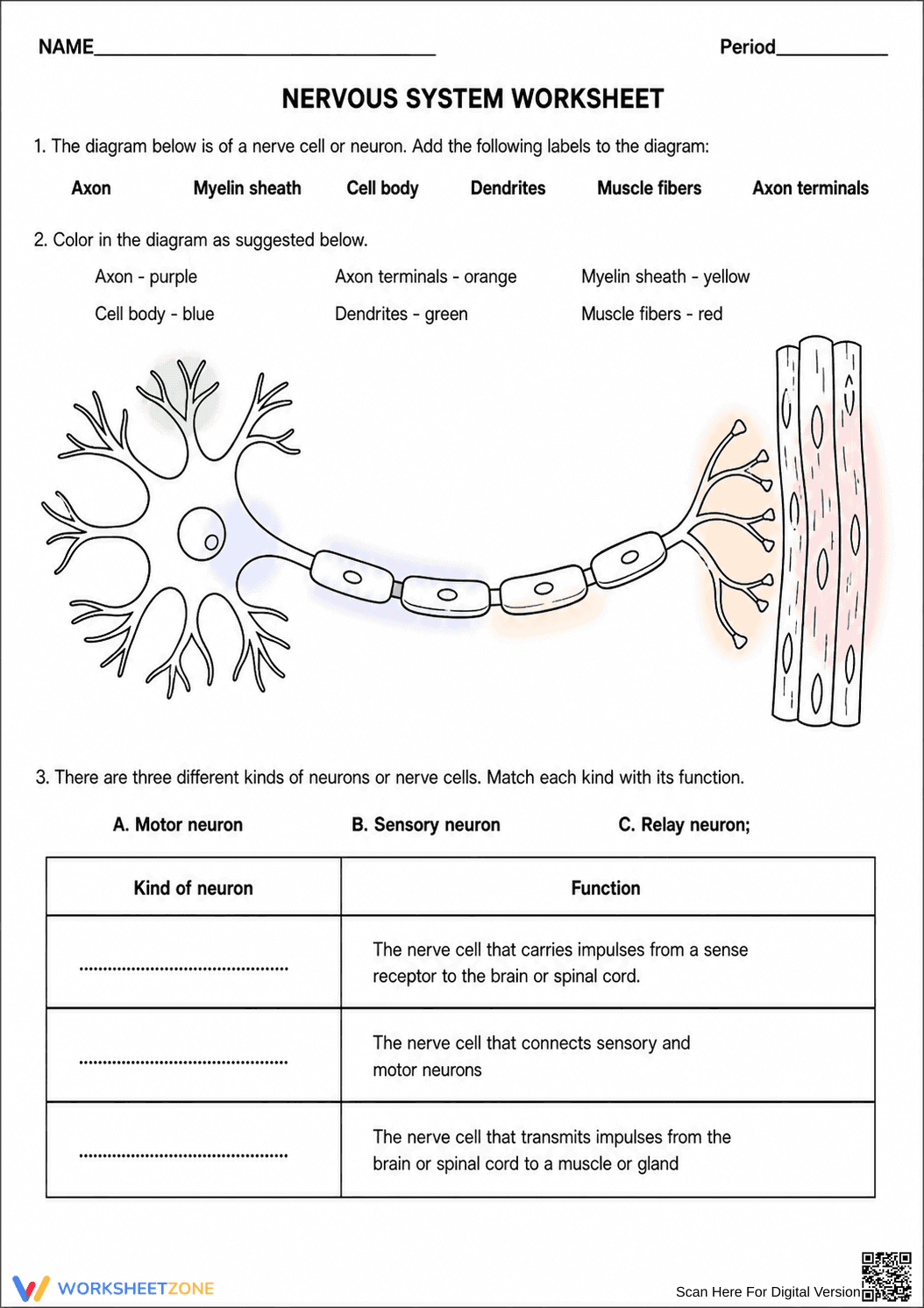
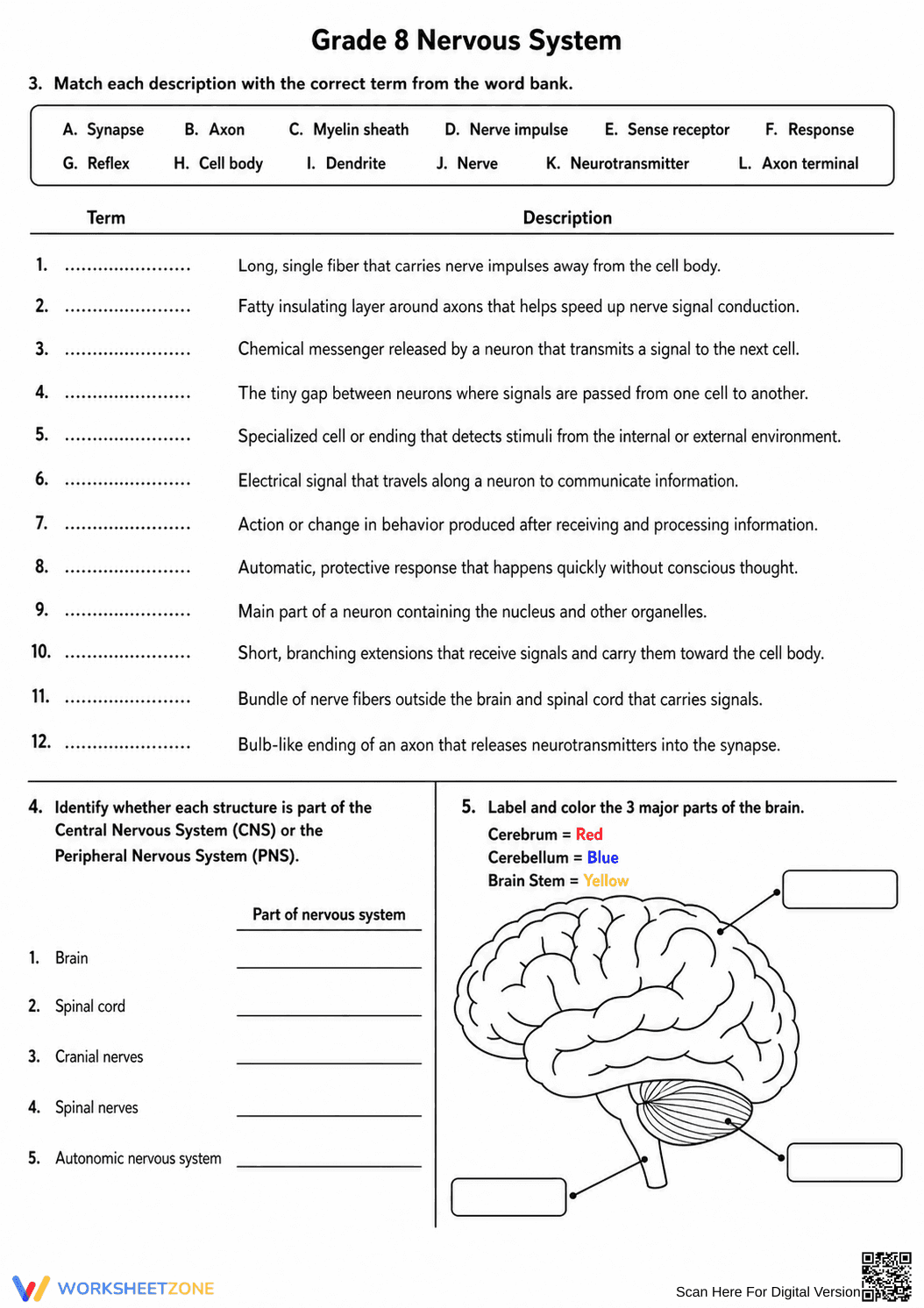
Inside this three-page packet, students tackle tasks designed to reinforce anatomical vocabulary. Activities include labeling and coloring a neuron diagram, matching three nerve cell types to their functions, and completing a 12-term vocabulary section. Students also classify nervous system parts into the Central or Peripheral Nervous System and color-code major brain regions.
This resource is designed for immediate classroom implementation with a streamlined workflow:
- Print (1 minute): The PDF format ensures diagrams and text print clearly without formatting issues.
- Distribute (1 minute): Hand out the packets as students enter the room for immediate engagement.
- Review (5 minutes): Go over the diagram coloring and vocabulary matching together to check for understanding.
With zero teacher setup required, this worksheet is an excellent addition to any biology unit and serves as a highly effective, self-explanatory emergency sub plan.
This material is aligned to the Next Generation Science Standard MS-LS1-8, which requires students to gather and synthesize information that sensory receptors respond to stimuli by sending messages to the brain for immediate behavior or storage as memories. By identifying the structures that facilitate these impulses—such as axons, dendrites, and synapses—students build the anatomical context needed for this standard.
Teachers can utilize this worksheet as an independent practice assignment following a direct instruction lesson. It also serves as a formative assessment tool; while students color and label, teachers can circulate to observe identification of nerve impulses. Completion typically takes 25 to 35 minutes.
This resource is designed for middle school science students studying human biology. Visual labeling and coloring tasks provide scaffolding for visual learners and ELLs. Pair this worksheet with a 3D brain model or a digital synapse simulation for a complete lesson.
Integrating structured visual aids and vocabulary reinforcement is essential for mastering complex biological systems. According to a ScienceDirect TpT Analysis, instructional materials that combine diagram labeling with targeted vocabulary matching significantly improve student retention of anatomical structures. This worksheet directly supports MS-LS1-8 by helping students understand how sensory receptors send messages to the brain. When learners actively color-code the myelin sheath, dendrites, and brain regions, they engage multiple cognitive pathways, which deepens their understanding of how the Central and Peripheral Nervous Systems interact. By breaking down the microscopic structures of neurons alongside the macroscopic structures of the brain, educators can provide a comprehensive overview of human neural processing. This approach ensures that foundational life science concepts are firmly established before students advance to more complex high school biology coursework.


