




























Views
Downloads
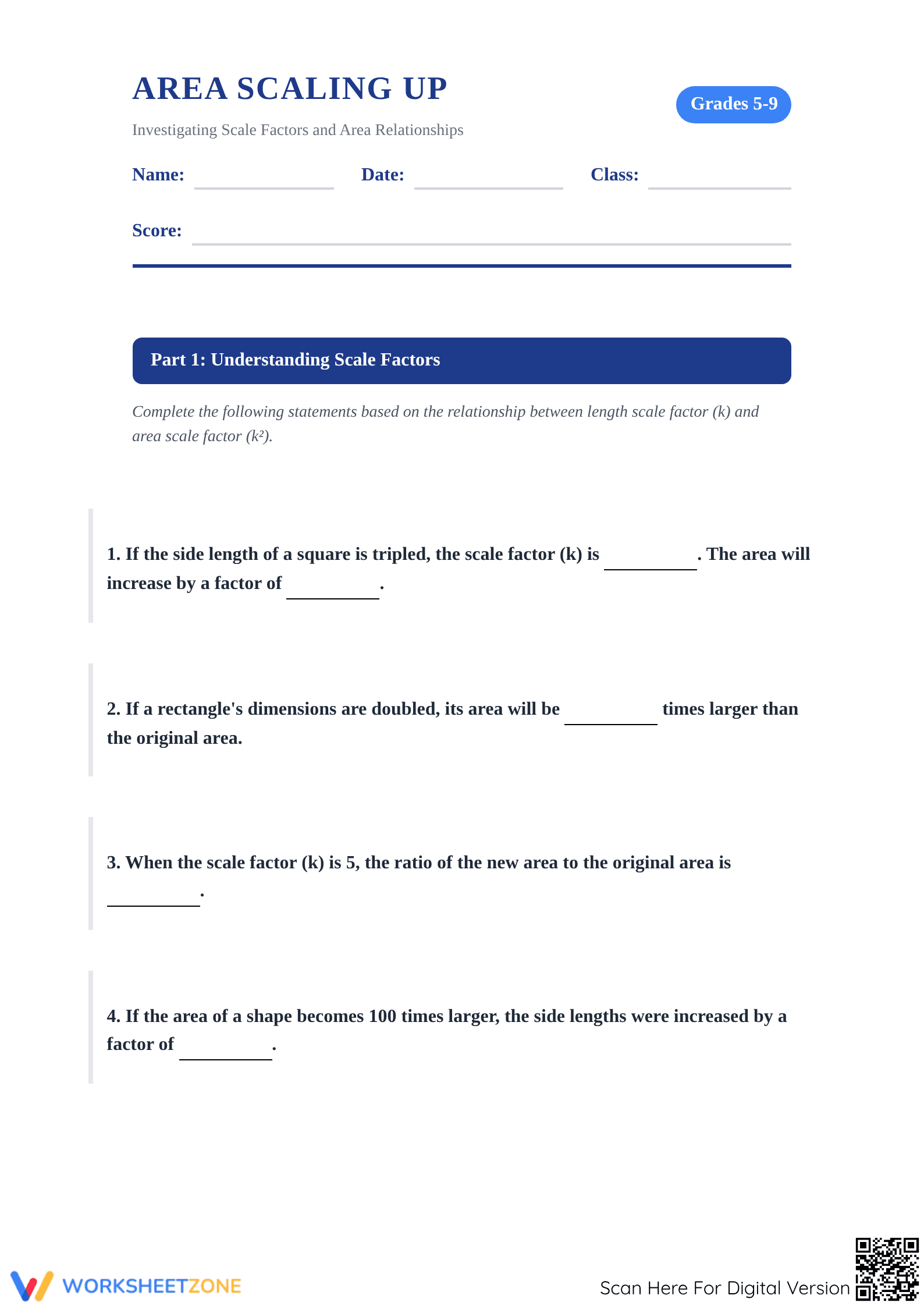
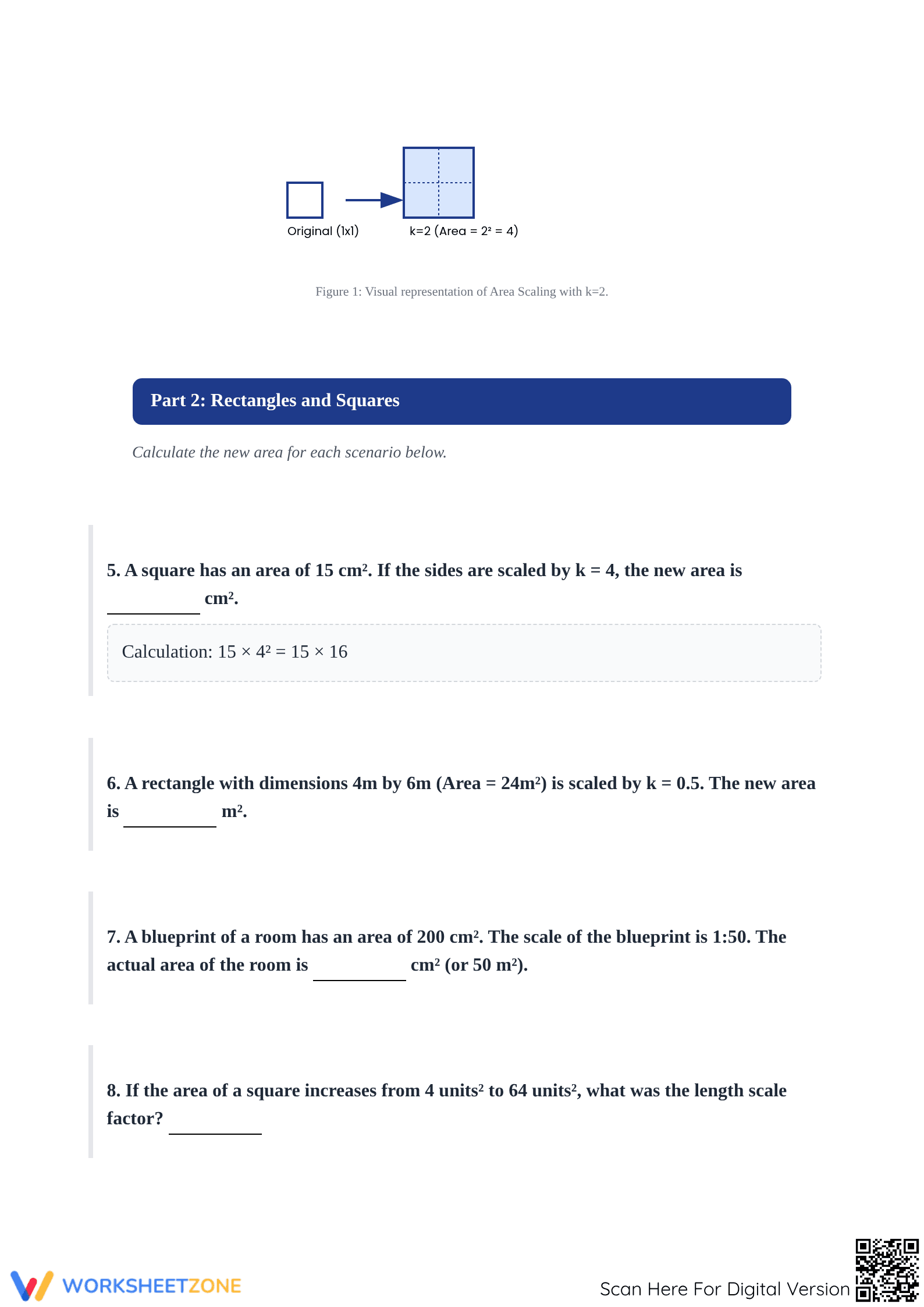
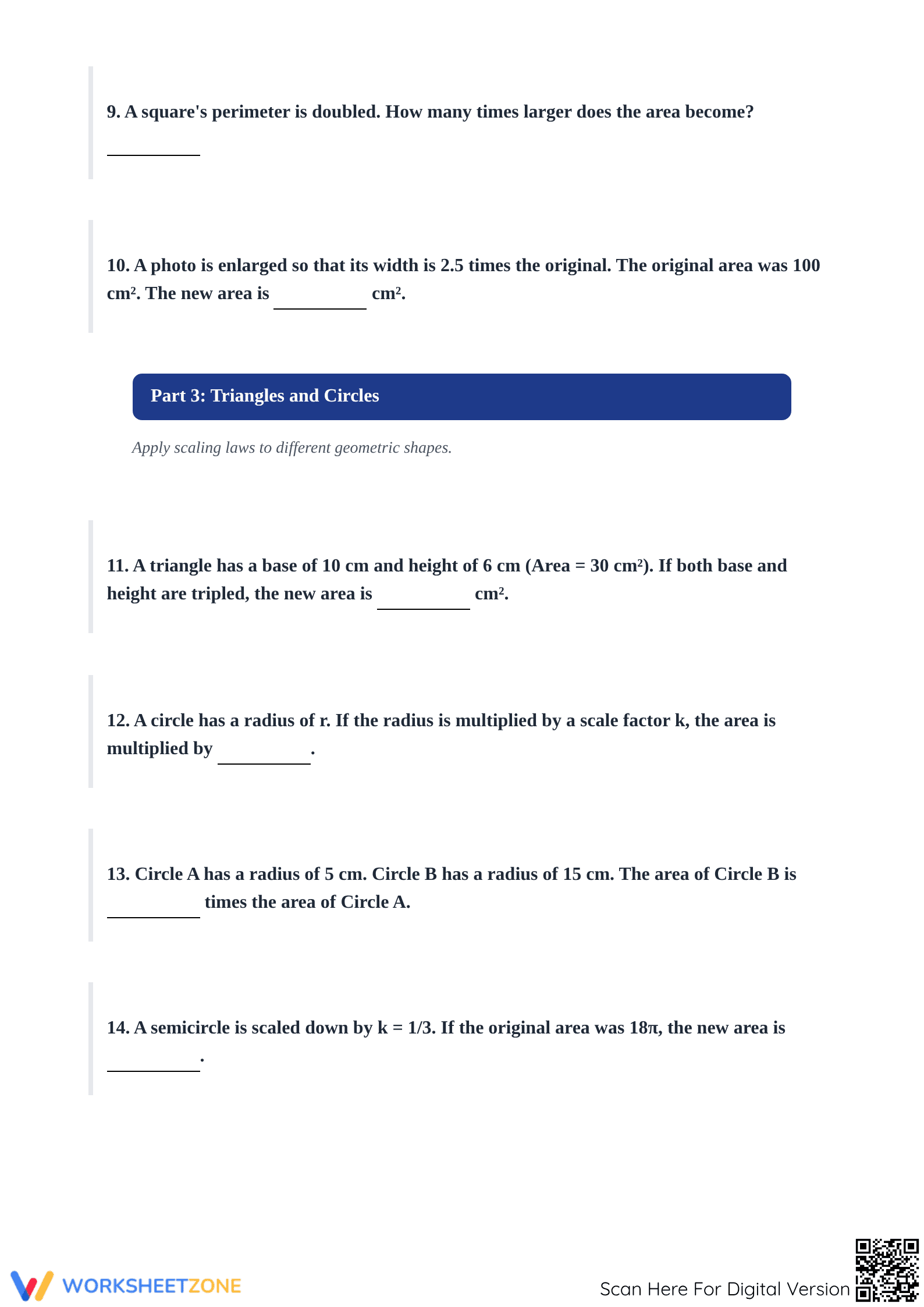
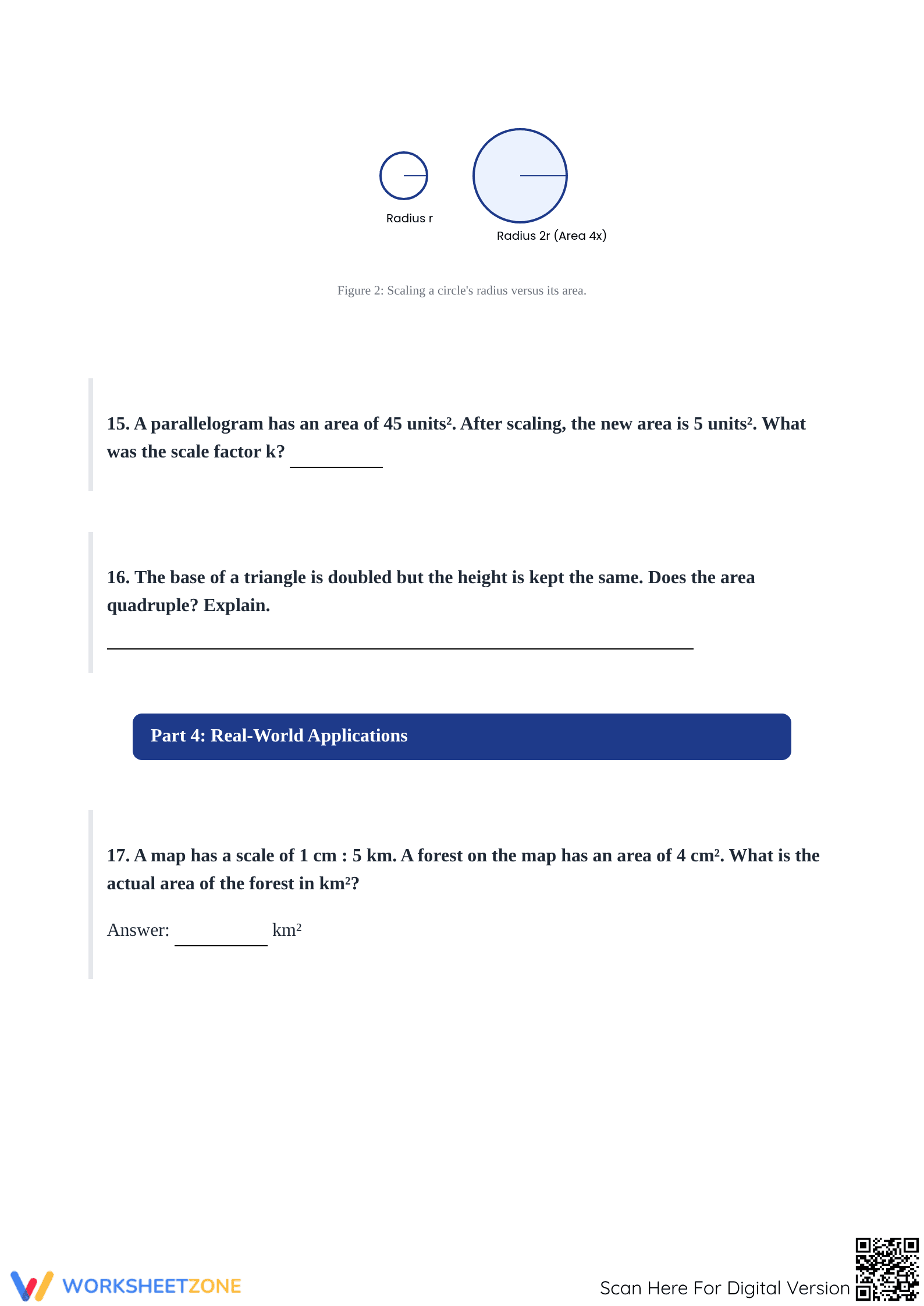
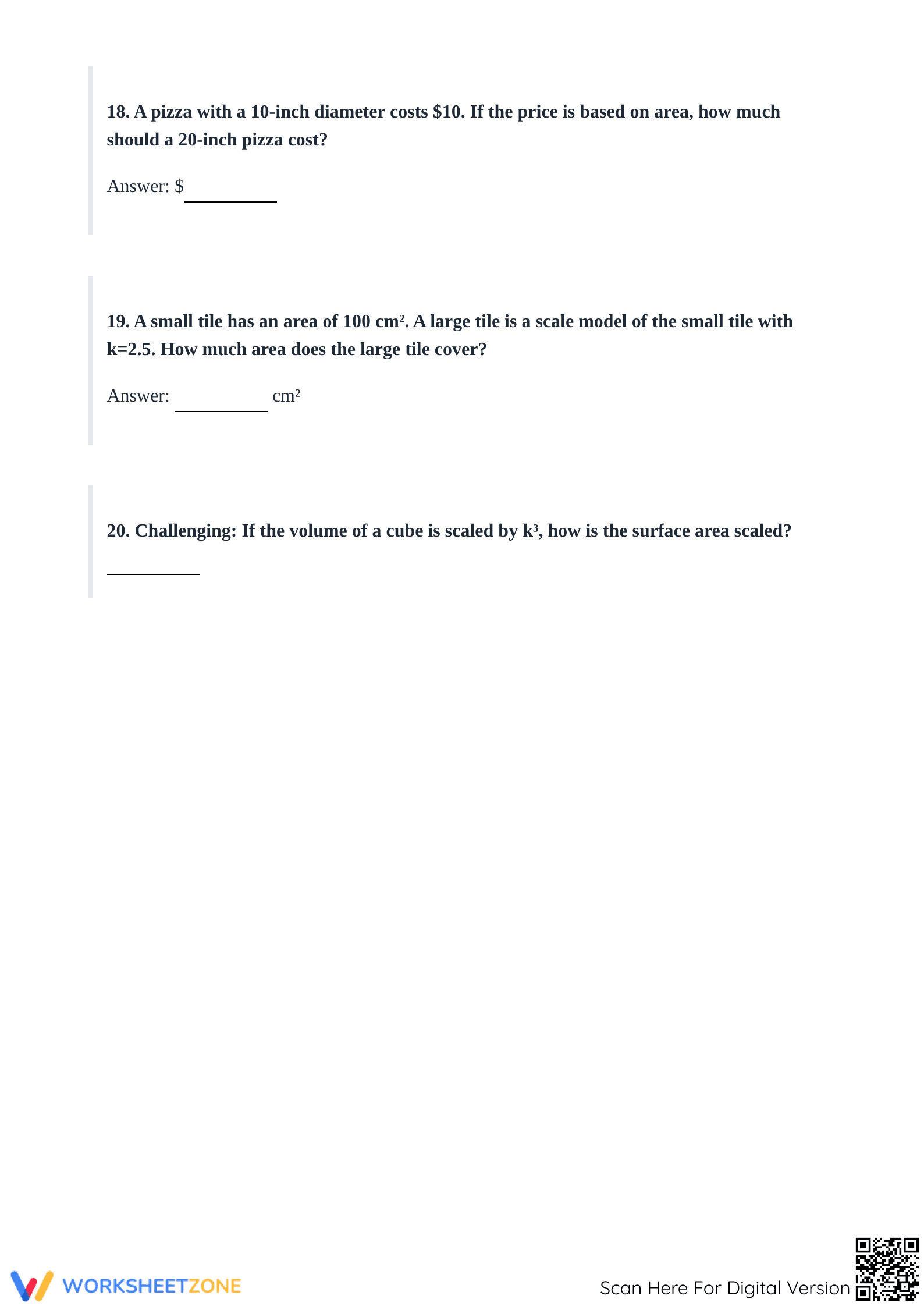

Essential Area Scaling Worksheet | Grades 5-9 Math

Paste this activity's link or code into your existing LMS (Google Classroom, Canvas, Teams, Schoology, Moodle, etc.).
Students can open and work on the activity right away, with no student login required.
You'll still be able to track student progress and results from your teacher account.
Investigate the mathematical relationship between linear scale factors and area with this comprehensive 5-page workbook. Students transition from conceptual understanding to complex real-world applications involving geometric shapes like circles and map scales. By calculating area changes relative to side lengths, learners master foundational principles of geometric transformations and proportional reasoning.
At a Glance
- Grade: 7 · Subject: Math
- Standard:
CCSS.MATH.CONTENT.7.G.A.1— Calculate actual areas from scale drawings using scale factors- Skill Focus: Area scaling relationships
- Format: 5 pages · 20 problems · Answer key included · PDF
- Best For: Middle school geometry and proportional reasoning units
- Time: 45–60 minutes
What's Inside
This 5-page PDF contains 20 problems building mastery over scaling laws. Divided into four parts—conceptual factors, quadrilaterals, circles/triangles, and real-world applications—it covers everything from blueprints to pizza pricing. The resource includes visual diagrams and a full answer key to facilitate independent student work or efficient classroom grading and review.
Skill Progression
- Guided Practice (Tasks 1-4): Conceptual entry point linking linear factors (k) to area factors (k²) through structured fill-in-the-blank statements.
- Supported Practice (Tasks 5-14): Problems applying scaling rules to diverse shapes, including circles and composite figures with formulaic hints.
- Independent Practice (Tasks 15-20): Complex real-world scenarios requiring students to solve practical geometry and map scale challenges.
The workbook follows a gradual-release model, moving from scaffolded conceptualization to unassisted problem-solving in applied contexts.
Standards Alignment
Aligned to CCSS.MATH.CONTENT.7.G.A.1, this resource focuses on solving problems involving scale drawings of geometric figures, specifically computing actual areas from a scale drawing. Students must apply the principle that if a figure is scaled by a factor of k, its area increases by k². Both standard codes can be copied directly into lesson plans, IEP goals, or district curriculum mapping tools.
How to Use It
Utilize this resource during the "Explore" phase of a geometry unit. Use the first page for guided instruction to establish the k to k² relationship before assigning subsequent pages for practice. For a formative assessment observation tip, monitor Task 17 to see if students correctly square the map scale before calculating actual forest area. The expected completion time for all 20 tasks is approximately 50 minutes.
Who It's For
Designed for Grade 7, this worksheet also supports Grade 8 and 9 learners reinforcing proportional relationships or preparing for higher-level geometry. Differentiation is built-in through the progression of difficulty; struggling students can focus on visual rectangle problems, while advanced learners tackle the challenging volume extension. It pairs naturally with an introductory lesson on unit rates or scale drawings.
Mathematical literacy in geometry depends on a student's ability to visualize how dimensions interact across multiple planes. Research from EdReports (2024) indicates that instructional materials emphasizing the "squared relationship" in scaling are significantly more effective at preventing common misconceptions where students assume area scales linearly with perimeter. This 20-problem workbook addresses this gap by explicitly requiring students to derive the k² factor before applying it to complex figures like circles and blueprints. By grounding abstract algebraic rules in the concrete visual evidence of geometric transformation, students develop a more robust mental model of spatial reasoning. This systematic approach ensures that the transition from simple similarity to three-dimensional scaling is logically supported. Educators can utilize these tasks to gather evidence of student mastery for standardized assessment preparation or diagnostic progress monitoring. The provided answer key ensures immediate feedback, a critical component of the effective gradual-release instructional framework.


