


























Views
Downloads

Grade 8 Scale Factor — Printable No-Prep Worksheet
Paste this activity's link or code into your existing LMS (Google Classroom, Canvas, Teams, Schoology, Moodle, etc.).
Students can open and work on the activity right away, with no student login required.
You'll still be able to track student progress and results from your teacher account.
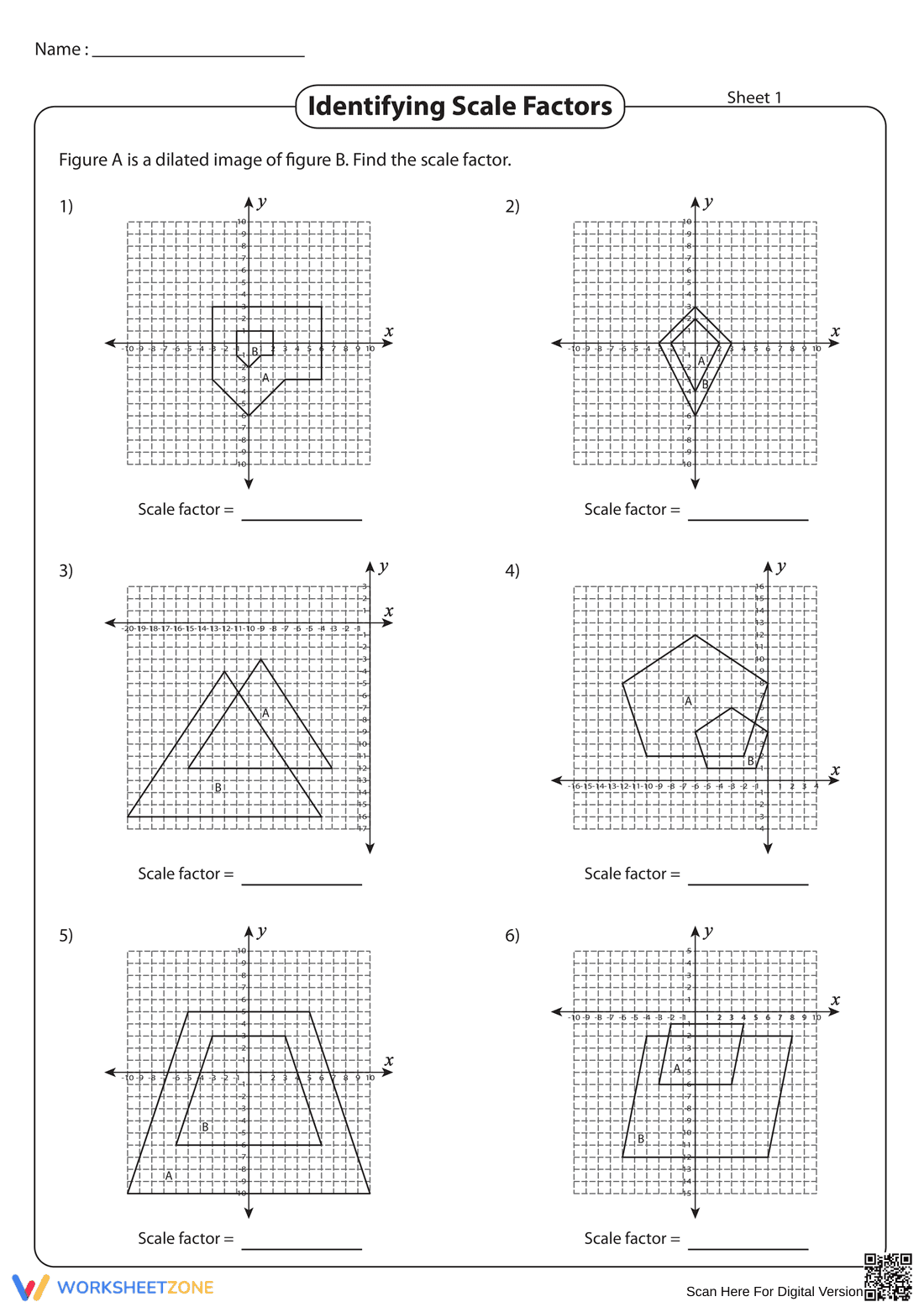
This Grade 8 geometry worksheet provides focused practice on identifying scale factors of dilated figures on a coordinate plane. Students analyze pre-images and images to determine the exact scale factor used in each transformation, building essential spatial reasoning and coordinate geometry skills required for advanced mathematics.
At a Glance
- Grade: 8 · Subject: Math
- Standard:
CCSS.MATH.CONTENT.8.G.A.3— Describe the effect of dilations on two-dimensional figures using coordinates.- Skill Focus: Identifying scale factors
- Format: 2 pages · 6 problems · Answer key included · PDF
- Best For: Independent practice
- Time: 10–15 minutes
This resource includes a single-page student worksheet featuring six distinct coordinate plane problems. Each task presents a pre-image (Figure B) and a dilated image (Figure A), requiring students to calculate and write the corresponding scale factor. The problems include both enlargements and reductions, resulting in whole number and fractional scale factors. A complete, color-coded answer key is provided on the second page for immediate feedback and easy grading.
Designed for maximum efficiency, this zero-prep resource follows a simple workflow:
- Print (1 minute): The single-page layout minimizes copy time and paper usage.
- Distribute (1 minute): Clear, self-explanatory instructions mean students can begin working immediately without extensive teacher setup.
- Review (3 minutes): Use the included answer key to quickly check student work or project it for whole-class self-correction.
With a total teacher prep time of under two minutes, this worksheet is an ideal, reliable option for emergency sub plans or quick skill reinforcement.
This worksheet is strictly aligned to CCSS.MATH.CONTENT.8.G.A.3: Describe the effect of dilations, translations, rotations, and reflections on two-dimensional figures using coordinates. It specifically targets the dilation aspect, ensuring students can mathematically quantify the proportional relationship between similar figures. Both standard codes can be copied directly into lesson plans, IEP goals, or district curriculum mapping tools.
Deploy this worksheet during the independent practice phase of a geometry lesson, immediately following direct instruction on transformations. It serves as an excellent formative assessment tool; teachers can observe whether students correctly identify the pre-image versus the image to avoid inverting the scale factor ratio. Alternatively, assign it as targeted homework. Students should complete the six problems within a 10 to 15-minute timeframe.
This practice sheet is designed for eighth-grade math students mastering coordinate geometry. The visual nature of the coordinate grids provides built-in scaffolding for visual learners, while the mix of enlargements and reductions challenges students to apply their understanding of fractions. Pair this resource with an anchor chart detailing the formula for scale factor (image length divided by pre-image length) to support students who need additional guidance.
Mastering geometric transformations is a critical stepping stone for high school algebra and geometry. This resource aligns with CCSS.MATH.CONTENT.8.G.A.3, requiring students to describe the effect of dilations on two-dimensional figures using coordinates. By isolating the specific skill of identifying scale factors, the worksheet reduces cognitive load and allows learners to focus entirely on the proportional relationships between pre-images and images. According to a recent EdReports 2024 analysis, instructional materials that provide clear, focused practice on single mathematical concepts significantly improve student retention and procedural fluency. The visual coordinate plane format further supports comprehension by grounding abstract ratios in observable geometric changes. This targeted approach ensures students build the foundational spatial reasoning skills necessary to tackle more complex mathematical models and theorems in subsequent grade levels.


