




























Views
Downloads

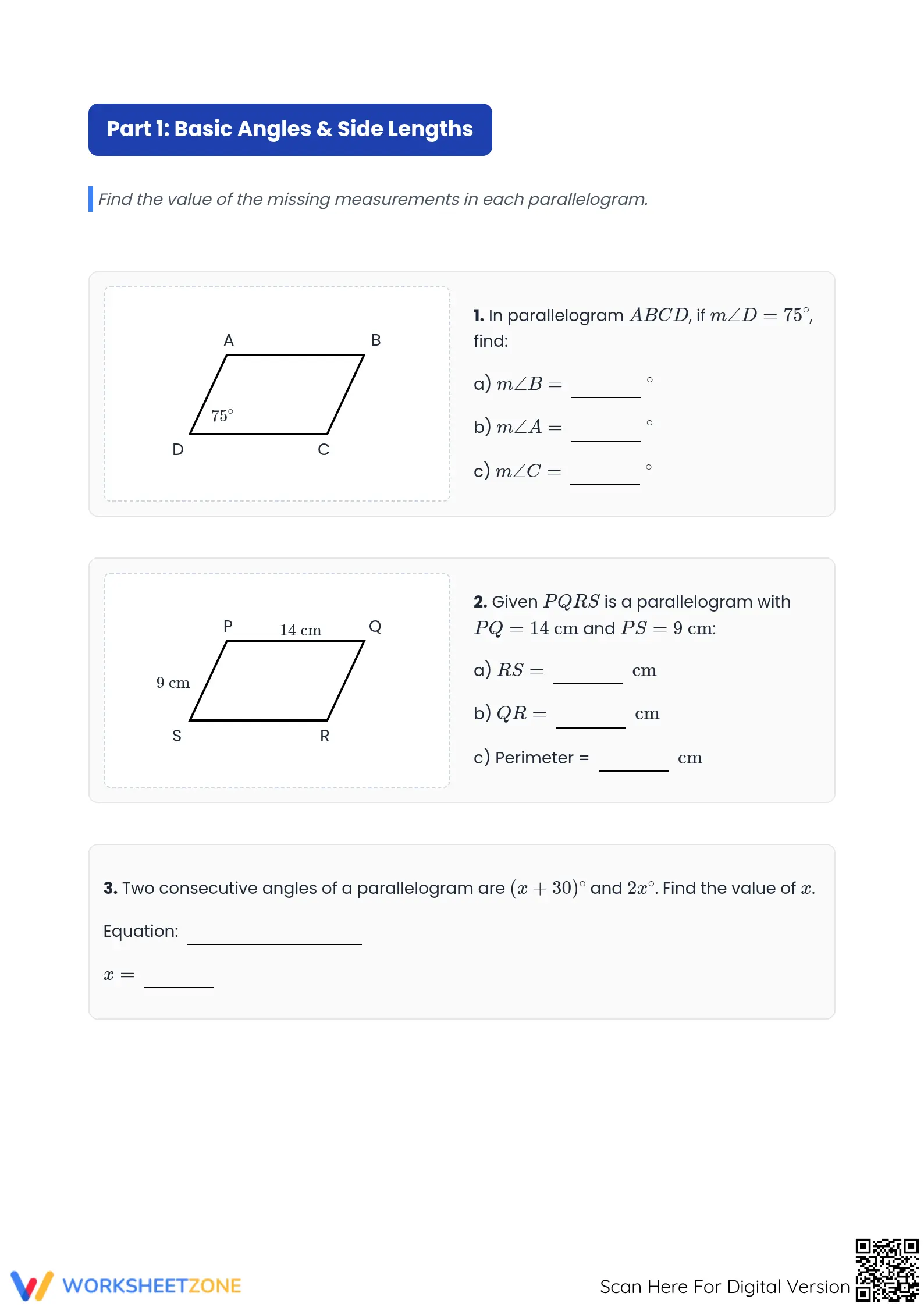


Printable Parallelogram Properties Worksheet | Grade 8

Paste this activity's link or code into your existing LMS (Google Classroom, Canvas, Teams, Schoology, Moodle, etc.).
Students can open and work on the activity right away, with no student login required.
You'll still be able to track student progress and results from your teacher account.
This comprehensive Parallelogram Properties worksheet provides middle and high school students with targeted practice identifying and calculating geometric relationships. By focusing on congruent sides, supplementary angles, and bisecting diagonals, learners build the spatial reasoning necessary for advanced proofs. Students progress from simple visual identification to complex algebraic applications across twelve rigorous problems.
At a Glance
- Grade: 6–9 · Subject: Geometry
- Standard:
HSG.CO.C.11— Prove and apply theorems about side, angle, and diagonal relationships in parallelograms- Skill Focus: Properties of Parallelograms · Algebraic Geometry
- Format: 5 pages · 12 problems · Answer key included · PDF
- Best For: Geometry unit practice and formative assessment
- Time: 35–50 minutes
This five-page PDF includes a detailed "Key Properties" reference sheet, followed by three distinct sections of exercises. The set contains twelve problems ranging from basic side-length calculations to advanced multi-step algebraic equations. A complete answer key is provided, allowing for immediate feedback or self-grading. The layout features clear diagrams for every shape, ensuring students can visualize each geometric concept.
Skill Progression
The worksheet follows a structured skill progression designed to build student confidence and mastery through a gradual release of responsibility.
- Guided Practice: The first set of problems uses numerical values to reinforce basic properties like opposite angle congruence and side length equality, requiring minimal scaffolding for initial success.
- Supported Practice: Intermediate tasks introduce single-variable algebraic expressions (e.g., 3x - 4), bridging the gap between arithmetic computation and geometric logic within a familiar shape framework.
- Independent Practice: The final section challenges students with complex diagonal intersections and systems of linear equations, culminating in a "Challenge" problem that integrates multiple properties into a single parallelogram.
This "I Do, We Do, You Do" approach ensures that students have a solid foundation before tackling high-order thinking tasks required in coordinate geometry.
Standards Alignment
This resource is directly aligned to HSG.CO.C.11, which requires students to prove and apply theorems about parallelograms, specifically that opposite sides and angles are congruent and diagonals bisect each other. Additionally, it supports 7.G.B.5 by requiring the application of supplementary angle facts. Both standard codes can be copied directly into lesson plans, IEP goals, or district curriculum mapping tools.
How to Use It
Use this worksheet as a primary practice tool after a direct instruction lesson on quadrilateral properties. It serves as an excellent "mid-unit check" to identify students who struggle with the transition from numeric to algebraic geometry. While students work, observe their ability to set up initial equations (e.g., 6y + 30 = 180); this is a key indicator of geometric conceptual understanding. Most students will complete the full set in 45 minutes.
Who It's For
Designed for Grade 6 through 9 students, this resource is ideal for standard Geometry courses, Pre-Algebra enrichment, or as a review for high schoolers. It provides natural differentiation through its increasing complexity, making it suitable for mixed-ability classrooms. Pair this worksheet with a coordinate geometry activity or an anchor chart displaying the four primary properties for maximum student support.


