




























Views
Downloads




Printable Area of Parallelograms Worksheet | Grade 6

Paste this activity's link or code into your existing LMS (Google Classroom, Canvas, Teams, Schoology, Moodle, etc.).
Students can open and work on the activity right away, with no student login required.
You'll still be able to track student progress and results from your teacher account.
This Grade 6 worksheet focuses on the fundamental geometric skill of calculating the area of parallelograms. Students transition from visual models to abstract calculations, eventually applying their knowledge to complex inverse operations and real-world scenarios. By mastering these 21 structured problems, learners build the spatial reasoning necessary for higher-level geometry and measurement tasks.
At a Glance
- Grade: 6 · Subject: Geometry
- Standard:
6.G.A.1— Find the area of special quadrilaterals and solve real-world mathematical problems- Skill Focus: Parallelogram Area Formula Mastery
- Format: 4 pages · 21 problems · Answer key included · PDF
- Best For: Core instruction and formative geometry assessment
- Time: 30–45 minutes
This four-page instructional resource includes 21 distinct problems organized into four pedagogical sections. It begins with basic visual identification of base and height, progresses to calculations involving decimal dimensions and mixed units, and concludes with challenging inverse operations and multi-step word problems. A full answer key is included for immediate feedback, and the worksheet features clear diagrams and dedicated workspace for every calculation.
Skill Progression
- Guided Practice (Problems 1-8): Students identify height and base on labeled visual diagrams to calculate area, reinforcing the
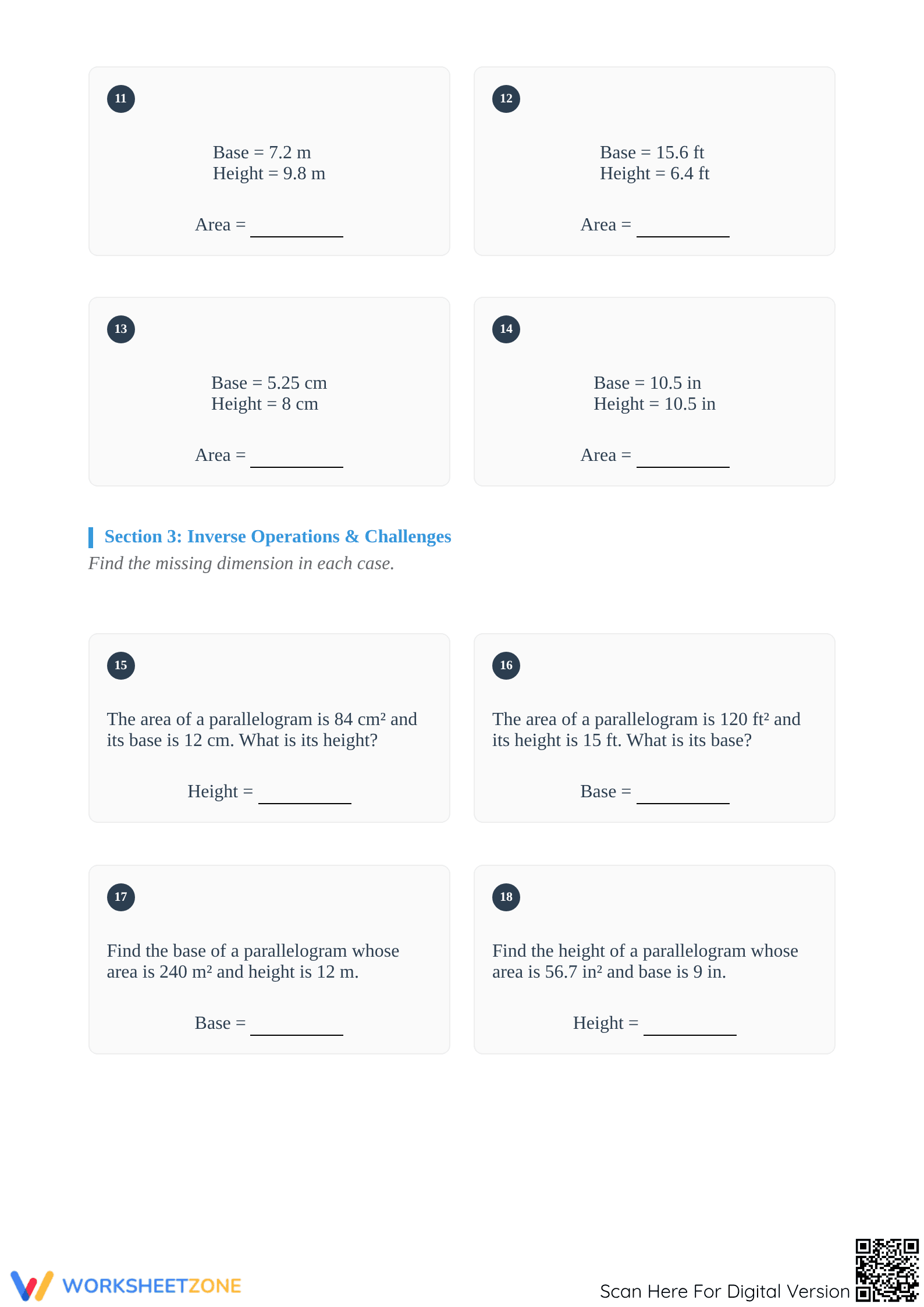
Area = base x heightformula with whole numbers and clear units. - Supported Practice (Problems 9-14): The scaffold shifts to word-based dimensions and decimal values, requiring students to maintain precision while applying the formula without visual cues.
- Independent Practice (Problems 15-21): Learners tackle inverse operations (finding height or base when area is given) and real-world application problems, such as calculating material costs for architectural panels.
This progression follows the gradual-release model, moving students from rote calculation to critical thinking and algebraic manipulation within a geometric context.
Standards Alignment
The primary alignment is 6.G.A.1, which requires students to find the area of special quadrilaterals by applying geometric techniques to solve mathematical problems. It also supports 6.EE.A.2.C by evaluating expressions at specific values of their variables. Both standard codes can be copied directly into lesson plans, IEP goals, or district curriculum mapping tools.
How to Use It
Use this worksheet as a primary practice set immediately following direct instruction on the area formula. The first two pages serve as excellent guided practice during the "We Do" phase of a lesson. For formative assessment, observe students during Section 3; if they struggle with the inverse operations, it indicates a need for additional algebraic scaffolding before moving to the real-world challenges.
Who It's For
This resource is designed for Grade 6 geometry students, though it provides excellent remediation for older students in Grades 7-8 who require a refresher on measurement. It is particularly beneficial for visual learners who need to see the relationship between the perpendicular height and the base. Pair this with a physical demonstration of decomposing a parallelogram for maximum conceptual impact.
Calculating the area of special quadrilaterals like parallelograms is a critical bridge between elementary measurement and middle-school algebra. According to the NAEP framework, student performance in geometry significantly improves when instruction balances procedural fluency with the application of formulas to varied problem types, including inverse operations and real-world contexts. This worksheet addresses that balance by providing 21 problems that range from basic visual identification to complex multi-step reasoning. By explicitly labeling base and height in early tasks before shifting to text-based dimensions, the resource supports the development of spatial reasoning skills identified by Fisher & Frey (2014) as essential for geometric mastery. The inclusion of decimal dimensions and unit tracking ensures that students maintain mathematical precision while aligning with the rigorous expectations of standard 6.G.A.1, which emphasizes solving real-world mathematical problems through the composition and decomposition of polygons.


