


























Views
Downloads



Printable Dividing Polynomials Practice Worksheet | Algebra
Paste this activity's link or code into your existing LMS (Google Classroom, Canvas, Teams, Schoology, Moodle, etc.).
Students can open and work on the activity right away, with no student login required.
You'll still be able to track student progress and results from your teacher account.
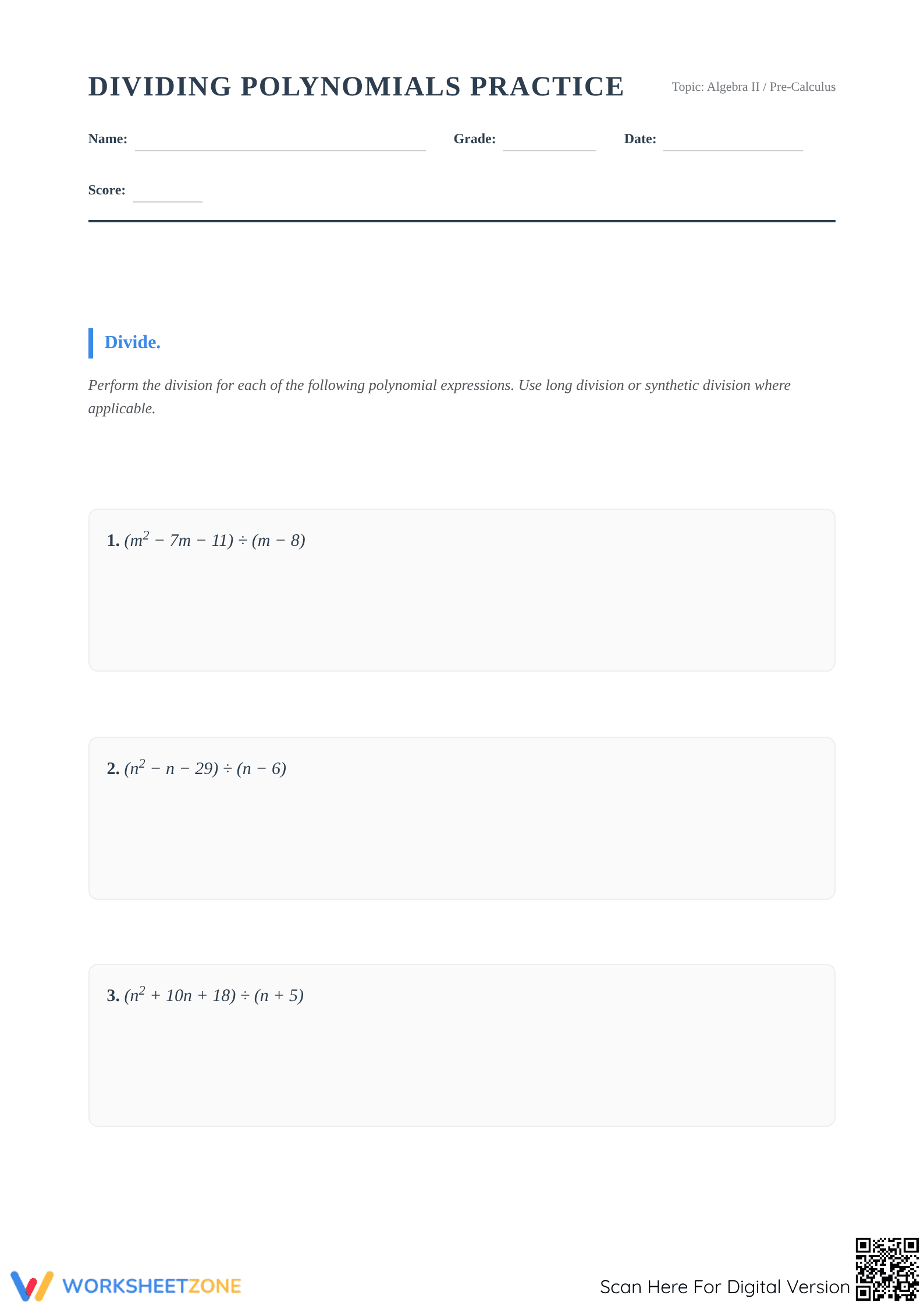
This comprehensive Dividing Polynomials Practice worksheet empowers students to master algebraic division through targeted practice. By working through structured expressions, learners develop the procedural fluency needed to rewrite rational functions. This resource ensures that students can confidently handle long division and synthetic division techniques to find quotients and remainders effectively and accurately.
At a Glance
- Grade: 9 · Subject: Algebra
- Standard:
HSA-APR.D.6— Rewrite simple rational expressions in different forms using long division techniques- Skill Focus: Polynomial Long Division
- Format: 5 pages · 20 problems · Answer key included · PDF
- Best For: High school algebra independent practice sessions
- Time: 45–60 minutes
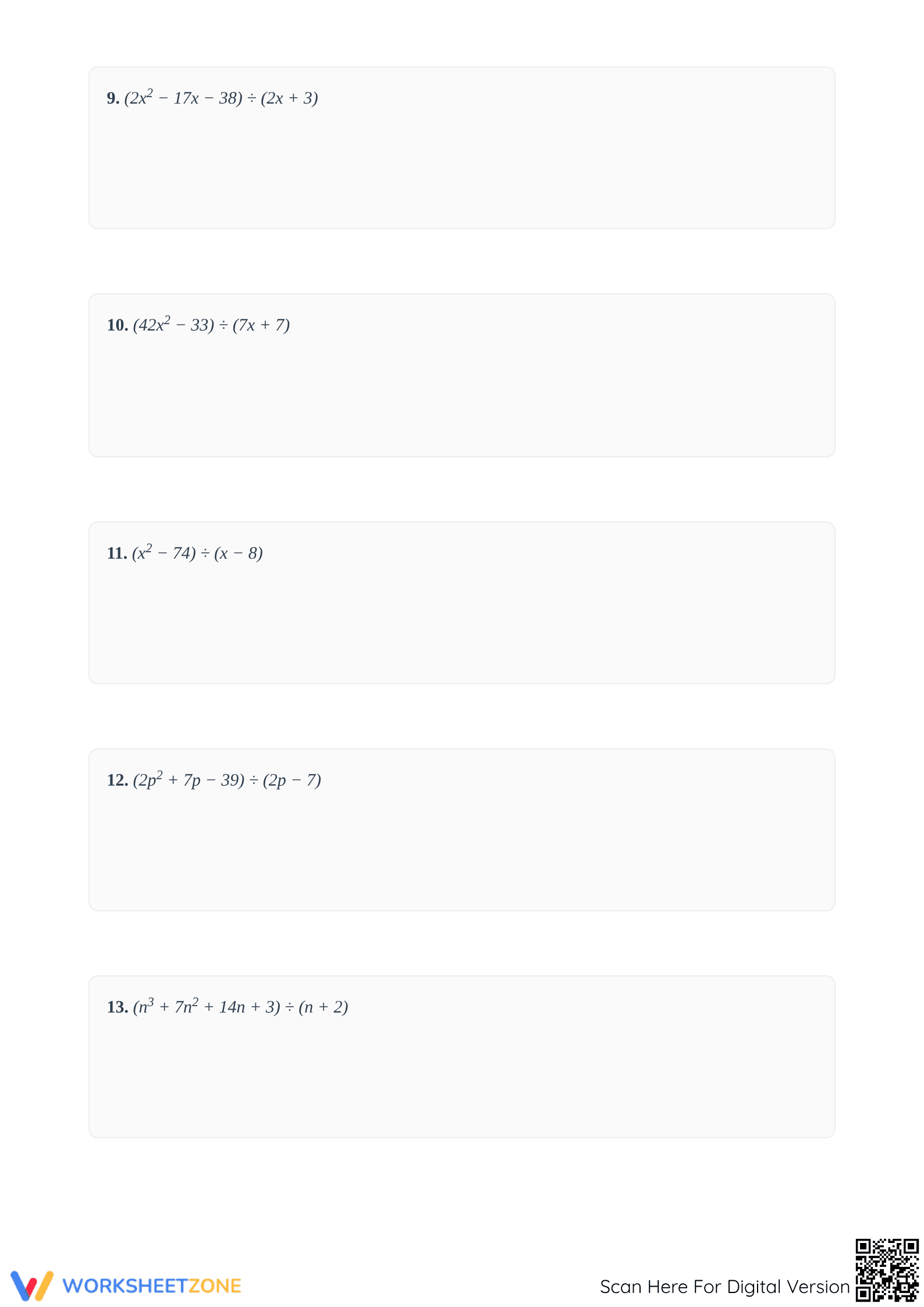
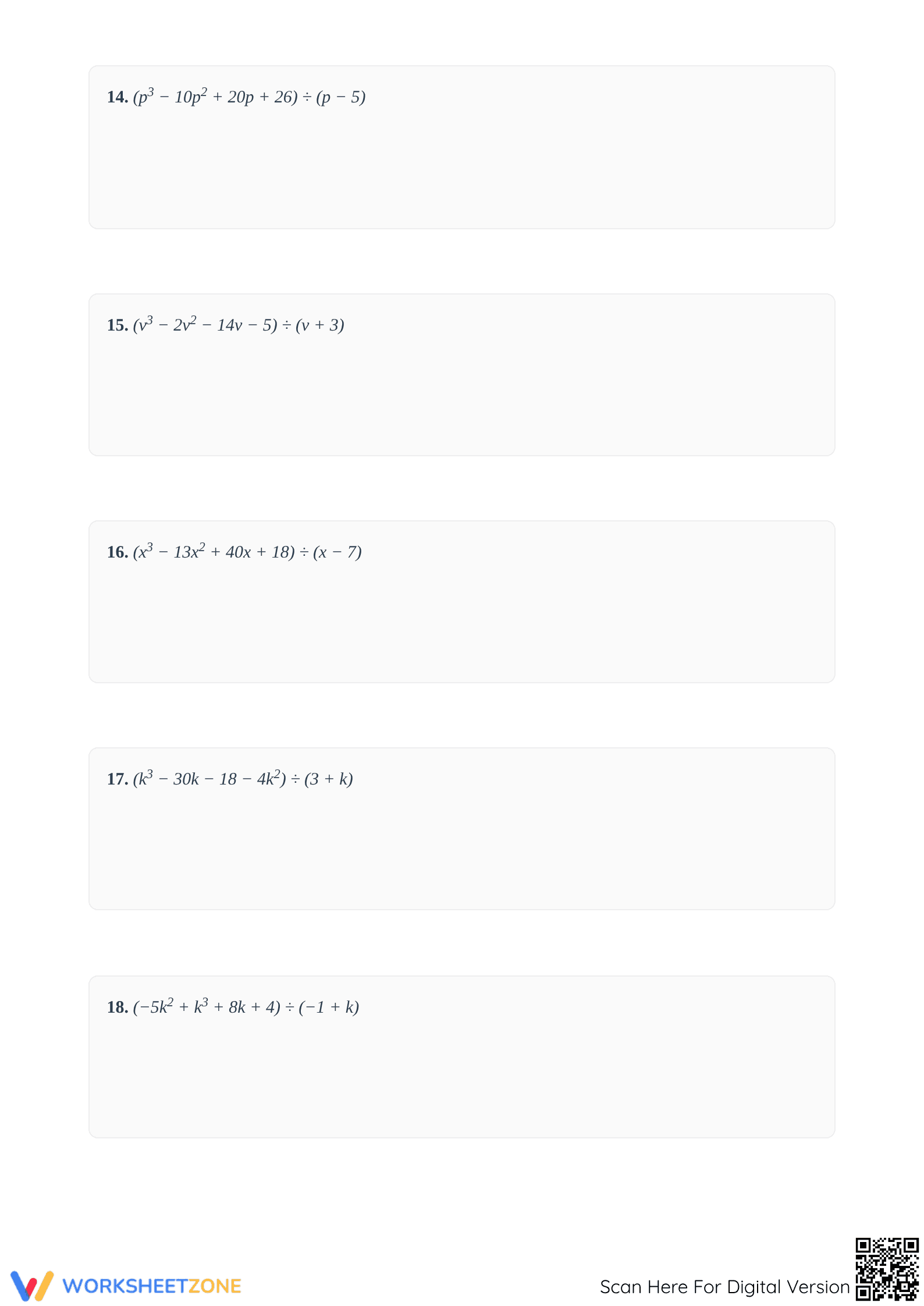
This five-page PDF resource features 20 curated polynomial division problems ranging from binomial divisors to complex expressions. The layout provides ample workspace for students to show vertical calculations, catching sign errors in subtraction. A full answer key is included, showing both the quotient and the remainder for every problem to facilitate quick grading.
Skill Progression
- Guided Practice: Problems 1–5 focus on binomial divisors with integer coefficients, establishing the "divide, multiply, subtract, bring down" rhythm with minimal complexity.
- Supported Practice: Problems 6–15 introduce larger coefficients and missing terms requiring zero-placeholders, challenging students to maintain structural alignment throughout the process.
- Independent Practice: The final problems involve higher-degree polynomials and non-monic divisors, testing the ability to apply algorithms to any rational expression.
This sequence follows a gradual-release model, moving from scaffolded repetition to complex problem-solving.
Standards Alignment
This worksheet aligns with Standard HSA-APR.D.6, requiring students to rewrite rational expressions a(x)/b(x) in the form q(x) + r(x)/b(x). It also supports Standard HSA-SSE.A.2 by requiring students to use expression structure to identify rewriting methods. Both standard codes can be copied directly into lesson plans, IEP goals, or district curriculum mapping tools.
How to Use It
This resource is ideal for independent practice during lessons on the Remainder Theorem. Teachers can assign the first page as an exit ticket or use the packet as homework. One formative-assessment observation tip is checking if students correctly distribute the negative sign during subtraction, where most procedural errors occur. Expected completion time is 45–60 minutes.
Who It's For
This worksheet is designed for Grade 9 Algebra students, though it is appropriate for Algebra II review. It serves as an essential tool for students requiring repetitive practice to internalize algorithms. The structured layout assists students who benefit from visual organization, while a natural pairing resource would be a graphing calculator to verify roots.
The necessity of procedural fluency in polynomial operations is a cornerstone of college-readiness standards. According to EdReports 2024, high-quality instructional materials must provide ample opportunities for students to engage with the structural properties of algebra, particularly when transforming rational expressions. This worksheet directly addresses the HSA-APR.D.6 standard by providing twenty distinct opportunities for students to practice the long division algorithm, which serves as a prerequisite for understanding the behavior of rational functions and horizontal asymptotes. Research indicates that frequent, targeted practice with algebraic transformations reduces cognitive load during higher-level calculus tasks. By isolating the mechanics of division, this resource allows students to build the "muscle memory" required for success in STEM-focused coursework. The inclusion of a comprehensive answer key further supports self-regulated learning and immediate feedback loops, which are critical for correcting common misconceptions regarding remainders and term alignment.


