


























Views
Downloads



Long Division Worksheet | Printable Grade 3 Math
Paste this activity's link or code into your existing LMS (Google Classroom, Canvas, Teams, Schoology, Moodle, etc.).
Students can open and work on the activity right away, with no student login required.
You'll still be able to track student progress and results from your teacher account.
This essential worksheet provides targeted practice in long division for third and fourth-grade students. Learners will solve 16 problems involving two and three-digit dividends, building both procedural fluency and number sense. It is a straightforward resource designed to reinforce core division skills in a clear, structured format.
At a Glance
- Grade: 3 · Subject: Math
- Standard:
CCSS.MATH.CONTENT.4.NBT.B.6— Find whole-number quotients with one-digit divisors.- Skill Focus: Long Division
- Format: 4 pages · 16 problems · Answer key included · PDF
- Best For: Independent practice or skill reinforcement
- Time: 20–30 minutes
What's Inside
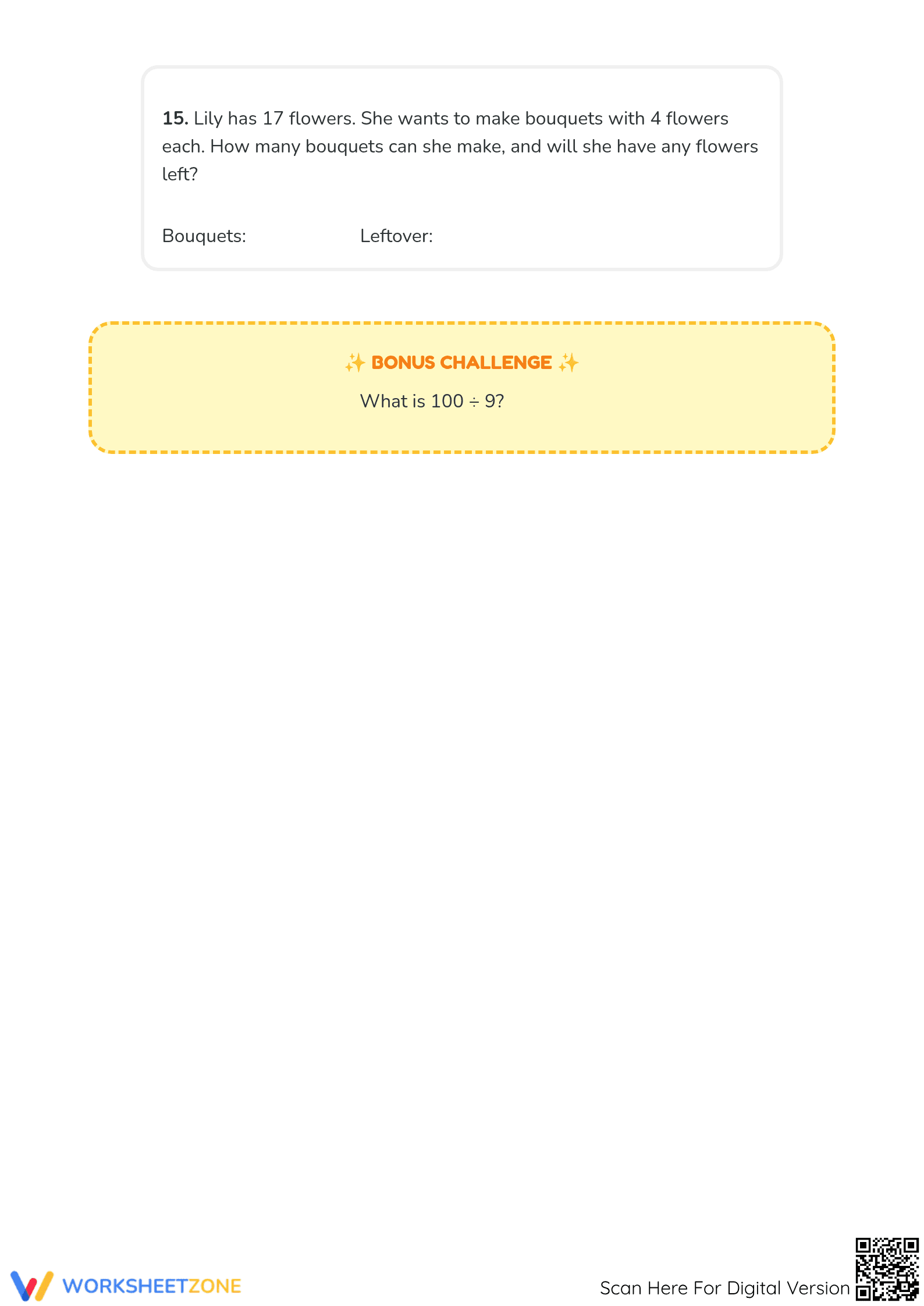
This download includes a four-page worksheet and a complete four-page answer key. The worksheet contains 16 long division problems, organized with four problems per page in a large font. Each problem provides ample gridded space for students to show their work. The corresponding answer key presents the final solution, allowing for quick grading.
Skill Progression
The worksheet structure follows a gradual release model. The first page acts as a guided warm-up with simpler two-digit dividends. The next two pages feature a mix of two and three-digit dividends, suitable for partner or small-group work. The final page serves as a check for independent understanding. This progression moves students from teacher-led instruction toward confident problem-solving.
Standards Alignment
This worksheet is directly aligned with Common Core standard CCSS.MATH.CONTENT.4.NBT.B.6, which requires students to "Find whole-number quotients and remainders with up to four-digit dividends and one-digit divisors." While labeled for third grade, this skill is a key component of the fourth-grade NBT domain. The standard code can be copied directly into lesson plans or curriculum maps.
How to Use It
This resource is effective as independent practice after a direct instruction lesson on the long division algorithm. Assign one or two pages for in-class work and the rest for homework. For formative assessment, observe how students handle the "bringing down" step, a common point of error. Most students can complete the full worksheet in approximately 20-30 minutes.
Who It's For
This worksheet is for third-grade students needing a challenge or fourth-grade students at grade-level. The clear layout and focused problem set make it accessible for many learners in a general education classroom. It pairs well with a place value anchor chart that students can reference as they work through the division process.
This worksheet provides focused practice on long division, a foundational arithmetic skill aligned with CCSS.MATH.CONTENT.4.NBT.B.6. Mastering this multi-step procedure is critical for future success in mathematics, including work with fractions and algebra. Research consistently shows that procedural fluency develops from repeated, structured practice. According to the RAND AIRS 2024 report on effective mathematics instruction, students require numerous opportunities to move from conceptual understanding to procedural efficiency through resources that isolate specific skills. This worksheet offers that targeted practice, providing 16 distinct opportunities for students to apply the long division algorithm to find whole-number quotients. Its design supports the development of automaticity, freeing up cognitive resources for more complex problem-solving later on and making it a valuable tool for teachers.


