


























Views
Downloads

Identifying Functions Worksheet | Grade 8 Printable
Paste this activity's link or code into your existing LMS (Google Classroom, Canvas, Teams, Schoology, Moodle, etc.).
Students can open and work on the activity right away, with no student login required.
You'll still be able to track student progress and results from your teacher account.
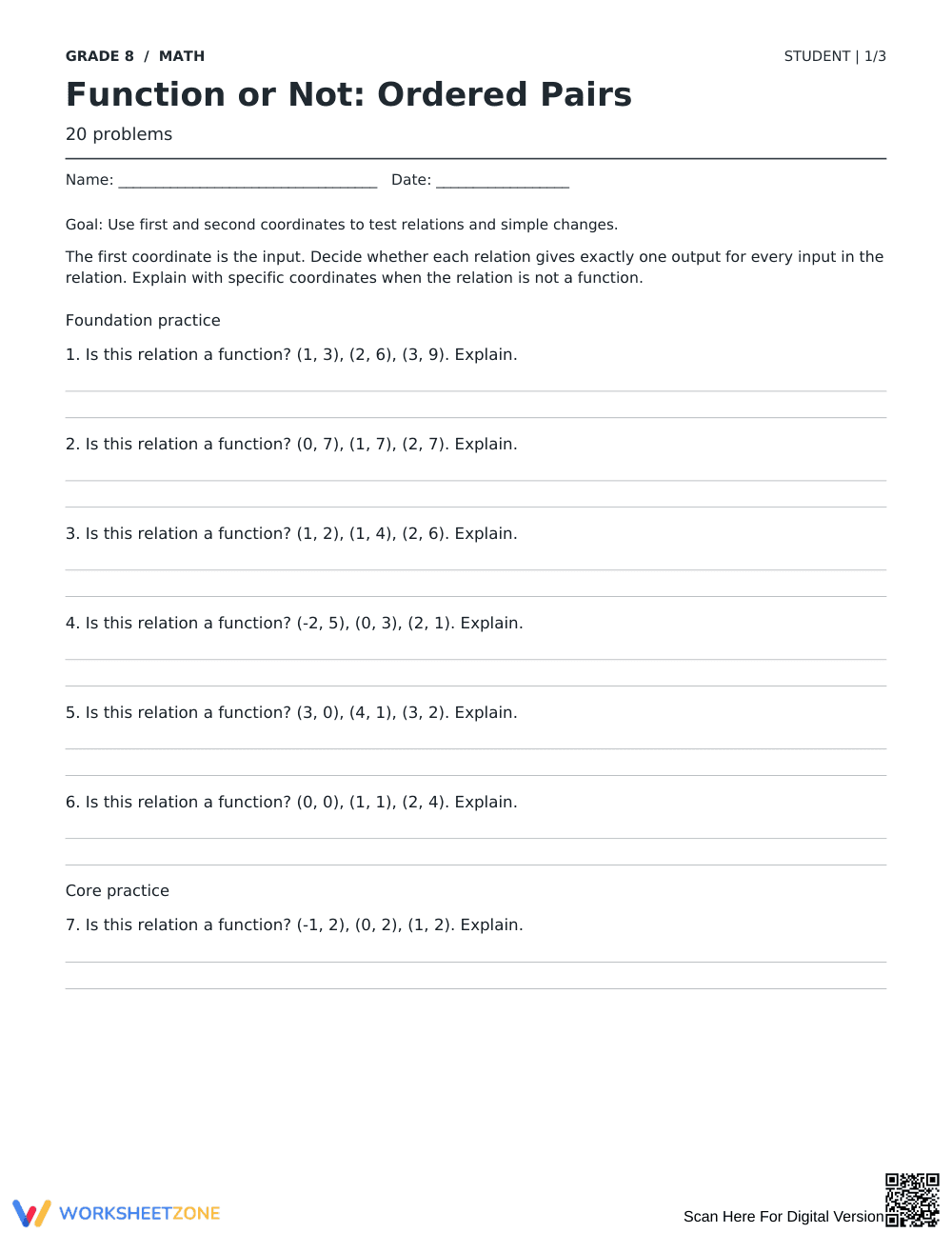
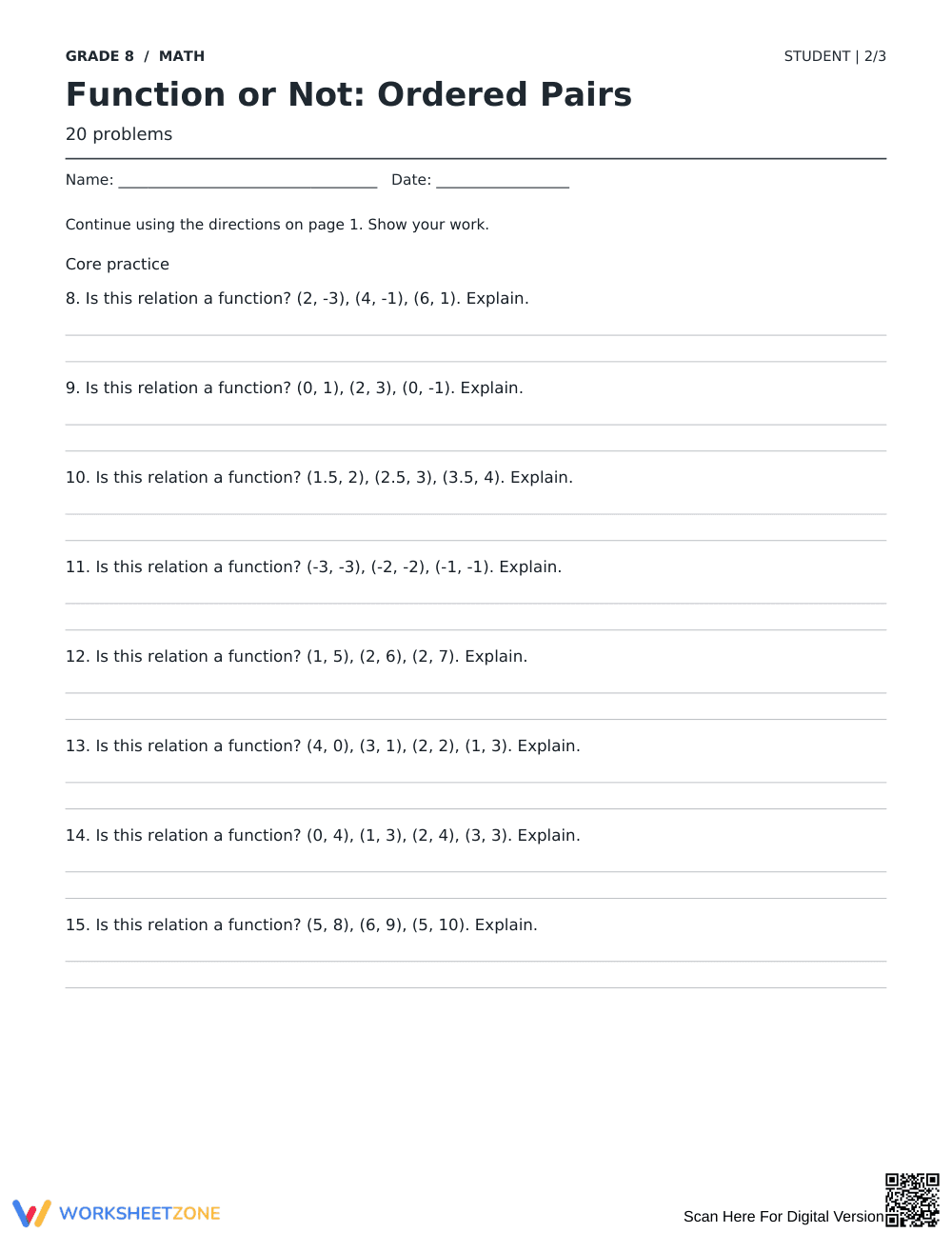
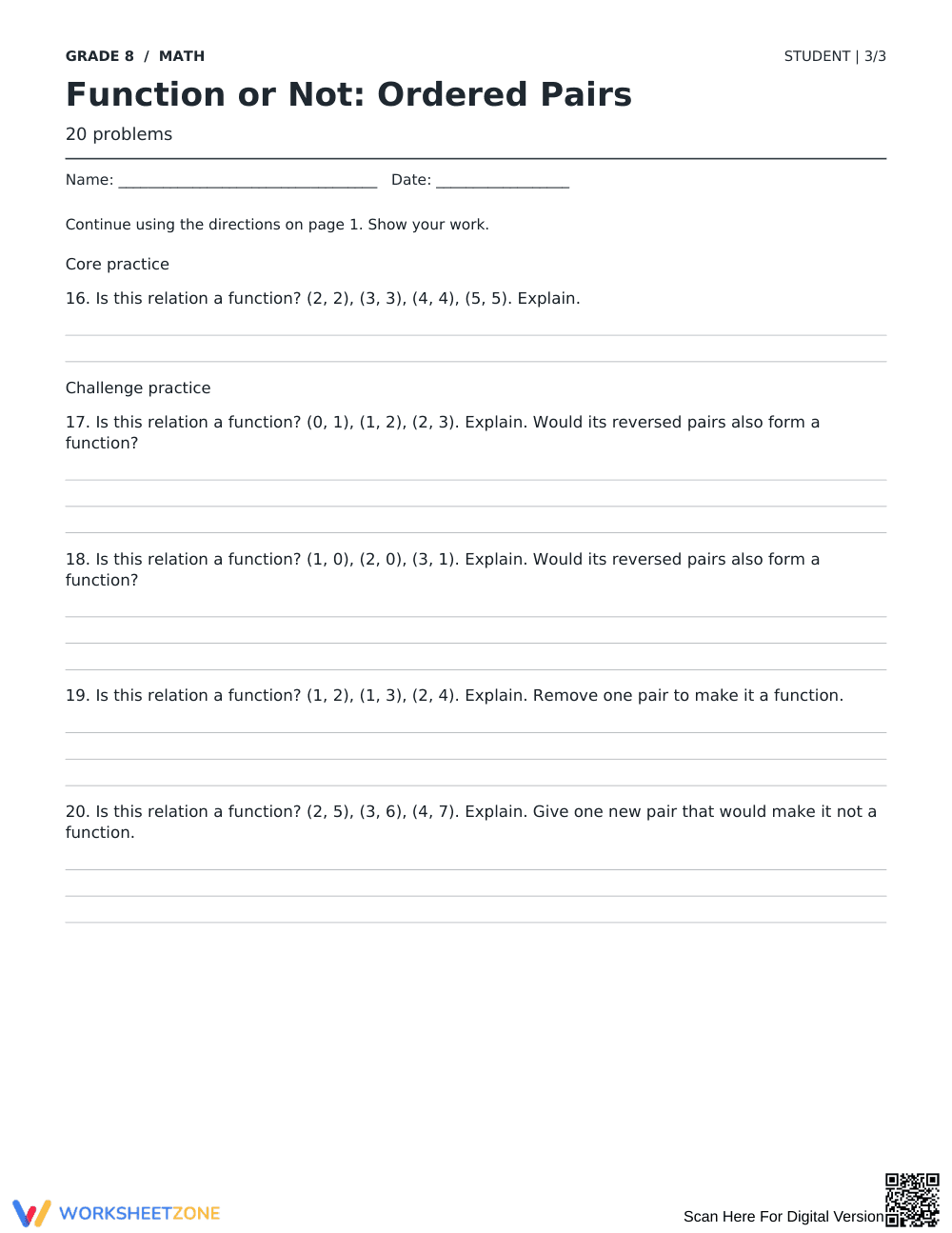
This Grade 8 mathematics worksheet trains students to determine whether a given relation is a function by analyzing sets of ordered pairs. Learners examine input-output relationships, identify duplicate domain values assigned to different range values, and write clear coordinate-based justifications to demonstrate mathematical reasoning.
At a Glance
- Grade: 8 · Subject: Math
- Standard:
CCSS.MATH.CONTENT.8.F.A.1— Understand that a function assigns to each input exactly one output- Skill Focus: Identifying functions from ordered pairs
- Format: 3 pages · 20 problems · Answer key included · PDF
- Best For: Independent practice and concept mastery
- Time: 30–45 minutes
What's Inside
The 3-page student activity features 20 structured relation sets presented as coordinate pairs, complete with designated response lines for student justifications. It includes positive integers, negative coordinates, decimals, and repeated values. A comprehensive 2-page answer key provides complete explanations for each item alongside a 60-point scoring guide for quick grading.
Skill Progression
- Foundation Practice (Problems 1–6): Guided baseline items with low scaffolding introduce basic 3-pair sets to help students test single-digit inputs and establish the one-input-one-output rule.
- Core Practice (Problems 7–16): Supported items expand set sizes and incorporate negative coordinates, decimals, and identical output values to address common misconceptions.
- Challenge Practice (Problems 17–20): Independent, higher-order tasks require students to test inverse relations and modify coordinates to create or repair valid functions.
This structured layout follows a gradual-release instructional model that systematically moves learners from foundational identification to active relation manipulation.
Standards Alignment
This resource aligns directly with primary standard CCSS.MATH.CONTENT.8.F.A.1: "Understand that a function is a rule that assigns to each input exactly one output. The graph of a function is the set of ordered pairs consisting of an input and the corresponding output." It also supports mathematical practice standard MP3 by requiring written justifications. Both standard codes can be copied directly into lesson plans, IEP goals, or district curriculum mapping tools.
How to Use It
Use this resource directly after introducing the definition of a function during whole-group instruction, or assign it during targeted small-group intervention. As a formative assessment tip, check whether students mistakenly reject relations with repeated y-values (such as Problem 2); use this pattern to clarify that multiple inputs may share identical outputs. Expected completion time is 30 to 45 minutes.
Who It's For
This printable is designed for Grade 8 math classrooms, introductory Algebra 1 modules, and targeted remediation groups. Pair this practice set with an input-output mapping diagram anchor chart or a coordinate graphing demonstration to reinforce visual representations.
According to Fisher & Frey (2014), structured practice with explicit requirements for written justification significantly strengthens conceptual retention and mathematical reasoning in secondary classrooms. This worksheet delivers comprehensive, standards-aligned practice on CCSS.MATH.CONTENT.8.F.A.1, ensuring eighth-grade students thoroughly master the foundational principle that every valid function assigns exactly one output to each unique input. By working through 20 strategically sequenced relation sets featuring positive integers, negative coordinates, and decimals, learners actively analyze coordinate pairs while eliminating common misconceptions surrounding duplicate domain versus range values. The gradual progression from basic verification to complex coordinate manipulation provides the targeted scaffolding needed for independent mastery and self-efficacy. Furthermore, articulating coordinate-based rationales helps students internalize key algebraic definitions, bridging the critical gap between mechanical rule memorization and authentic conceptual understanding. Incorporating this research-backed resource into regular classroom practice ensures students develop lasting proficiency with functional relationships and coordinate analysis.


