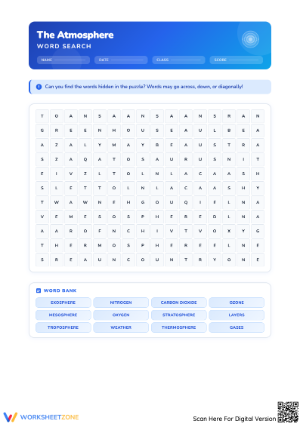
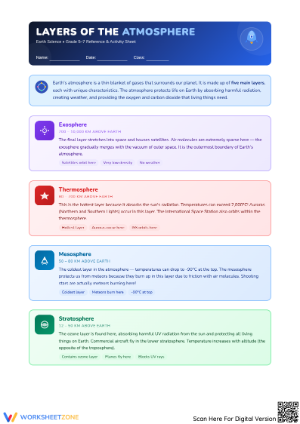
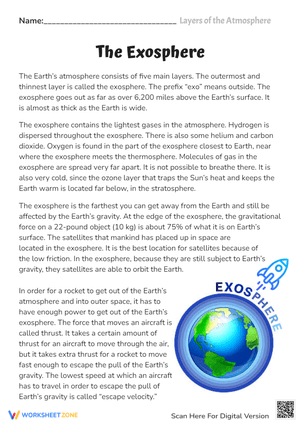
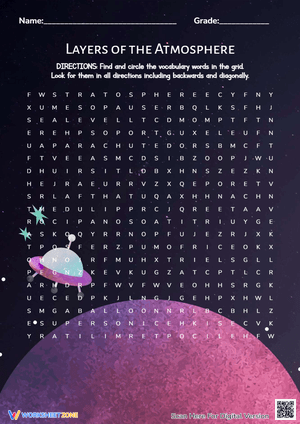
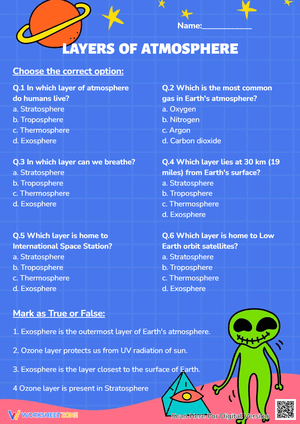
7th grade atmospheric layers printable worksheets give Earth science teachers a focused tool for turning one of the more abstract units in middle school science into concrete, repeatable practice. The five-layer model — troposphere, stratosphere, mesosphere, thermosphere, exosphere — looks manageable on a diagram but trips students up the moment they're asked to recall it without visual support. Each worksheet gives students varied, structured contact with the same core content: layer names, order from Earth's surface upward, and the defining characteristic tied to each zone.
What Each Worksheet Builds
The set moves students past simple name memorization toward understanding what makes each layer distinct. The entry point is the troposphere — the layer where weather forms and where every student already lives — which makes it the natural anchor for the whole sequence. From there, tasks ask students to connect each remaining layer to one defining phenomenon rather than treating the five names as an isolated list to recite.
Specific skills practiced across the set include:
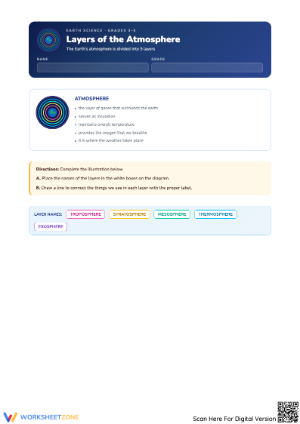
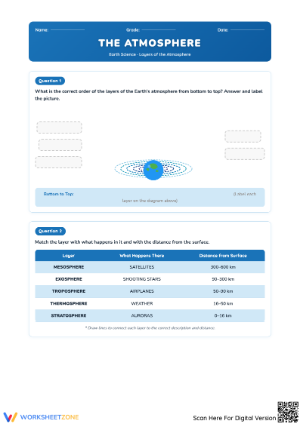
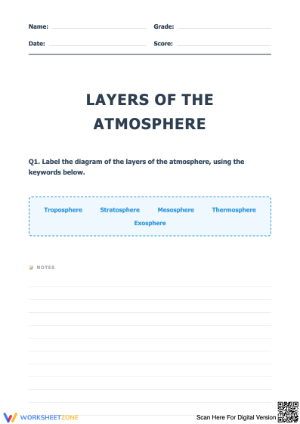
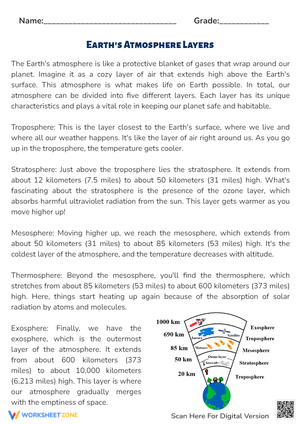
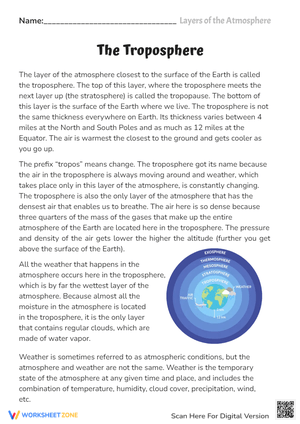
- Labeling and ordering all five layers on a cross-section diagram, from Earth's surface outward to the exosphere
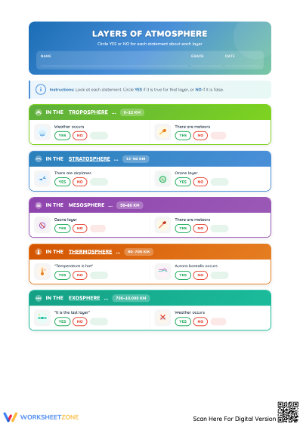
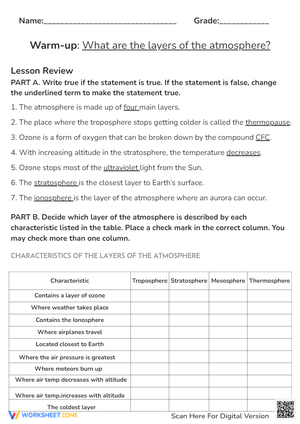
- Matching vocabulary terms — ozone layer, altitude, meteor, UV radiation — to correct definitions and layer locations
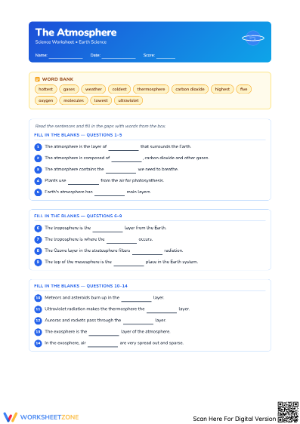
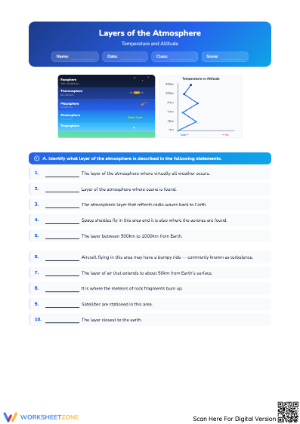
- Completing fill-in-the-blank statements about each layer's key feature
- Comparing two or more layers using a structured chart covering order, temperature pattern, and one associated phenomenon
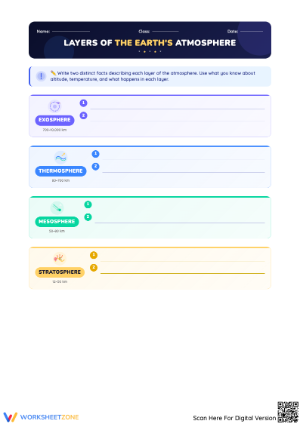
- Writing short explanations for why phenomena like ozone absorption and meteor burn-up occur where they do
The diagram task is especially important at this level. When students physically label a cross-section of Earth's atmosphere, they build a spatial mental model that reading a textbook paragraph doesn't produce on its own. Placing "stratosphere" directly above "troposphere" on a diagram, then writing "ozone layer" next to it, creates a visual memory that holds up better during later recall than a definition learned in isolation.
Common Mistakes That Surface in Student Work
The most persistent error at this level is layer-order reversal between the troposphere and stratosphere. Students who label a diagram correctly on Monday will still write "the ozone layer is in the troposphere" on Thursday's quiz — especially once the diagram is no longer in front of them. The confusion makes developmental sense: both layers sit near the bottom of the atmospheric stack, and students conflate where people live with where UV protection happens.
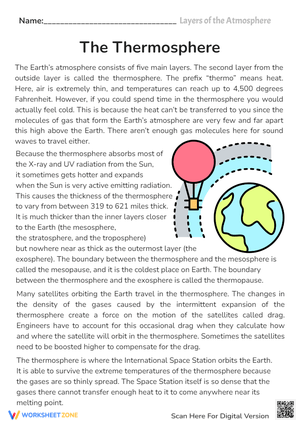
The thermosphere and exosphere cause a different kind of trouble. Neither layer has a built-in everyday referent the way the troposphere (weather) or mesosphere (meteors) does. Students who can name all five layers in order will leave questions about the thermosphere or exosphere blank, or produce vague one-word answers. Worksheets that attach a single concrete fact to each of these layers — Aurora Borealis in the thermosphere, orbiting satellites in the exosphere — give students enough of an anchor to stop the blending. Without that hook, written responses on those two layers stay thin regardless of how much instructional time was spent.
How to Work These Worksheets Into Your Lesson Planning
Most teachers do best introducing the topic with a projected atmosphere diagram and a brief class walkthrough of all five layers before any independent work begins. Starting with the visual model cuts down on confusion because students have seen the full sequence before they're asked to reproduce it. From that point, the worksheets move naturally into guided practice: label one or two layers together as a class, then release students to complete the rest independently.
- Monday warm-up after morning meeting: Use a blank five-layer diagram as a quick recall check. Even incomplete responses show which layers students retained from the previous week.
- Station rotation: Assign one worksheet per station — diagram labeling at one, vocabulary matching at another, comparison chart at a third. Rotations of 10 to 12 minutes keep the pace moving without cutting tasks short.
- Sub plan: Any worksheet in the set works as a self-contained activity because the directions are self-explanatory and the visual structure keeps students on task without teacher facilitation.
- Day-before-assessment review: Pull the comparison chart or a short written-explanation worksheet to surface lingering confusion about layer order and key phenomena while there's still time to address it.
The 8 minutes before the end-of-period bell is enough time for an exit ticket asking students to list the five layers in order and identify which one contains weather, ozone, and burning meteors. It takes almost no teacher setup and gives immediate feedback on retention.
Adjusting the Worksheets for a Range of Learners
Students who need additional support work well with a partially completed diagram — two or three layers already labeled — so they can focus on placing the remaining ones correctly rather than starting from a blank page. A word bank alongside fill-in-the-blank tasks reduces the demand on recall memory while still requiring students to match terms to meanings. Sentence starters on written-explanation tasks help students who freeze when facing an open prompt like "explain why meteors burn up in the mesosphere."
For students ready to go further, remove the word bank and ask them to compare two non-adjacent layers — say, the troposphere and the mesosphere — explaining what accounts for the differences in temperature and phenomena at those altitudes. A short extension that asks students to reason through why the ozone layer's position in the stratosphere (and not the troposphere) matters for life on Earth moves the task from recall into genuine analysis. These extensions stay grounded in the same five-layer model; they simply ask more from students who've already secured the basics.
When 7th grade atmospheric layers printable worksheets are set up with these adjustments in place, the same five-layer content reaches every student in the room without requiring separate lesson plans for different readiness levels.
Standard Alignment
NGSS MS-ESS2-5 asks students to collect data and build explanations for how air mass motion produces changes in weather conditions. The five-layer sequence is foundational to that standard — students can't engage meaningfully with why weather is confined to the lower atmosphere, or why temperature shifts dramatically at different altitudes, without first knowing which layer they're working with. In classroom terms, the atmospheric layers unit typically arrives early in a weather and climate sequence, serving as the spatial map that makes later phenomena (jet streams, UV absorption, meteor entry) easier to understand and place. Choosing 7th grade atmospheric layers printable worksheets that foreground the same anchor concepts — weather in the troposphere, ozone in the stratosphere, meteor burn-up in the mesosphere — keeps classroom practice aligned with the knowledge priorities that NASA Space Place, NOAA SciJinks, and UCAR Center for Science Education identify for this grade band.
Frequently Asked Questions
What are the five atmospheric layers in order from Earth's surface upward?
The five layers are the troposphere, stratosphere, mesosphere, thermosphere, and exosphere. That sequence — from the layer where weather forms to the outermost boundary of Earth's atmosphere — is the single most important fact for students to practice and retain across the unit.
Which layer contains the ozone, and why does its location matter?
The ozone layer sits within the stratosphere. Its position there — above the troposphere where weather and living things exist, but below the higher layers — means it intercepts much of the Sun's ultraviolet radiation before it reaches Earth's surface. Students who understand why location matters here move beyond treating the ozone layer as a simple memorization point.
Why do meteors burn up in the mesosphere rather than in a higher layer?
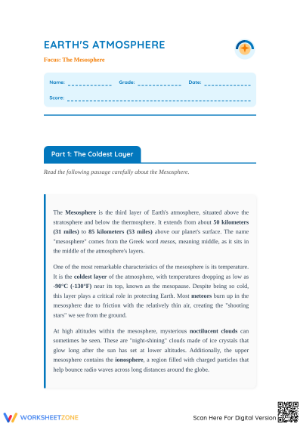
Meteors traveling toward Earth encounter the mesosphere at high speed. The air there, while thinner than the stratosphere below, is still dense enough to generate significant friction during entry — enough heat to vaporize most meteors before they descend further. The mesosphere tops out at roughly 85 km above Earth's surface, which is close enough that students find the phenomenon easier to visualize than the more rarefied conditions in the thermosphere or exosphere above it.
Are these worksheets useful for students who struggle with science reading?
The diagram and matching tasks don't depend on reading fluency — students can engage with a label-the-layers exercise or a vocabulary sort before they tackle any written explanation. That sequence gives struggling readers an entry point through visual and vocabulary tasks before asking them to produce written responses. 7th grade atmospheric layers printable worksheets that mix task types this way serve classrooms with a wide range of reading levels, since every student works with the same material while the task demand shifts rather than the content.












 Interactive Worksheet Maker
 Quiz Maker
 Word Search Maker
 Crossword Puzzle Maker
 Word Scramble Generator
 Sentence Scramble Generator
 Handwriting Worksheet Generator
 Name Tracing Generator
 Fill In The Blank Generator