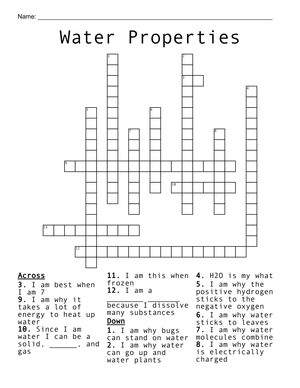
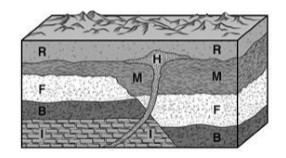
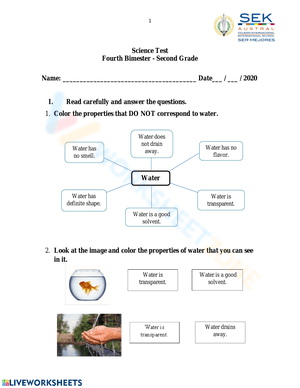
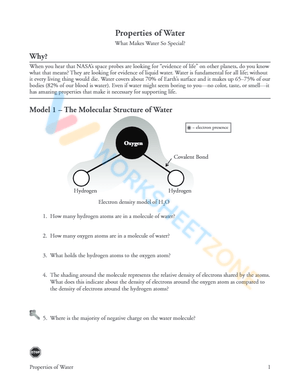
These water pdf worksheets for 7th grade give science teachers print-ready practice across the content that seventh-grade science units actually demand: water cycle mechanics, freshwater distribution, watershed behavior, groundwater storage, pollution, and conservation. Each worksheet covers one focused area, so teachers can drop a targeted resource into a lesson plan without restructuring the surrounding instruction to make it fit.
What Each Worksheet Actually Asks Students to Do
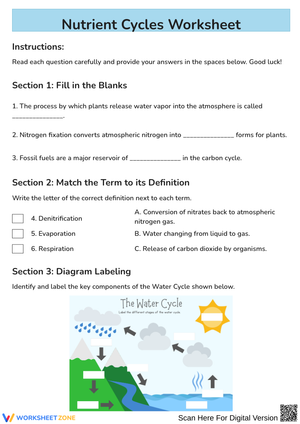
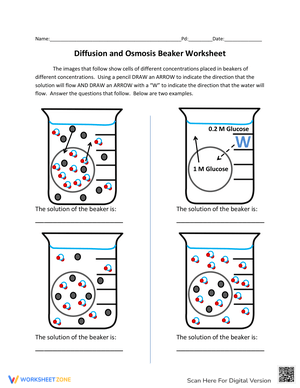
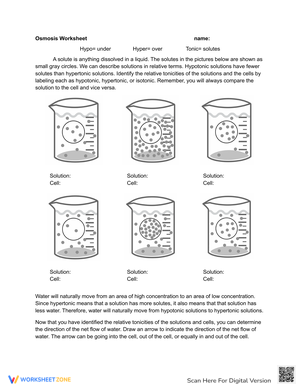
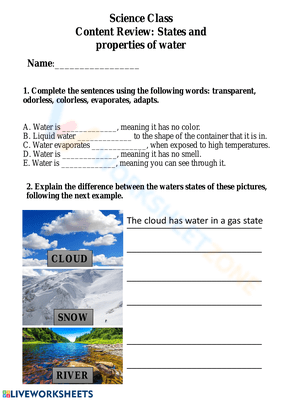
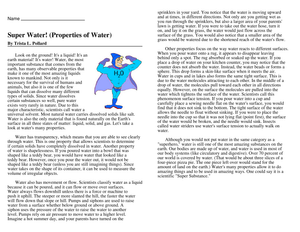
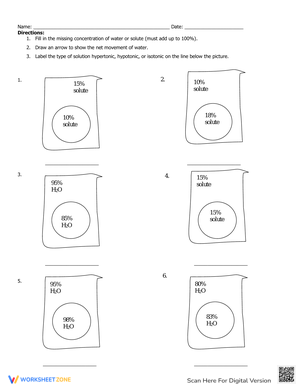
The task mix matters as much as the content coverage. Diagram worksheets ask students to label evaporation, condensation, precipitation, runoff, infiltration, and transpiration — and then identify the energy source driving the cycle, which pushes past surface naming into actual understanding. Reading-based worksheets pair a short passage with evidence-based questions, building science literacy without turning a science period into a reading lesson. Data interpretation worksheets give students a bar graph or pie chart — freshwater versus saltwater distribution, regional rainfall trends, or household water use patterns — and ask them to draw conclusions rather than simply extract numbers from an axis.
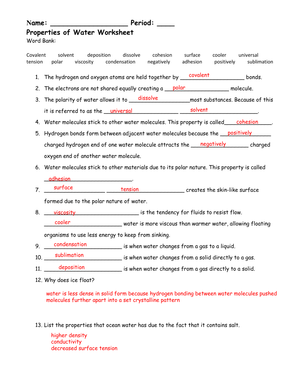
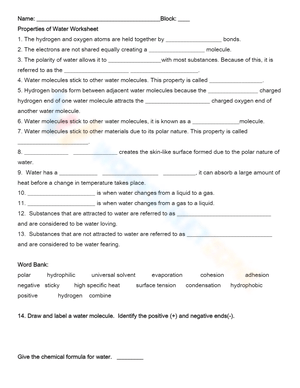
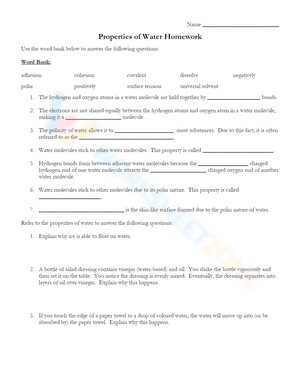
Vocabulary practice appears in context throughout rather than as an isolated definition list. Several worksheets close with a short constructed-response prompt: explain why urban pavement increases runoff, or describe what happens when agricultural fertilizers reach a watershed. That kind of explanatory writing is exactly what teachers need students to practice before tackling longer lab reports or formal assessments. The water pdf worksheets for 7th grade in this set span enough distinct task types — diagram, reading, data, and written explanation — that teachers can run several class sessions without students working through the same format twice.
Where Student Thinking Breaks Down on Water Topics
The most common error in 7th grade water work is not a vocabulary gap — it is a conceptual one. Students who correctly state that 71 percent of Earth's surface is covered by water will still write that freshwater is plentiful, because they are conflating the total amount of water with the amount that is actually accessible. A worksheet that presents a pie chart broken into ocean water, glacial ice, groundwater, and surface freshwater forces that comparison in a way that lecture alone rarely does. The moment students see that usable freshwater represents a fraction of a fraction, the conversation about conservation becomes concrete rather than abstract.
Groundwater generates its own persistent confusion. Students routinely draw aquifers as underground lakes or rivers because that is how many textbook illustrations frame them. When a worksheet asks students to trace the path of water from a rain event through soil layers down to saturated rock and sediment, and then explain how a community well draws from that system, most students stall at the infiltration step. They understand rain falling and water coming out of a tap, but the slow downward movement through porous material is a conceptual gap that diagram labeling alone does not always close. Adding a follow-up question — What happens to groundwater recharge in a neighborhood where most surfaces are paved? — reveals whether students have connected those ideas or are still treating them as separate vocabulary terms.
On pollution worksheets, students frequently write that rain "washes away" contamination as though the problem disappears once water moves. A scenario question that asks where fertilizer runoff goes after leaving a farm field — and what happens when it reaches a stream or aquifer — surfaces that thinking quickly and gives teachers an exact misconception to address in discussion.
Fitting These Worksheets Into the Week
Bell-ringer use is where these resources reliably earn their place. A diagram worksheet on the water cycle takes about eight minutes — long enough for students to recall terminology and put something on paper before direct instruction begins, short enough that it does not consume the lesson. Teachers running stations can divide the set by task type: one station for diagram labeling, one for a short reading passage about freshwater scarcity, one for a pollution scenario that asks students to trace a contaminant through a watershed.
Sub plans are a genuinely practical use that teachers mention often. Water content requires no lab equipment and no special setup — students can read, label, and respond without the teacher present, which makes these worksheets dependable emergency plans. For end-of-unit review, pairing two shorter worksheets — one focused on vocabulary and diagram recall, one on a pollution or conservation scenario — creates a spaced retrieval pass through the key content in a single class period. The scenario-based questions consistently generate more substantive discussion than standard fact-recall formats, which matters when a review block needs to do more than confirm memorization.
Standard Alignment
The central standard for this content is NGSS MS-ESS2-4, which asks students to develop a model describing how water cycles through Earth's systems driven by solar energy and gravity. Seventh grade is typically when that standard receives its most direct instructional attention — after students have built foundational physical science concepts about energy transfer and before high school Earth systems courses take over. Pollution and conservation worksheets connect to MS-ESS3-3, which addresses applying scientific principles to monitor and minimize human environmental impact. Those worksheets fit that standard directly because they ask students to analyze cause-and-effect relationships between human activity and water quality, rather than simply identify environmental problems in general terms.
Adjusting These Worksheets for a Range of Learners
The diagram-based worksheets offer a natural entry point for students who need additional support. A student who cannot yet produce a full written explanation can still demonstrate real understanding by accurately labeling a water cycle diagram and answering two targeted questions rather than an open-ended paragraph prompt. Adding a word bank to vocabulary sections reduces the retrieval demand without reducing the science content itself.
For students ready for more challenge, system-thinking extension prompts work well: A town paves over an open field to build a parking lot. What happens to runoff during a heavy rain, and how does that affect groundwater recharge over time? That question requires integrating impervious surfaces, infiltration rates, and aquifer dynamics — concepts that span multiple worksheets in the set — and student responses reveal quickly whether water has been understood as a system or memorized as a list of terms. Teachers who work with water pdf worksheets for 7th grade in mixed-readiness classes find that the combination of diagram, reading, and scenario tasks gives every student a point of entry while still pushing more advanced students toward genuine synthesis.
Frequently Asked Questions
Which water topics get their own worksheet?
Each worksheet focuses on one topic: the water cycle, freshwater versus saltwater distribution, watersheds and surface runoff, groundwater and aquifers, water pollution, or conservation. That separation makes it straightforward to assign one worksheet per lesson rather than sorting through a broad review collection that mixes unrelated concepts.
Do these work as homework assignments?
Reading-passage worksheets and diagram worksheets are well-suited to homework because students can complete them independently without class discussion first. Pollution scenario worksheets tend to work better in class, where students can raise questions about unfamiliar examples before writing a response.
How does a teacher sequence multiple worksheets across a longer unit?
Most teachers start with the water cycle worksheet, move through freshwater availability and groundwater, then close with pollution and conservation — a sequence that follows the NGSS progression from natural systems to human impact and gives each worksheet a logical place in the instructional arc. The set covers enough distinct content to support a two- to three-week unit without repetition.
Are these appropriate for students reading below grade level?
These water pdf worksheets for 7th grade include task types that vary considerably in reading demand. Diagram and data worksheets carry the lowest reading load, so teachers can sequence those first for students who need more support. For passage-based worksheets, reading the text aloud as a class before students complete the questions independently removes the decoding barrier while keeping the science task fully intact.












 Interactive Worksheet Maker
 Quiz Maker
 Word Search Maker
 Crossword Puzzle Maker
 Word Scramble Generator
 Sentence Scramble Generator
 Handwriting Worksheet Generator
 Name Tracing Generator
 Fill In The Blank Generator